

Global gas markets tighten as China leads demand

China’s economic recovery led to an 18 percent year-on-year jump in thermal generation through the first half of 2021. (AFP)
Short Url
Updated 17 August 2021
Follow

Global gas markets tighten as China leads demand

MOSCOW: The global natural gas market is tightening with demand recovering this year as many countries led by China are seeing their economic life rebound following the pandemic.

The global liquefied natural gas (LNG) demand growth this year has been driven primarily by China, Francisco Blanch, commodity and derivatives strategist at the Bank of America Securities said in a note issued on Aug. 12.

China’s economic recovery led to an 18 percent year-on-year jump in thermal generation through the first half of 2021, which in turn, resulted in LNG year-to-date imports volumes rising nearly 30 percent year-on-year to 8.6 million tons. China is on pace in 2021 to overtake Japan as the world’s largest importer, Blanch said.

Another important factor driving gas prices up in both Europe and Asia in recent weeks is an increasingly low level of gas inventories in Europe, which fell to 16 billion cubic meters (bcm) or 20 percent below the five-year average. This is partly because “Russia has declined to export additional volumes to Europe as it hopes to push Nord Stream 2 over the finish line,” according to Blanch.

Gas flows via the Mallnow compressor station at the German border which handles predominantly Russian gas for transport to the west of the country remained low on Aug. 16, at around 20 million cubic meters per day, much reduced from the start of the month, Alex Froley, a LNG analyst at a London-based energy market information provider ICIS said in a comment posted on LinkedIn on Aug. 16.

Concerns over Russian gas availability increased recently after a fire at a production plant in Russia’s Yamal peninsula. Russian gas is transported to western Europe via several pipeline routes, including the Yamal-Europe line through Poland and into Germany’s GASCADE network at Mallnow. Flows at Mallnow, in particular, seem to have reduced over August, Froley said.
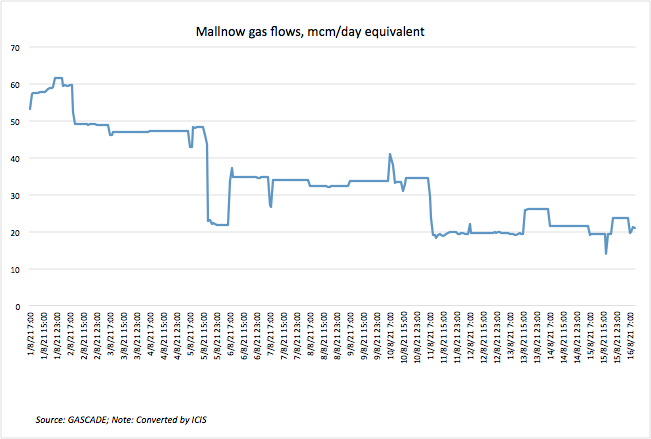
Data from German grid operator GASCADE shows flows of Russian gas into Germany at the Mallnow border point have dropped from 60 million cubic meters a day at the start of August to around 20 million cubic meters a day as of mid-August.


Saudi Arabia’s debt capital market to hit $600bn by end-2026, up 15% Fitch says 

Updated 7 sec ago
Follow

Saudi Arabia’s debt capital market to hit $600bn by end-2026, up 15% Fitch says 

RIYADH: Saudi Arabia’s debt capital market is expected to reach $600 billion in outstanding issuance by the end of 2026, cementing its position as the largest US dollar debt and sukuk issuer among emerging markets. 

In a report published this week, Fitch Ratings said outstanding Saudi debt surpassed $520 billion in 2025, an annual increase of 21 percent, with sukuk — Shariah-compliant financial instruments — accounting for roughly 62 percent of the total.

The steady momentum in Saudi Arabia’s sukuk market highlights the broader expansion of the Kingdom’s debt markets, as domestic and international investors seek diversification and stable returns. 

Bashar Al-Natoor, global head of Islamic finance at Fitch Ratings, said: “Driven by cross-sector financing needs, fiscal deficits, regulatory initiatives, and expected lower oil prices and interest rates, Saudi Arabia’s DCM is likely to reach $600 billion outstanding in 2026.” 

He added: “Almost all Fitch-rated Saudi sukuk are investment grade, with issuers on Stable Outlooks and no defaults. Following reforms, foreign investors now contribute more than 10 percent of the government’s outstanding direct domestic issuance in primary local markets at end-2025.”

In 2025, the Kingdom’s dollar debt issuance surged by 49 percent to around $100 billion, with sukuk growth outpacing bonds. 

In emerging markets excluding China, Saudi Arabia was both the largest dollar-debt issuer in 2025, with an 18 percent share, and the largest environmental, social and governance dollar-debt issuer, with more than a 26 percent share. 

“Subordinated sukuk issuances by banks are rising. Access to the Saudi riyal and dollar markets is bringing benefits amid tighter riyal liquidity. This is supported by no additional currency risk, and established access to foreign investors,” said Fitch. 

It added that Saudi Arabia’s annual borrowing plan, approved by the National Debt Management Center, aims to source up to 50 percent of sovereign funding needs from private markets, 25 percent to 30 percent from international debt capital markets, and 20 percent to 30 percent from domestic debt capital markets. 

The report further noted that private funding channels, syndicated financing and certificates of deposit for banks are expected to remain among the prominent alternative funding sources in Saudi Arabia. 

Fitch, however, cautioned that Saudi Arabia’s DCM is exposed to oil price sensitivity, interest rate volatility, evolving Shariah requirements for sukuk, and geopolitical risks, which could affect fiscal balances, funding costs and investor sentiment. 

Earlier this month, a separate report by Fitch Ratings revealed that global sukuk issuances reached $300 billion in 2025, representing a 25 percent increase compared to the previous year, driven by steady offerings in Gulf Cooperation Council countries. 

The report added that this growth momentum is likely to continue in 2026, supported by funding diversification efforts, upcoming maturities and refinancing activity across sovereigns, banks and corporates.