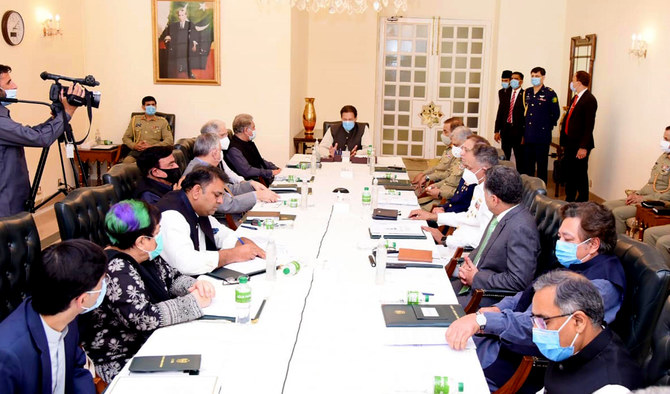
ISLAMABAD: Pakistani prime minister Imran Khan convened a meeting of the National Security Committee (NSC) today, Monday, where the government called on all parties in Afghanistan to ensure that Afghan soil was not used by militants against any country.
The meeting comes a day after Taliban insurgents took over the Afghanistan capital without a fight. Just last week, a US intelligence estimate said Kabul could hold out for at least three months.
“The NSC noted positively that major violence had been averted thus far and called on all parties in Afghanistan to respect the rule of law, protect fundamental human rights of all Afghans, and ensure that Afghan soil is not used by any terrorist organization/group against any country,” a statement from the PM Office said.
“Participants reiterated that Pakistan remains committed to an inclusive political settlement as the way forward representing all Afghan ethnic groups. It was reaffirmed that Pakistan would continue to work with the international community and all Afghan stakeholders to facilitate an inclusive political settlement in the country. It was stressed that the principle of non-interference in Afghanistan must be adhered to.”
PM Khan directed that all possible facilities be made available to repatriate Pakistanis, diplomats, journalists and the staff of international organizations seeking to leave Afghanistan.
“The Prime Minister lauded the ongoing efforts of the Pakistan embassy in Kabul and the state machinery in this regard,” the statement said.
Earlier on Sunday, Taliban insurgents captured the eastern city of Jalalabad without a fight, giving them control of one of the main highways into landlocked Afghanistan. They also took over the nearby Torkham border post with Pakistan, leaving Kabul airport the only way out of Afghanistan, which is still in government hands.
The capture of Jalalabad followed the Taliban’s seizure of the northern city of Mazar-i-Sharif late on Saturday, also with little fighting.
After US-led forces withdrew the bulk of the their remaining troops in the last month, the Taliban campaign accelerated as the Afghan military’s defenses appeared to collapse.
Afghan President Ashraf Ghani also fled the country on Sunday, saying he had left to avoid bloodshed.
In a post on his Facebook page, Ghani said he had faced a difficult decision, with the fate of millions of Kabul residents and the security of the city at stake after 20 years of war in which countless had already been killed.
“To avoid bloodshed, I thought it would be better to leave,” he said in his first comments since quitting the presidential palace and flying out of the country.
He added that the Taliban insurgents, who later entered the presidential palace in Kabul, now faced a historic test.
“The Taliban won victory in the judgment of sword and gun and they have the responsibility to protect the honor, prosperity and self-respect of our compatriots,” he said.
He did not disclose details of his current location.


Pakistan says Afghan soil should not be used by ‘terrorist’ groups against any country
https://arab.news/5ktvk
Pakistan says Afghan soil should not be used by ‘terrorist’ groups against any country

- Prime minister Imran Khan convenes a meeting of the National Security Committee
- Consultation comes a day after Taliban insurgents took over the Afghanistan capital without a fight

Pakistan warns citizens in Iran to keep travel documents ready amid intensifying protests
- Iranian universities reschedule exams, allow foreign students to leave the country for one month
- Donald Trump pledges support for Iranian protesters as ‘activists’ report more than 2,500 deaths
ISLAMABAD: Pakistan’s top diplomat to Iran on Tuesday urged Pakistani nationals to keep their travel documents handy and advised students to plan ahead after Iranian universities rescheduled examinations to allow international students to leave, as weeks-long nationwide protests further intensified.
Iran has been gripped by protests since late December after shopkeepers in Tehran’s Grand Bazaar shut their businesses to protest worsening economic conditions, triggered by the Iranian rial plunging to record lows against the US dollar.
The demonstrations quickly spread beyond the capital, with unrest reported in most of the country’s 31 provinces and involving traders, students and other groups.
Authorities have responded with arrests, use of force and Internet and mobile network disruptions, which rights groups say are aimed at curbing coordination and limiting coverage of the protests.
At least 100 Pakistani citizens, including students and pilgrims, have returned home through the Pakistan-Iran border in the southwestern province of Balochistan, a Pakistani official told Arab News on Tuesday, though many are still believed to be in the neighboring state.
“I urge all Pakistani citizens in Iran to keep their travel documents, particularly immigration-related documents such as passport and ID cards, readily available with them,” Ambassador Mudassir Tipu said in a post on X. “Those who have expired documents, or their documents are not in their possession, they may kindly urgently approach us for timely and expeditious assistance.”
In a separate post, he said Iranian universities had rescheduled examinations and allowed international students to leave the country for one month, advising Pakistani students to make their plans accordingly.
On Jan. 1, Pakistan advised its citizens to avoid traveling to Iran, citing safety concerns linked to the protests. The Pakistani embassy in Tehran also set up a crisis management unit to provide round-the-clock assistance to citizens.
Iran eased some restrictions on Tuesday, allowing international phone calls via mobile networks for the first time in days, but maintained limits on Internet access and text messaging as the death toll from the protests rose to at least 2,571 people, according to the Associated Press that quoted “activists.”
In a message on Truth Social, US President Donald Trump urged Iranian protesters to continue their anti-government demonstrations, saying “help is on its way,” without providing details. Shortly afterward, Ali Larijani, secretary of Iran’s Supreme National Security Council, accused the United States and Israel of responsibility for the deaths of Iranian civilians.
Iranian state television said officials would hold funerals on Wednesday for “martyrs and security defenders” killed during the unrest, which has intensified over the past week.


