

Ravaged Lebanon in complete darkness as electricity grid disintegrates

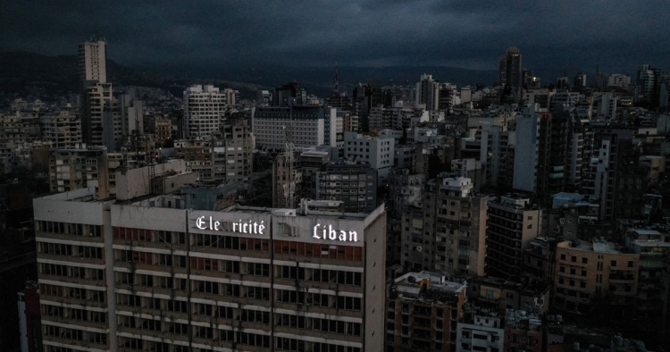
The Electricite du Liban company building in Beirut. Lebanon was plunged into darkness as the country faces power shortage and economic crisis. (AFP/File)
Short Url
Updated 16 August 2021
Follow

Ravaged Lebanon in complete darkness as electricity grid disintegrates

  • Acute fuel shortages have led the small Mediterranean country to the brink of a humanitarian disaster, with hospitals across the country sounding the alarm

DUBAI: Lebanon has been plunged into total darkness after its electric grid crumpled, piling further sorrows on a country teetering on the edge of collapse.

In a statement late on Sunday, the state-owned Électricité Du Liban announced that it had entered the stage of a complete blackout after “feeding reached an extremely low level.”

EDL had been supplying around one hour of electricity per day in the crisis-torn country with private generators struggling to fill the gaps, leaving residents with more than 15 hours of blackouts.

Eight feeding stations, which transfer power from Lebanon’s four main power plants onto its grid, have also been seized by angry residents, diverging electricity solely to their towns and villages.

The stations, located in southern Lebanon and Baalbek, have been seized for the better part of a week, with EDL calling on security forces to restore order.

“We’re in no man’s land, it’s simply not safe for employees to go to work anymore,” an EDL manager, who spoke on condition of anonymity, told Arab News.

With these stations effectively being run by untrained residents, the danger of an overload on a circuit becomes a possibility.

“It’s a disaster waiting to happen,” he said. To make matters worse, public-sector employees including EDL workers are expected to go on a full-fledged strike starting this week, he said.

“How do you expect an employee, living on $40 a month, with no gasoline, no medicine and no sense of security, to go to work,” he asked.

Acute fuel shortages have led the small Mediterranean country to the brink of a humanitarian disaster, with hospitals across the country sounding the alarm.

As dwindling diesel stocks threatened the lives of “40 adult patients and 15 children living on respirators” and another 180 others who are receiving dialysis treatment, one of Lebanon’s foremost university hospitals pleaded with concerned stakeholders for help.

These patients would die “within a matter of days,” the American University of Beirut’s Medical Center said on Saturday, before issuing a statement saying that it had replenished its stock for a week.

“After many calls that went unheeded, the AUB administration finally managed to get through to those who saw the dangers and were willing to take the initiative and help. Fuel suppliers, companies and citizens have stepped up, and AUBMC and other hospitals began to receive a resupply of fuel,” it said Sunday.

“AUBMC is gradually building back up its fuel supply and by tonight should have around a week of reserves,” it added.

The impending catastrophe comes on the heels of a tragic accident in the northern Akkar district that killed 28 people and injured scores of others.

At least 28 people were killed and 79 injured when a fuel tanker exploded in northern Lebanon early on Sunday, the health ministry said, after a seized fuel tanker exploded while residents flocked to replenish makeshift tanks.

Accounts varied as to what caused the explosion, from gunfire from the disgruntled tanker owner to reports that it was caused by a person who ignited a lighter.

With the country’s hospitals running on fumes and unable to care for patients amid fuel and medicine shortages, officials turned to friendly neighbors for help.

Three patients with severe burn wounds were airlifted to Turkey while Kuwait and Egypt sent over 10 tonnes of medical aid to Lebanon.

Speaking to his supporters Sunday evening, Hezbollah leader Hassan Nasrallah said his Iran-backed party will begin importing fuel from Tehran.

The militant chief had previously said his group would be able to import fuel from Iran while bypassing Lebanon’s central bank to evade US sanctions.

“We will go to Iran and negotiate with the Iranian government… and buy vessels full of petrol and fuel oil and bring them to Beirut port,” he said, defying the “Lebanese state (to dare) to prevent the fuel and gasoline from reaching the Lebanese people.”


Israeli strikes kill 3 people in Gaza, hospital says

Updated 10 February 2026
Follow

Israeli strikes kill 3 people in Gaza, hospital says

  • Shifa Hospital reported the deaths amid the months-old ceasefire that has seen continued fighting

DEIR AL-BALAH: Israeli military strikes on Monday killed three people west of Gaza City, according to the hospital where the casualties arrived.
Shifa Hospital reported the deaths amid the months-old ceasefire that has seen continued fighting. The Israeli army said Monday it is striking targets in response to Israeli troops coming under fire in the southern city of Rafah, which it says was a violation of the ceasefire. The army said it is striking targets “in a precise manner.”
The four-month-old U.S-backed ceasefire followed stalled negotiations and included Israel and Hamas accepting a 20-point plan proposed by US President Donald Trump aimed at ending the war unleashed by Hamas’ Oct. 7, 2023, attack into Israel. At the time, Trump said it would lead to a “Strong, Durable, and Everlasting Peace.”
Hamas freed all the living hostages it still held at the outset of the deal in exchange for thousands of Palestinian prisoners held by Israel and the remains of others.
But the larger issues the agreement sought to address, including the future governance of the strip, were met with reservations, and the US offered no firm timeline.
Top UN official concerned over Israel’s West Bank decision
The United Nations top official on Monday expressed concern about the Israeli security cabinet’s decision to deepen the country’s control over the occupied West Bank.
Secretary-General Antonio Guterres is “gravely concerned” and warned that the Israeli decision could erode the prospect of a two-state solution, spokesperson Stéphane Dujarric said in a statement.
“Such actions, including Israel’s continued presence in the Occupied Palestinian Territory are not only destabilizing but – as recalled by the International Court of Justice – unlawful,” he said.
Israel ‘s security cabinet on Sunday approved measures that aim to deepen Israeli control over the occupied West Bank and weaken the already limited powers of the Palestinian Authority.
Israel’s far-right Finance Minister Bezalel Smotrich said the measures would make it easier for Jewish settlers to force Palestinians to give up land, adding that “we will continue to bury the idea of a Palestinian state.”
Israel captured the West Bank, as well as Gaza and east Jerusalem, in the 1967 Mideast war. The Palestinians want all three territories for a future state.
Rafah crossing improving, official says
The Palestinian official set to oversee day-to-day affairs in Gaza said on Monday that passage through the Rafah crossing with Egypt is starting to improve after a chaotic first week of reopening marked by confusion, delays and a limited number of crossings.
Ali Shaath, head of the National Committee for the Administration of Gaza, told Egypt’s Al-Qahera News that operations at the crossing were improving on Sunday. He said 88 Palestinians were scheduled to travel through Rafah on Monday, more than have crossed in the initial days since reopening. Israel did not immediately confirm the figures.
The European Union border mission at the crossing said in a statement Sunday that 284 Palestinians had crossed since reopening. Travelers included people returning after having fled the war and medical evacuees and their escorts. In total, 53 medical evacuees departed during the first five days of operations.
That remains well below the agreed target of 50 medical evacuees exiting and 50 returnees entering daily, negotiated by Israeli, Egyptian, Palestinian and international officials.
Shaath and other members of the committee remain in Egypt, without Israeli authorization to enter the war-battered enclave.
The Rafah crossing opened last week for the first time since mid-2024, one of the main requirements for the ceasefire between Israel and Hamas. It was closed Friday and Saturday because of confusion around operations.
Palestinian officials say nearly 20,000 people are seeking to leave Gaza for medical care unavailable in its largely destroyed health system.
Palestinians who returned to Gaza in the first days after the crossing reopened described hourslong delays and invasive searches by Israeli authorities and an Israeli-backed Palestinian armed group, Abu Shabab. Israel denied mistreatment.
Gaza’s Health Ministry said on Monday that five people were killed over the previous 24 hours, bringing the death toll to 581 since the October ceasefire. The truce led to the return of the remaining hostages — both living captives and bodies — from the 251 abducted during the Oct. 7, 2023, attack that triggered the war.
Hamas-led militants killed around 1,200 people, mostly civilians, in the attack. Israel’s military offensive has since killed over 72,000 Palestinians, according to the ministry, which operates under the Hamas-run government and is staffed by medical professionals. The UN and independent experts consider it the most reliable source on war casualties.