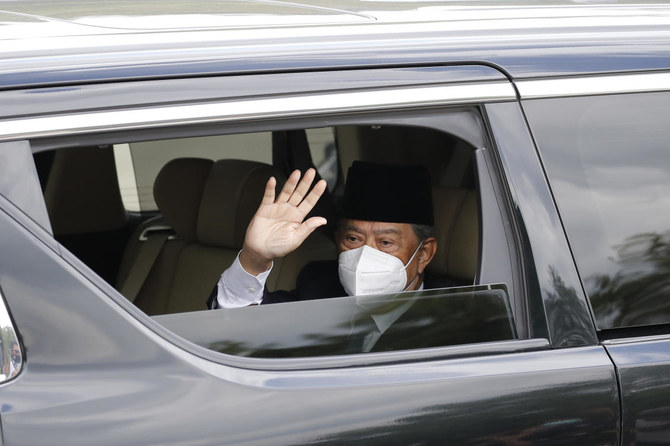

KUALA LUMPUR: Malaysia’s prime minister resigned on Monday after just 17 months in power amid chronic infighting within his coalition and over his government’s handling of the COVID-19 outbreak, which has seen a resurgence in cases in recent weeks.
The palace said that Muhyiddin Yassin would remain as caretaker prime minister, with King Abdullah Ahmad Shah saying it was in the “best interest” of Malaysians not to hold general elections.
“The king hopes that the political turmoil that has been in the way of the country’s administration will be resolved to benefit the people and the economy that is under threat by the COVID-19 pandemic,” it said in a statement.
Striking a somber tone in his televised address to the nation, the 74-year-old leader said he had decided to resign after losing his majority in parliament since assuming power as head of the Perikatan Nasional coalition in March last year.
He spoke of “greedy people,” a veiled reference to the president and other members of the United Malays National Organisation (UMNO) facing graft trials.
UMNO had been part of his ruling coalition, but regular threats of withdrawal from prominent members eventually led to the government’s collapse.
“They do not care about the health of the people,” he added. “I will never align myself with kleptocrats or the sacrifice of the judiciary and constitution. I have tried my best in this crisis we are facing. I hope the new government can be formed soon to carry on the work.”
Political analysts said the onus on selecting the next prime minister lay with the monarch, and that the candidate “must have the numbers in parliament to helm his Cabinet.”
“The king has absolute discretion to pick any of the MPs to try to put together a new government,” Prof. James Chin, director of the Asian Institute at the University of Tasmania, told Arab News. “But the only difference now is that there is a consensus among all the MPs in Malaysia. Both ruling and opposition believe that this instability can only be resolved by a general election.”
Dr. Firdausi Suffian, a public policy lecturer at the Universiti Teknologi Mara in Sabah, said political stability was key for the country to get through its economic crisis and COVID-19 response because people wanted “to see the change” from the appointment.
“This is not just appointing the prime minister, but also to see the proposal that the PM can put forward on the table for a better nation,” Suffian told Arab News.
Malaysia recorded 20,546 cases on Sunday, its fourth successive day of more than 20,000 cases, with overwhelmed hospitals struggling to cope with the influx of patients.
Pressure continued to mount on the prime minister after some lawmakers from UMNO withdrew their support last month, including UMNO president Zahid Hamidi and former Prime Minister Najib Razak. Both men are facing multiple criminal and civil charges in court.
Yassin said they withdrew support because he declined to drop court charges.
Chin said the king now had the opportunity to select one of the MPs or “give a chance” to one of the MPs to form a new government.
“Whoever forms the next government will have to pass a confidence vote in the floor parliament in September and, sometime next year when the pandemic has come under control, must call for a general election to resolve this.”
Suffian said the next candidate would need to prove themselves as “having the ability to resolve the crisis” the country was in now.
“They can use that as one of their political campaigns. I guess people are really sick and tired of all our political problems and political crises for the past one year.”