Sydney records deadliest day of COVID-19 pandemic, Melbourne lockdown extended

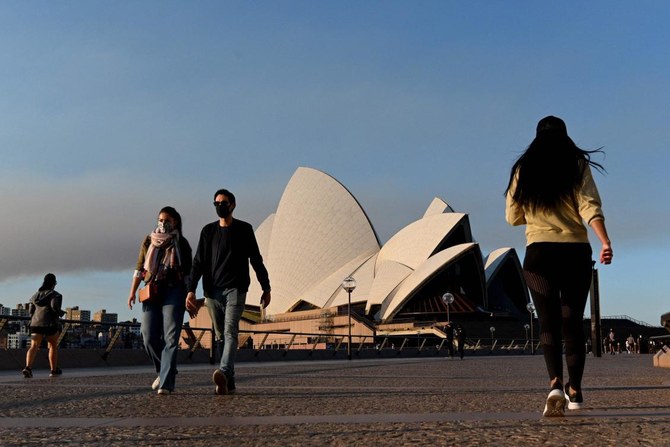
While Sydney, Melbourne, Canberra and Darwin — which begun its curbs on Monday — are all in lockdown, COVID-19 cases have proved stubbornly difficult to suppress. (AFP)
Short Url
Updated 16 August 2021
Follow

Sydney records deadliest day of COVID-19 pandemic, Melbourne lockdown extended

  • Sydney, which is in its eighth week of lockdown, is the center of Australia’s third COVID-19 wave
  • Melbourne’s 5 million residents will also be subjected to a nightly curfew

SYDNEY: Australia’s biggest city of Sydney recorded its deadliest day of the COVID-19 pandemic on Monday, while residents in Melbourne face a nightly curfew and a further two weeks of lockdown amid a surge in infections.
Sydney, which is in its eighth week of lockdown, is the epicenter of Australia’s third COVID-19 wave that threatens to push the country’s A$2 trillion ($1.5 trillion) economy into its second recession in as many years.
New South Wales state Premier Gladys Berejiklian said seven people in Sydney had died from COVID-19 in the past 24 hours, surpassing the state’s previous record daily toll from earlier this month.
Berejiklian said New South Wales has also detected 478 infections, the highest one-day rise since the pandemic begun.
“Our community transmission numbers are disturbingly high,” Berejiklian told reporters in Sydney.
“Every death is a person who has loved ones, who has died in tragic circumstances and our heartfelt condolences to all of those loved ones and families.”
Authorities also confirmed the death of 15-year-old boy from Sydney, who had pneumococcal meningitis and COVID-19.
The toll was announced as 200 military personnel were deployed across Sydney to set up roadblocks to enforce restrictions of movement. Australia last month deployed 500 troops to help New South Wales.
With only 26 percent of people above 16 years of age fully vaccinated, Australia is vulnerable to the highly infectious Delta variant that has steadily spread across the country.
While Sydney, Melbourne, Canberra and Darwin — which begun its curbs on Monday — are all in lockdown, cases have proved stubbornly difficult to suppress.
Victoria state Premier Daniel Andrews said Melbourne will now remain in a lockdown until Sept 2 after recording 22 new COVID-19 cases.
Melbourne’s 5 million residents will also be subjected to a nightly curfew.
“We are at a tipping point. There is simply no option today but to further strengthen this lockdown,” Andrews told reporters in Melbourne.
Canberra, the national capital, recorded 19 new cases, the biggest one-day rise in cases on Monday as it extended its lockdown for a further two weeks.
Australia’s economy rebounded strongly from the initial wave of the pandemic, with unemployment hitting its lowest levels in more than a decade at 4.9 percent in June.
But with many of its most populated cities on the east coast now in lockdown, economists expect a heavy toll.
“Unemployment may spike back up to 5.5 percent in the months ahead, mainly driven by (New South Wales),” said Shane Oliver, Chief Economist at AMP.
The outbreak and sluggish vaccine rollout has fueled pressure on Prime Minister Scott Morrison, who must return to the polls before May 2022.
Morrison said on Sunday Australia said on Sunday it had bought about 1 million doses of Pfizer’s COVID-19 vaccine from Poland, which had moved quickly to buy excess supplies.
Morrison declined to specify how much Australia had paid for the vaccines, which will be in addition to 40 million dose his government has ordered from Pfizer.
Morrison said more than half of the doses from Poland would be rushed to inoculate 20- to 39-year-olds in the worst-affected suburbs of Sydney.


National security trial for Hong Kong’s Tiananmen vigil organizers to open

Updated 4 sec ago
Follow

National security trial for Hong Kong’s Tiananmen vigil organizers to open

  • Three government-vetted judges will preside over the trial, which is expected to last 75 days

HONG KONG: Two pro-democracy activists behind a group that for decades organized a vigil that commemorated people killed in Beijing’s Tiananmen Square crackdown in 1989 will stand trial on Thursday, in another landmark case brought under a China-imposed national security law that has practically crushed protests in the semiautonomous Chinese city.
Critics say their case shows that Beijing’s promise to keep the city’s Western-style civil liberties intact for 50 years when the former British colony returned to Chinese rule in 1997 has weakened over time. But the city’s government said its law enforcement actions were evidence-based and strictly in accordance with the law.
Chow Hang-tung and Lee Cheuk-yan, former leaders of the Hong Kong Alliance in Support of Patriotic Democratic Movements of China, were charged with incitement to subversion in September 2021 under the law. They are accused of inciting others to organize, plan or act through unlawful means with a view to subvert state power, and if convicted, they face a maximum penalty of 10 years in prison.
A third leader of the group, Albert Ho, is expected to plead guilty, his lawyer said previously. This might result in a sentence reduction.
Before sunrise, dozens of people were in line outside the court building to secure a seat in the public gallery under a cold-weather warning.
Tang Ngok-kwan, a former core member of the alliance, has been queuing since Monday afternoon. He said he wanted to show support for his former colleagues in detention.
“They use their freedom to exchange for a dignified defense,” he said. “It’s about being accountable to history.”
Former pro-democracy district councilor Chan Kim-kam, a former vigil-goer and also Chow’s friend, stayed awake the whole night outside the building.
“We need to witness this, regardless of the results,” she said.
Trial expected to last 75 days
Three government-vetted judges will preside over the trial, which is expected to last 75 days. Videos related to the alliance’s years of work will be part of the prosecution evidence.
Chow, also a lawyer defending herself, tried to throw out her case in November, arguing the prosecution had not specified what “unlawful means” were involved. But the judges rejected her bid.
The judges explained their decision on Wednesday, saying the prosecution made it clear that “unlawful means” meant ending the Chinese Communist Party’s rule and violating the Chinese constitution. The prosecution accused the defendants of promoting the call of “ending one-party rule” by inciting people’s hatred of and disgust over the state’s power, the judges said.
The prosecution, they said, had pointed to the defendants’ media interviews and public speeches related to the alliance to sustain the group’s operation and promote that call to others after the security law took effect in June 2020. Although the scope of the charge was relatively wide, the prosecutors had provided sufficient details for the defendants, they added.
The court will not allow the trial to become a tool of political suppression in the name of law, the judges said.
Prosecutors are expected to detail their case this week.
Urania Chiu, lecturer in law at Oxford Brookes University, said the case goes to the heart of freedom of expression.
“The prosecution case hinges on the argument that the Alliance’s general call for ‘bringing the one-party rule to an end’ constitutes subversion without more, which amounts to criminalizing an idea, a political ideal that is very far from being actualized,” she said.
Sarah Brooks, Amnesty International’s Deputy Regional Director, alleged the case was about “rewriting history and punishing those who refuse to forget the victims of the Tiananmen crackdown.”
Alliance’s disbandment a blow to civil society
The alliance was best known for organizing the only large-scale public commemoration of the 1989 crackdown in China for decades. Tens of thousands of people attended it annually until authorities banned it in 2020, citing anti-pandemic measures.
After COVID-19 restrictions were lifted, the park was occupied instead by a carnival organized by pro-Beijing groups. Those who tried to commemorate the event near the site were detained.
Before the alliance voted to disband in September 2021, police had sought details about the group, saying they had reasonable grounds to believe it was acting as a foreign agent. The alliance rejected the allegations and refused to cooperate.
Chow, Tang, another core member of the alliance were convicted in a separate case in 2023 for failing to provide authorities with information on the group and were each sentenced to 4 1/2 months in prison. But the trio overturned their convictions at the city’s top court in March 2025.
Chow, Lee and Ho have been in custody, awaiting the trial’s opening, which has been postponed twice.
Beijing said the 2020 security law was necessary for the city’s stability following the 2019 protests, which sent hundreds of thousands of people onto the streets.
The same law has convicted dozens of other leading pro-democracy activists, including pro-democracy former media mogul Jimmy Lai last month. Dozens of civil society groups have closed since the law took effect.