

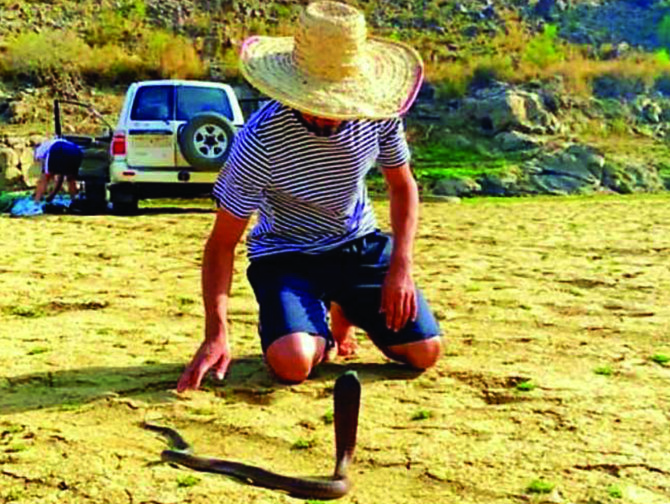
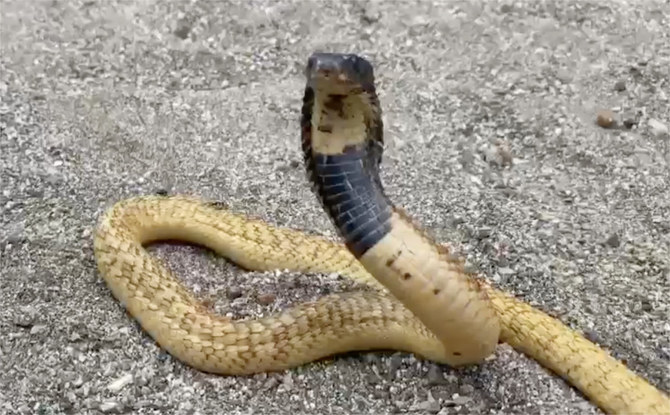


MAKKAH: For a little over 30 years, residents of Baha in the southwest part of Saudi Arabia have sought the help of a local cobra catcher who shares a unique bond with the slithery creatures, while also trying to protect them through conservation and awareness efforts.
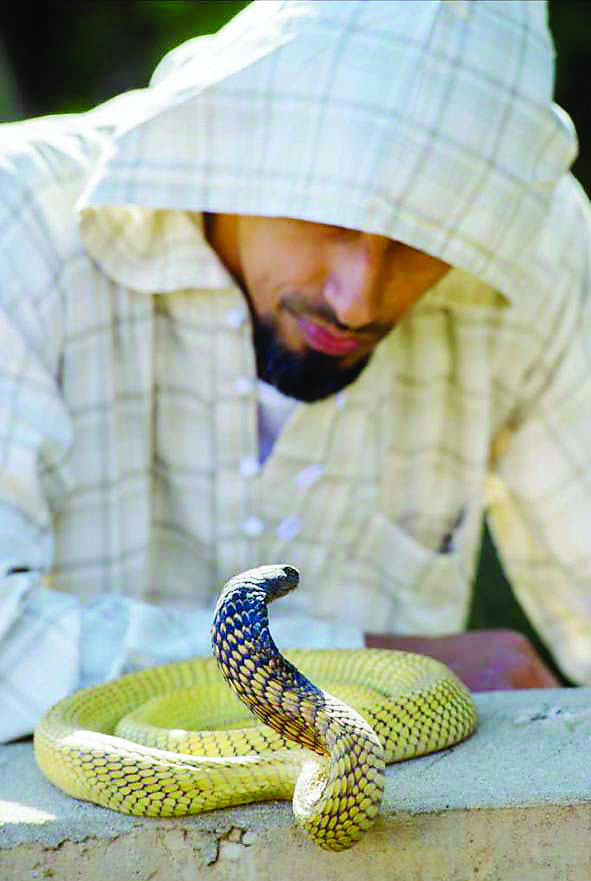
Hamza Al-Ghamdi, an animal behavior expert and a longtime conservationist, has caught snakes in the region for “as long as I can remember” due to his unique charm and technique.
He captures snakes in an attempt to protect and conserve them, and in the process tries to correct the damaging stereotype that all snakes are dangerous, venomous and will leave a human dead within 30 minutes.
The truth is, “snakes are shy and would rather escape than confront people,” Al-Ghamdi told Arab News.
A native of the southwestern mountainous region, he said that there are 45 species of snakes from seven main families in the Kingdom. Some are rare, while others can be found easily, but the distribution of species around the Kingdom depends on climate, terrain and the availability of prey, he added.
“Some of the most venomous snakes found in the Kingdom are the Arabian cobra, a venomous snake that is endemic to Arabian Peninsula, the puff adder and the horned desert viper, and there are also those that are mildly venomous, such as the hissing snake and braid snake,” said Al-Ghamdi.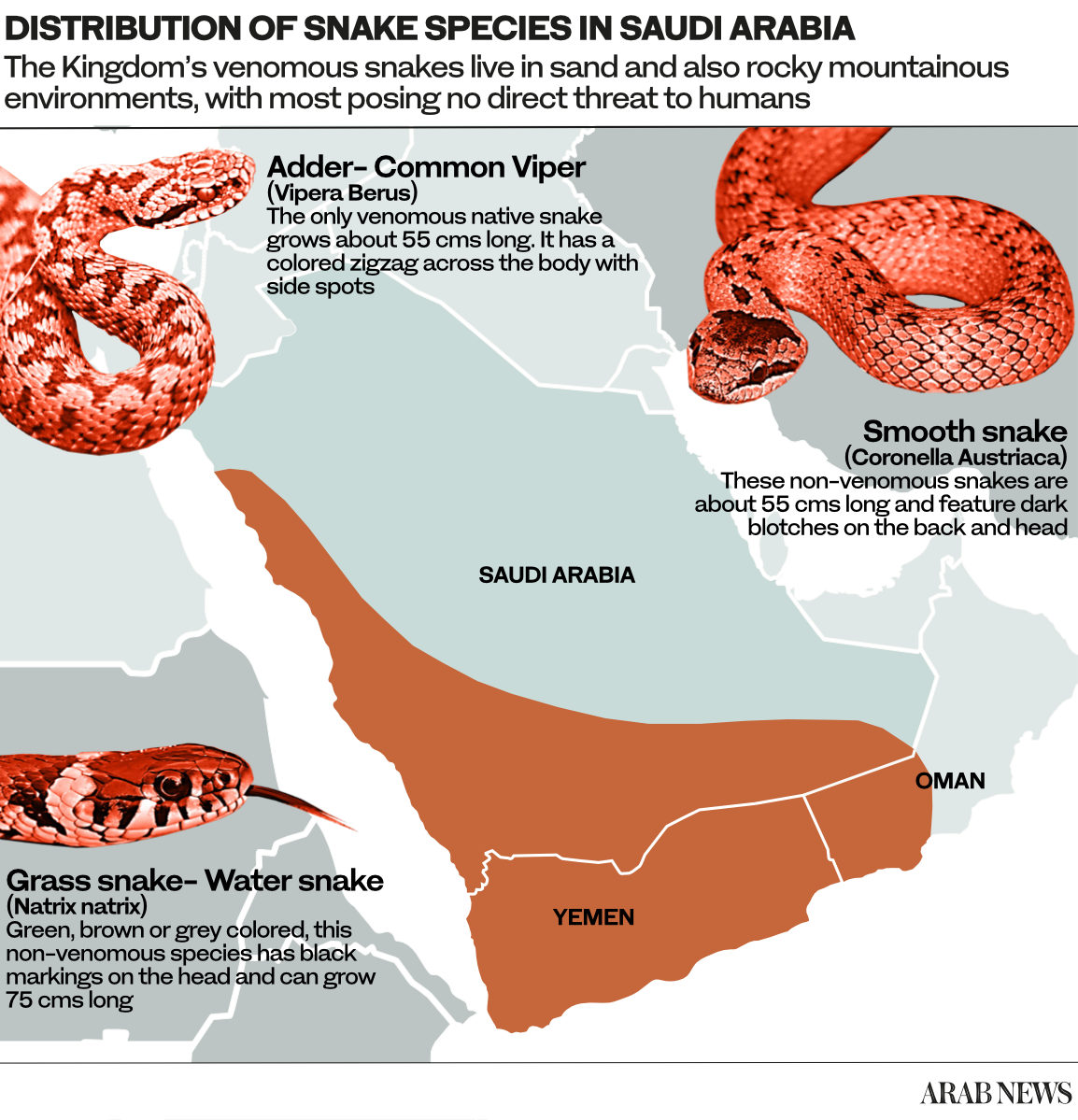
The average size of the Kingdom’s snake species ranges between 55 and 75 centimeters in length, Al-Ghamdi added. He stressed that common fears surrounding snakes are “exaggerated” and called on people to protect and conserve them, especially through education and handling lessons, which can change people’s opinions of the slithery creatures.
He said that smaller snakes are “clever camouflagers,” often ignored by humans due to their size or color, leading some to believe that they are earthworms. “There are also two species of boas that are known as the burrowing serpent, as well as the atractaspidae family that includes the most dangerous venomous snake — a small black but deadly one.”
He said that snakes are often found in agricultural areas, and near bodies of water and poultry farming sites, especially pigeon farms. They are attracted to the smell of their prey, which include mice, baby pigeons and bird nests. But Al-Ghamdi said that cats enjoy killing snakes near residential areas, with the two animals being “sworn enemies.”
IhopeI manage to create an exhibition to present these species in our region, in order to promote awareness for visitors, spread knowledge to interested people and preserve these rare species.
Hamza Al-Ghamdi
His connection with snakes is a special one found in many snake catchers, he said, telling Arab News how he has an “emotional communication” with them, and how his time caring for them helped him reach “higher levels of concentration while performing tasks.”
Al-Ghamdi said that some snake species are diurnal, such as the Arabian cobra, the braid snake and the hissing snake, while others are nocturnal, due to their slow movement and inability to climb.
And statistically, snakes pose a tiny threat to the Kingdom, he added, with snake bite numbers being relatively low and usually limited to people who carelessly try to catch them — often men and children. “I was bitten several times while handling snakes throughout 30 years and catching more than 500 cobras in that time,” he said.
Al-Ghamdi believes that cobras are some of the most “highly evolved and fascinating creatures.” He said that attempting to kill a snake puts people in danger, and as predators, they will defend themselves if threatened. “They’ll snap and continuously try to bite if they feel you’re trying to kill them.”
Only about one in five of the world’s snake species are venomous, with most snakes encountered by people being harmless and in fact beneficial, playing an important role in balancing the ecosystem. Predators by nature, snakes help protect agriculture by catching and killing rodents, which are major culprits in destroying crops and causing damage.
HIGHLIGHTS
• A native of the southwestern mountainous region, Hamza Al-Ghamdi said that there are 45 species of snakes from 7 main families in the Kingdom. Some are rare, while others can be found easily, but the distribution of species around the Kingdom depends on climate, terrain and the availability of prey.
• The average size of the Kingdom’s snake species ranges between 55 and 75 centimeters in length, Al-Ghamdi said. He stressed that common fears surrounding snakes are ‘exaggerated’ and called on people to protect and conserve them, especially through education and handling lessons, which can change people’s opinions of the slithery creatures.
Though he continues to try to educate nearby residents, there is still a common misconception that all snakes are harmful to humans. On the contrary, Al-Ghamdi said, they prefer to flee over risking a potentially dangerous encounter.
“I established a nonofficial group to hunt snakes that Baha citizens inform us about in their homes or farms, and we create awareness-raising videos about the importance of these species, especially the Arabian cobra that only lives in the Kingdom, Oman and Yemen. It is a distinct species that must be preserved,” he added.
“I hope I manage to create an exhibition to present these species in our region, in order to promote environmental awareness for visitors, spread knowledge to interested people and preserve these rare species. We often warn against handling snakes and underestimating their capability, and recommend leaving them alone. If snakes find an escape, they will flee and simply leave you alone without attacking.”


