

Philippines extends travel ban for 10 countries over Delta concerns

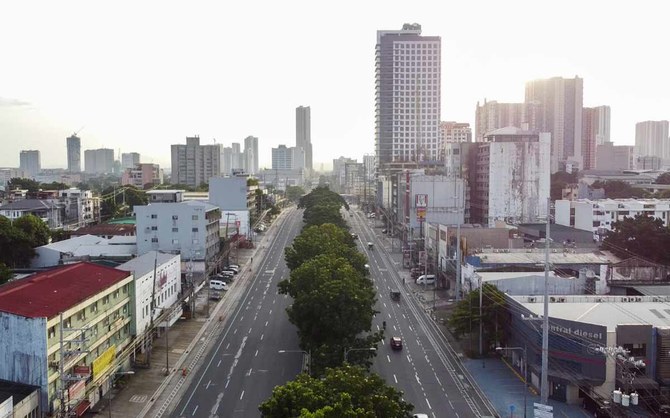
An aerial view shows minimal traffic in a main thoroughfare in Quezon City on Aug. 9, 2021, during a two-week lockdown following a surge in COVID-19 cases in Metro Manila, Philippines. (REUTERS)
Short Url
Updated 13 August 2021
Follow

Philippines extends travel ban for 10 countries over Delta concerns

  • Ban includes Pakistan, Bangladesh, Sri Lanka, Nepal, the UAE, Oman, Thailand, Malaysia and Indonesia

MANILA: The Philippines will extend a ban on travelers from India and nine other countries to the end of August because of concerns posed by the highly contagious Delta variant of the coronavirus, the presidential spokesperson said on Friday.
Authorities in the Philippines are scrambling to contain a jump in coronavirus cases to a four-month high, with infections staying above the 12,000 mark for a second straight day on Thursday, and hospitals in some areas nearing capacity.
The travel ban, which was first imposed on April 27, has been rolled over several times and expanded to include Pakistan, Bangladesh, Sri Lanka, Nepal, the United Arab Emirates, Oman, Thailand, Malaysia and Indonesia.
President Rodrigo Duterte approved the recommendation of the coronavirus task force to extend the travel restrictions from Aug. 16 to Aug. 31, presidential spokesperson Harry Roque said in a statement.
The Manila capital region, an urban sprawl of 16 cities that is home to 13 million people, remains under a strict lockdown to contain the spread of Delta, while the government ramps up its vaccination drive.

With about 11 percent of the country’s 110 million people fully immunized, millions still remain highly vulnerable to COVID-19, which has killed more than 29,500 in the Southeast Asian country.
As cases surge, more hospitals in the capital region have reported intensive care units, isolation beds and wards were nearing full capacity.


Venezuela’s furious street forces ready to ‘fight’ after US raid

Updated 59 min 30 sec ago
Follow

Venezuela’s furious street forces ready to ‘fight’ after US raid

  • As proud defenders of the Venezuelan leadership’s socialist “Bolivarian revolution,” the ousting of Maduro has left them furious and bewildered, convinced that he was betrayed by close allies

CARACAS: When explosions boomed in the night and US warplanes roared in the sky over Caracas, Jorge Suarez and his companions rushed fearfully for their guns.
For these members of the “colectivos” — armed loyalists of the leftist leadership — the US raid that ousted Nicolas Maduro as their president was the most dramatic challenge yet.
“We’re not used to it — it was like a best-seller, like something out of a movie,” said Suarez, in black sunglasses and a cap bearing the slogan: “Doubt is treason.”
“We took to the streets, waiting for instructions from our leaders.”
As proud defenders of the Venezuelan leadership’s socialist “Bolivarian revolution,” the ousting of Maduro has left them furious and bewildered, convinced that he was betrayed by close allies.
“There is frustration, anger and a will to fight,” said a 43-year-old member of one collective the Boina Roja — which translates to Red Beret — who identified himself only as Willians, in a black cap and hooded jacket.
“It’s still not really clear what happened...What is clear is that there were many betrayals,” he added — pointing to implausible failures in Maduro’s defenses.
“We don’t understand how the anti-aircraft system failed. We don’t know what happened with the rocket-launch system.”

- Policing the transition -

Established in their current form under Maduro’s predecessor Hugo Chavez, the colectivos are tasked with keeping social order on the streets — but accused by opponents of beating and intimidating rivals.
They have closed ranks behind Delcy Rodriguez, Maduro’s former deputy who took over as interim president.
She has pledged to cooperate with US President Donald Trump over his demand for access to Venezuela’s huge oil reserves — but has insisted the country is not “subordinate” to Washington.
Willians said the colectivos were resisting certain post-Maduro narratives, which he dismissed as mind games — such as “that Trump might bomb again, or that Delcy Rodriguez is with the United States.”
They respect her ideological pedigree — Rodriguez is the daughter of a far-left militant who died in the custody of the intelligence services in 1976.
“I don’t think anyone would betray her father,” said Alfredo Canchica, leader of another collective, the Fundacion 3 Raíces.
“You can betray the people, but not your father.”
Colectivo members declined to be drawn out on how the post-Maduro phase might play out under Trump and Rodriguez, however.
“We don’t believe the threats that the Americans are going to come, dig in and take us out,” said Canchica.
“They’ll have to kill us first.”

- Maduro ‘betrayed’ -

Feared by opponents as a rifle-wielding, motorbike-mounted shock force, the colectivos are welcomed in some neighborhoods where they are credited with preventing crime — and where authorities hand out subsidized food parcels.
Speaking at the Chato Candela baseball stadium in the working-class 23 de Enero district, Canchica rejected the negative image they have gained.
When opposition demonstrators and some world powers were accusing Maduro of stealing an election in July 2014, “we stopped the shantytowns from rising up,” he said.
The colectivos also claim to run sports programs, coordinate with hospitals and transport networks, and visit traders to keep price speculation in check.
Fiercely committed to the “Chavista” cause, they felt the sting of betrayal in Maduro’s capture.
“The betrayal must have come from someone very close to our commander” Maduro, said Canchica.
“It was so perfect we didn’t notice, and we still don’t know who betrayed us, how they betrayed us — it happened so fast.”
In his office with images of independence hero Simon Bolivar, Chavez and Maduro on the wall, and books, bullets and a sound-wave bomb on the table, Suarez bitterly recalled watching animated reconstructions of Maduro’s capture published online.
“It makes you angry,” he said.
“Despite all the support Commander (Vladimir) Putin, China and North Korea have given us militarily, how can we react in real time when (the US) has more advanced technology than we do?“