
MANILA: The Philippines government on Sunday began enforcing quarantine control points (QCP) along the borders of the National Capital Region (NCR) to curb the spread of the delta variant of the coronavirus, ahead of a strict lockdown later this week.
“At the moment, the QCPs are at the borders of Bulacan, Rizal, Laguna and Cavite with adjoining provinces, but once we move to ECQ (enhanced community quarantine) starting Aug. 6, checkpoints will now be located inside Metro Manila,” Interior Secretary Eduardo Ano said in a statement.
The two-week ECQ will be imposed in Metropolitan Manila, the nation’s capital region with more than 13 million people, from Aug. 6 to 20.
On Sunday, the Department of Health reported 8,735 new COVID-19 infections, taking the total tally to 1,597,689 cases.
Of the total, 94.3 percent have recovered, while the number of active cases stood at 4 percent, or 63,646, a majority with mild or no symptoms.
There were 127 new deaths reported, taking the country’s death toll to 28,016 since the start of the pandemic.
As of Thursday, 216 delta variant cases had been detected in the Philippines.
Ano said that the QCPs, manned by the Philippine National Police (PNP), the Armed Forces of the Philippines, the Philippine Coast Guard and the Bureau of Fire Protection, will be located along the borders of Bulacan, Rizal, Laguna and Cavite, and will “ensure that only authorized persons outside of residence are allowed to pass."
These include health and emergency frontline service workers and uniformed personnel, government officials and employees on official travel, those involved in fully authorized relief and humanitarian assistance efforts, those traveling for medical or humanitarian reasons, persons going to and from airports, anyone crossing zones for work in permitted industries and public utility vehicle operators.
Those found to be unauthorized people outside of residence will not be allowed to pass and will be asked to return to their homes, Ano said, adding that from Aug. 1 to 5, “no QCPs will be put up inside the NCR Plus (Metro Manila plus Bulacan, Rizal, Laguna and Cavite).
“The PNP, nonetheless, may still set up regular checkpoints inside the NCR Plus bubble to implement curfew hours, enforce minimum health standards and for general law enforcement,” he said.
In an earlier radio interview, Ano said that during the interim period between Friday’s announcement of Metro Manila’s return to a hard lockdown, the government “has to implement additional heightened restrictions, to include inter-zonal movement.
“With the announcement of the ECQ, it is expected that some people would be rushing to leave Metro Manila. With that, there is a high risk that people who may already be infected with the delta variant could spread the virus to other areas,” he added.
He stressed that the implementation of strict border controls was “critical” to stop the spread of the delta variant.
“Among the objectives of the ECQ is to shut down the mobility of people to cut the chain of transmission of the delta variant and to incubate the virus, so that it will die naturally,” Ano said.
He added that another purpose is to allow the government to ramp up vaccination measures against COVID-19, and allow for a more aggressive and intensive contact tracing to identify and isolate infected individuals.
“It is important for the government to act now because once there is a surge in delta variant cases in the country, it will be explosive and exponential, and it will not be easy to reverse,” he said.
The official cited other countries in the region that also had resorted to imposing hard lockdowns.
“For example, in Indonesia, they have 21,000 infections per day, and 1,700 are dying every day. In India, the rate was 44,000 cases per day, and when they ramped up their vaccination program, the recorded deaths went down to at least 500 to 600 per day. But Malaysia and Thailand, they are at about 16,000 infections per day, and until now their cases continued to surge,” Ano said.
“In the UK and the US, they still have a high rate of infection with 27,000 new cases a day, but the number of people dying has gone down because they have already vaccinated a large number of their population. It shows that vaccination slows down the transmission of the delta variant and also helps prevent death among patients,” he added.
Meanwhile, Ano reminded the PNP to allow the “unimpeded movement of cargo and delivery vehicles across all quarantine control points, because of the importance to the economy.”
PNP chief Guillermo Eleazar assured the public that human rights “would be respected at border control points in the area.”
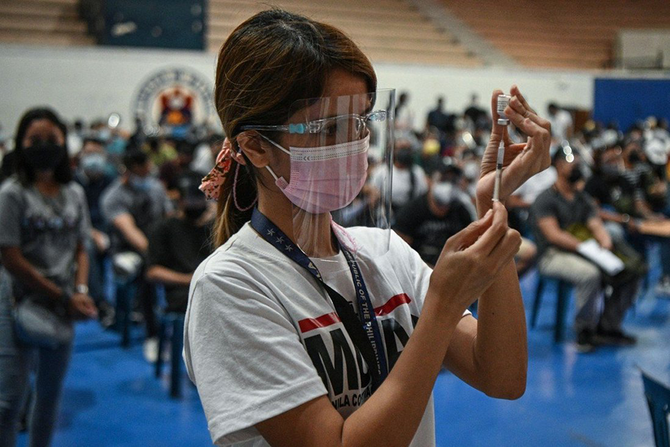
At the same time, he said that the PNP’s Medical Reserve Force (MRF) was placed on standby to assist in the vaccination process during the enforcement of the ECQ in the capital region.
“The MRF is ready to help as additional manpower in the vaccination process after the Metro Manila Council’s pronouncement that it is targeting 250,000 individuals for incoluation each day during the two-week ECQ,” Eleazar said in a statement.
He also tasked concerned police commanders to coordinate with local government officials, especially village executives, to discuss the vaccination process during the ECQ.