


Egypt launches first Arabic robotic nurse

(Shutterstock)
Short Url
Updated 13 August 2021
Follow

Egypt launches first Arabic robotic nurse

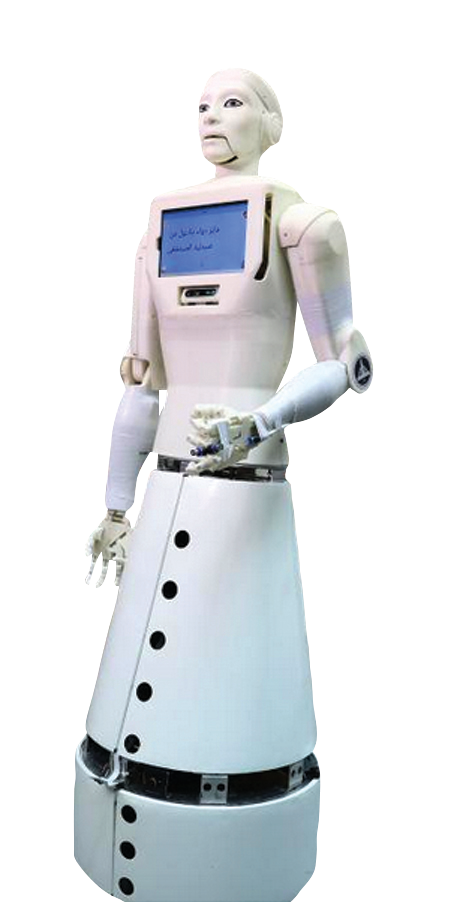
CAIRO: Ain Shams University in Cairo has announced the testing of its first Arabic-speaking robot nurse.

University President Mahmoud Al-Matini said the idea for the robot stemmed from the conditions imposed by the coronavirus disease (COVID-19) pandemic and the need to follow preventive measures.
Students from the computers and information faculty were keen to implement a project that would benefit the health sector during the COVID-19 fight.

Al-Matini said the university had supported the project to optimize its capabilities and use.

The faculty of computers and information worked with the faculties of medicine and nursing to ensure it became an integrated project.

Nagwa Badr, dean of the faculty of computers and information, said the robot, named Shams, speaks Arabic and can recognize the faces of patients or doctors. It can also deal with patient needs and enter health status data.

She added that it can take the necessary samples for analysis and deliver them to the laboratory, bring medication from the pharmacy to the patient, and can also carry out communication between the patient and the treating doctor through a video call. It also performs sterilization operations.

Badr said Ain Shams Specialized Hospital was chosen to conduct experiments on the robot. It will develop Shams to carry out larger tasks using artificial intelligence techniques.

Mohamed Marai, assistant professor at the faculty of computers and information, and one of the members of the research team working on Shams, said there are plans to start making 20 more robotic nurses for the hospital.

An assistant professor at the faculty told local media that plans were underway to cooperate with the Arab Organization for Industrialization to produce a large number of these robots.


Palestinians attempt to use Gaza’s Rafah Border crossing amidst delays

Updated 58 min 22 sec ago
Follow

Palestinians attempt to use Gaza’s Rafah Border crossing amidst delays

  • The Rafah Crossing opened to a few Palestinians in each direction last week, after Israel retrieved the body of the last hostage held in Gaza and several American officials visited Israel to press for the opening

CAIRO: Palestinians on both sides of the crossing between Gaza and Egypt, which opened last week for the first time since 2024, were making their way to the border on Sunday in hopes of crossing, one of the main requirements for the US-backed ceasefire. The opening comes as Prime Minister Benjamin Netanyahu is expected to travel to Washington this week, though the major subject of discussion will be Iran, his office said.
The Rafah Crossing opened to a few Palestinians in each direction last week, after Israel retrieved the body of the last hostage held in Gaza and several American officials visited Israel to press for the opening. Over the first four days of the crossing’s opening, just 36 Palestinians requiring medical care were allowed to leave for Egypt, plus 62 companions, according to United Nations data.
Palestinian officials say nearly 20,000 people in Gaza are seeking to leave for medical care that they say is not available in the war-shattered territory. The few who have succeeded in crossing described delays and allegations of mistreatment by Israeli forces and other groups involved in the crossing, including and an Israeli-backed Palestinian armed group, Abu Shabab.
A group of Palestinian patients and wounded gathered Sunday morning in the courtyard of a Red Crescent hospital in Gaza’s southern city of Khan Younis, before making their way to the Rafah crossing with Egypt for treatment abroad, family members told The Associated Press.
Amjad Abu Jedian, who was injured in the war, was scheduled to leave Gaza for medical treatment on the first day of the crossing’s reopening, but only five patients were allowed to travel that day, his mother, Raja Abu Jedian, said. Abu Jedian was shot by an Israeli sniper while he was building traditional bathrooms in the central Bureij refugee camp in July 2024, she said.
On Saturday, his family received a call from the World Health Organization notifying them that he is included in the group that will travel on Sunday, she said.
“We want them to take care of the patients (during their evacuation),” she said. “We want the Israeli military not to burden them.”
The Israeli defense branch that oversees the operation of the crossing did not immediately confirm the opening.
A group of Palestinians also arrived Sunday morning at the Egyptian side of the Rafah crossing border to return to the Gaza Strip, Egypt’s state-run Al-Qahera News satellite television reported.
Palestinians who returned to Gaza in the first few days of the crossing’s operation described hours of delays and invasive searches by Israeli authorities and an Israeli-backed Palestinian armed group, Abu Shabab. A European Union mission and Palestinian officials run the border crossing, and Israel has its screening facility some distance away.
The crossing was reopened on Feb. 2 as part of a fragile ceasefire deal that stopped the war between Israel and Hamas. Amid confusion around the reopening, the Rafah crossing was closed Friday and Saturday.
The Rafah crossing, an essential lifeline for Palestinians in Gaza, was the only crossing not controlled by Israel prior to the war. Israel seized the Palestinian side of Rafah in May 2024, though traffic through the crossing was heavily restricted even before that.
Restrictions negotiated by Israeli, Egyptian, Palestinian and international officials meant that only 50 people would be allowed to return to Gaza each day and 50 medical patients — along with two companions for each — would be allowed to leave, but far fewer people than expected have crossed in both directions.