

Pakistan’s Sialkot airport first to install rapid COVID-19 testing for UAE passengers 

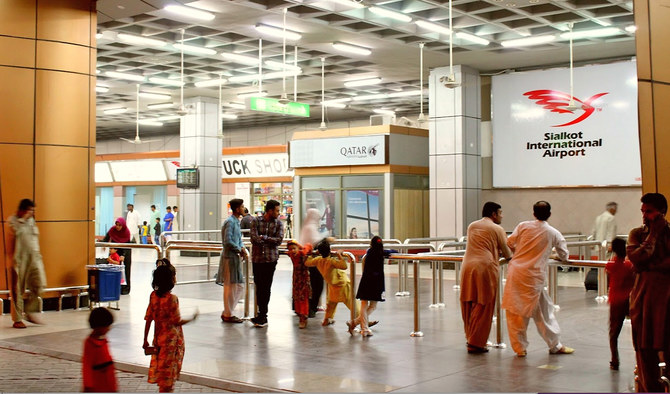
People stand by an exit at Sialkot International Airport in Sialkot, Pakistan, on November 5, 2017. (Photo courtesy: Online)
Short Url
Updated 10 August 2021
Follow

Pakistan’s Sialkot airport first to install rapid COVID-19 testing for UAE passengers 

  • Airport manager says 122 passenger had traveled to Dubai with reports of rapid PCR tests
  • Says the facility had been operational since Monday night and passengers had to pay for their own tests

ISLAMABAD: Pakistan’s Sialkot International Airport has become the first airport in the country to install a Rapid PCR (polymerase chain reaction) testing facility for passengers traveling to the United Arab Emirates (UAE), an airport official said on Tuesday.
UAE lifted a ban on transit passenger traffic from India, Pakistan, Nigeria and other countries from August 5, with the National Emergency and Crisis Management Authority (NCEMA) saying passengers traveling from countries where flights had been suspended would be able to transit through its airports as long as they presented negative rapid PCR tests taken 72 hours prior to departure.
However, the Pakistan Civil Aviation Authority (PCAA) has said the country does not have the resources to conduct rapid PCR tests and only rapid antigen testing (RAT) was currently available at its airports.
“We have arranged a rapid PCR testing facility at our airport with the help of a city lab and research center,” Nisar Ahmad, a manager at Sialkot International Airport, told Arab News, adding that the facility had been operational since Monday night, and passengers had to pay for their own tests. 
“Under this arrangement, 122 passengers traveled to Dubai on a FlyDubai flight with reports of rapid PCR tests,” Ahmed said.


A rapid PCR (polymerase chain reaction) testing facility for passengers can be seen at Sialkot International Airport, Pakistan, on August 9, 2021. (Courtesy: Sialkot International Airport)

A spokesperson for the Pakistan Civil Aviation Authority, Saad bin Ayub, said the authority was “working on different options” to fulfill the requirements of the UAE government and had written a letter to the ministry of foreign affairs requesting them to use diplomatic channels to convince the UAE government to accept rapid antigen, instead of Rapid PCR, tests. 
“The response we have got from MoFA is that the UAE government requires only the rapid PCR,” he added. 
The UAE embassy in Islamabad said rapid PCR test results were mandatory for all nationalities and destinations.
“Yes, rapid PCR is mandatory for all nationalities and destinations,” the embassy told Arab News in a statement.


EU, Pakistan sign €60 million loan agreement for clean drinking water in Karachi

Updated 5 sec ago
Follow

EU, Pakistan sign €60 million loan agreement for clean drinking water in Karachi

  • Project will finance rehabilitation, construction of water treatment facilities in Karachi city, says European Investment Bank
  • As per a report in 2023, 90 percent of water samples collected from various places in city was deemed unfit for drinking

ISLAMABAD: The European Investment Bank (EIB) and Pakistan’s government on Wednesday signed a €60 million loan agreement, the first between the two sides in a decade, to support the delivery of clean drinking water in Karachi, the EU said in a statement. 

The Karachi Water Infrastructure Framework, approved in August this year by the EIB, will finance the rehabilitation and construction of water treatment facilities in Pakistan’s most populous city of Karachi to increase safe water supply and improve water security. 

The agreement was signed between the two sides at the sidelines of the 15th Pak-EU Joint Commission in Brussels, state broadcaster Radio Pakistan reported. 

“Today, the @EIB signed its first loan agreement with Pakistan in a decade: a €60 million loan supporting the delivery of clean drinking water for #Karachi,” the EU said on social media platform X. 

https://x.com/eupakistan/status/2001258048132972859

Radio Pakistan said the agreement reflects Pakistan’s commitment to modernize essential urban services and promote climate-resilient infrastructure.

“The declaration demonstrates the continued momentum in Pakistan-EU cooperation and highlights shared priorities in sustainable development, public service delivery, and climate and environmental resilience,” it said. 

Karachi has a chronic clean drinking water problem. As per a Karachi Water and Sewerage Corporation (KWSC) study conducted in 2023, 90 percent of water from samples collected from various places in the city was deemed unsafe for drinking purposes, contaminated with E. coli, coliform bacteria, and other harmful pathogens. 

The problem has forced most residents of the city to get their water through drilled motor-operated wells (known as ‘bores’), even as groundwater in the coastal city tends to be salty and unfit for human consumption.

Other options for residents include either buying unfiltered water from private water tanker operators, who fill up at a network of legal and illegal water hydrants across the city, or buying it from reverse osmosis plants that they visit to fill up bottles or have delivered to their homes.

The EU provides Pakistan about €100 million annually in grants for development and cooperation. This includes efforts to achieve green inclusive growth, increase education and employment skills, promote good governance, human rights, rule of law and ensure sustainable management of natural resources.