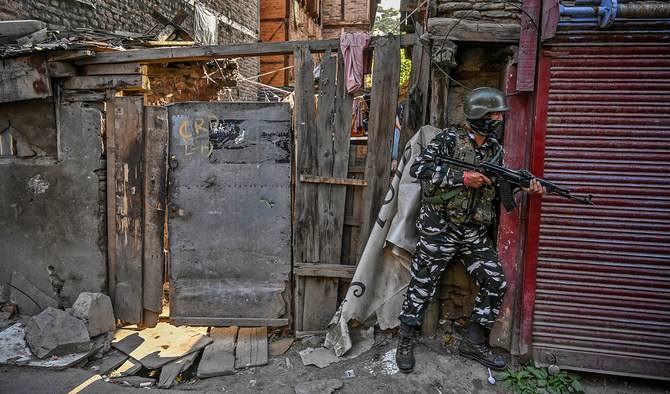
SRINAGAR: India’s National Investigation Agency (NIA) said on Sunday it conducted raids at nearly five dozen places linked to banned religious organization Jamaat-e-Islami (JeI) in Jammu and Kashmir in an alleged terrorism funding case.
The government accuses Jamaat-e-Islami of supporting militancy in Indian-controlled Kashmir, which is at the heart of decades of conflict with Muslim Pakistan.
India’s main counter-terrorism arm said in a statement that members of the organization have collected funds domestically and abroad through donations for the charity and welfare activities, but the funds were instead used for violent and secessionist activities.
“The funds raised by JeI are also being channelled to proscribed terrorist organizations such as Hizb-ul-Mujahideen, Lashkar-e-Taiba and others through well organized networks of JeI cadres,” the agency said.
The agency raided premises of the association’s leadership, its members and also trusts run by JeI.
The NIA also said JeI had motivated impressionable youth in Kashmir and recruited new members in Jammu and Kashmir to participate in disruptive secessionist activities.
JeI was banned by the Indian government after a militant strike in Kashmir more than two years ago, which was claimed by a Pakistan-based militant group and in which 40 Indian troops were killed when a suicide bomber rammed his car into a bus carrying para-military troops.
The JeI could not be reached for comment on Sunday. It has not previously commented on its funding but has said it had not done anything to invite the ban.

India raids banned Jamaat-e-Islami in alleged terror funding case
Short Url
https://arab.news/69qm9
India raids banned Jamaat-e-Islami in alleged terror funding case
- New Delhi accuses Jamaat-e-Islami of supporting militancy in Indian-controlled Kashmir
- India’s main investigative agency raided premises of the association’s leadership, members and trusts run by JeI
Another construction crane collapse in Thailand kills 2 people a day after deadly train derailment
- A construction crane has collapsed onto an elevated road near Bangkok, a day after another construction accident in northeastern Thailand killed 32 people
NAKHON RATCHASIMA, Thailand: A construction crane collapsed onto an elevated road near Bangkok, killing two people on Thursday, a day after another crane fell on a moving passenger train in northeastern Thailand and killed 32 people.
The work on an extension of the Rama 2 Road expressway — a major artery leading from Bangkok — has become notorious for construction accidents, some of them fatal.
The crane collapsed at part of the road project in Samut Sakhon province, trapping two vehicles in the wreckage, according to the government’s Public Relations Department.
Transport Minister Phiphat Ratchakitprakarn said on Thai TV Channel 7 that two people had died. It was unclear if anyone else had been trapped in the wreckage.
There was uncertainty about the number of victims because the site is still considered too dangerous for search teams to enter, said Suchart Tongteng, a rescue worker with the Ruamkatanyu Foundation.
“At this moment, we still can’t say whether another collapse could happen,” he said, citing dangling steel plates. “That’s why there are no rescue personnel inside the scene, only teams conducting on-site safety assessments.”
At the site of Wednesday’s train derailment, the search for survivors ended, Nakhon Ratchasima Gov. Anuphong Suksomnit said. Three passengers listed as missing were presumed to have gotten off the train earlier, but that was still being investigated.
Officials believed 171 people had been aboard the train’s three carriages, which were being removed from the scene Thursday.
The crane that fell, crushing part of the train, was a launching gantry crane, a mobile piece of equipment often used in building elevated roadways.
Police were still collecting evidence and interviewing witnesses and have not pressed charges, provincial Police Chief Narongsak Promta told reporters.
South Korea’s Foreign Ministry reported a South Korean man in his late 30s, was among the dead.
The high-speed rail project where the accident occurred is associated with the plan to connect China with Southeast Asia under Beijing’s Belt and Road Initiative.
In August 2024, a railway tunnel on the planned route, also in Nakhon Ratchasima, collapsed, killing three workers.
Anan Phonimdaeng, acting governor of the State Railway of Thailand, said the project’s contractor is Italian-Thai Development, with a Chinese company responsible for design and construction supervision.
A statement posted on the website of the company, also known as Italthai, expressed condolences to the victims and said the company would pay compensation to the families of the dead and hospitalization expenses for the injured.
Transport Minister Phiphat said Italthai was also the lead contractor on the highway project where Thursday’s accident took place, though several other companies are also involved.
The rail accident had already sparked outrage because Italthai was also the co-lead contractor for the State Audit Building in Bangkok that collapsed during construction last March during a major earthquake centered in Myanmar. The building’s collapse was the worst quake damage in Thailand and about 100 people were killed.
Twenty-three individuals and companies have been indicted, including Italthai’s president and the local director for the company China Railway No. 10, the project’s joint venture partner. The charges in the case include professional negligence and document forgery, and Thailand’s Department of Special Investigation has recommended more indictments.
The involvement of Chinese companies in both projects has also drawn attention, as has Italthai and Chinese companies’ involvement in the construction of several expressway extensions in and around Bangkok where several accidents, some fatal, have occurred.
In Beijing, Chinese Foreign Ministry spokesperson Mao Ning said Wednesday the government was aware of the rail accident and had expressed condolences.
The work on an extension of the Rama 2 Road expressway — a major artery leading from Bangkok — has become notorious for construction accidents, some of them fatal.
The crane collapsed at part of the road project in Samut Sakhon province, trapping two vehicles in the wreckage, according to the government’s Public Relations Department.
Transport Minister Phiphat Ratchakitprakarn said on Thai TV Channel 7 that two people had died. It was unclear if anyone else had been trapped in the wreckage.
There was uncertainty about the number of victims because the site is still considered too dangerous for search teams to enter, said Suchart Tongteng, a rescue worker with the Ruamkatanyu Foundation.
“At this moment, we still can’t say whether another collapse could happen,” he said, citing dangling steel plates. “That’s why there are no rescue personnel inside the scene, only teams conducting on-site safety assessments.”
At the site of Wednesday’s train derailment, the search for survivors ended, Nakhon Ratchasima Gov. Anuphong Suksomnit said. Three passengers listed as missing were presumed to have gotten off the train earlier, but that was still being investigated.
Officials believed 171 people had been aboard the train’s three carriages, which were being removed from the scene Thursday.
The crane that fell, crushing part of the train, was a launching gantry crane, a mobile piece of equipment often used in building elevated roadways.
Police were still collecting evidence and interviewing witnesses and have not pressed charges, provincial Police Chief Narongsak Promta told reporters.
South Korea’s Foreign Ministry reported a South Korean man in his late 30s, was among the dead.
The high-speed rail project where the accident occurred is associated with the plan to connect China with Southeast Asia under Beijing’s Belt and Road Initiative.
In August 2024, a railway tunnel on the planned route, also in Nakhon Ratchasima, collapsed, killing three workers.
Anan Phonimdaeng, acting governor of the State Railway of Thailand, said the project’s contractor is Italian-Thai Development, with a Chinese company responsible for design and construction supervision.
A statement posted on the website of the company, also known as Italthai, expressed condolences to the victims and said the company would pay compensation to the families of the dead and hospitalization expenses for the injured.
Transport Minister Phiphat said Italthai was also the lead contractor on the highway project where Thursday’s accident took place, though several other companies are also involved.
The rail accident had already sparked outrage because Italthai was also the co-lead contractor for the State Audit Building in Bangkok that collapsed during construction last March during a major earthquake centered in Myanmar. The building’s collapse was the worst quake damage in Thailand and about 100 people were killed.
Twenty-three individuals and companies have been indicted, including Italthai’s president and the local director for the company China Railway No. 10, the project’s joint venture partner. The charges in the case include professional negligence and document forgery, and Thailand’s Department of Special Investigation has recommended more indictments.
The involvement of Chinese companies in both projects has also drawn attention, as has Italthai and Chinese companies’ involvement in the construction of several expressway extensions in and around Bangkok where several accidents, some fatal, have occurred.
In Beijing, Chinese Foreign Ministry spokesperson Mao Ning said Wednesday the government was aware of the rail accident and had expressed condolences.
© 2026 SAUDI RESEARCH & PUBLISHING COMPANY, All Rights Reserved And subject to Terms of Use Agreement.


