India raids banned Jamaat-e-Islami in alleged terror funding case

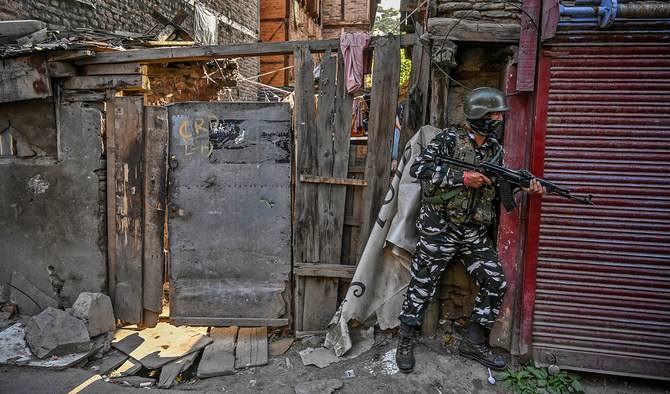
An Indian paramilitary trooper takes position to secure the area in Barbarshah area of Srinagar on June 26, 2021. (AFP/File)
Short Url
Updated 09 August 2021
Follow

India raids banned Jamaat-e-Islami in alleged terror funding case

  • New Delhi accuses Jamaat-e-Islami of supporting militancy in Indian-controlled Kashmir
  • India’s main investigative agency raided premises of the association’s leadership, members and trusts run by JeI

SRINAGAR: India’s National Investigation Agency (NIA) said on Sunday it conducted raids at nearly five dozen places linked to banned religious organization Jamaat-e-Islami (JeI) in Jammu and Kashmir in an alleged terrorism funding case.
The government accuses Jamaat-e-Islami of supporting militancy in Indian-controlled Kashmir, which is at the heart of decades of conflict with Muslim Pakistan.
India’s main counter-terrorism arm said in a statement that members of the organization have collected funds domestically and abroad through donations for the charity and welfare activities, but the funds were instead used for violent and secessionist activities.
“The funds raised by JeI are also being channelled to proscribed terrorist organizations such as Hizb-ul-Mujahideen, Lashkar-e-Taiba and others through well organized networks of JeI cadres,” the agency said.
The agency raided premises of the association’s leadership, its members and also trusts run by JeI.
The NIA also said JeI had motivated impressionable youth in Kashmir and recruited new members in Jammu and Kashmir to participate in disruptive secessionist activities.
JeI was banned by the Indian government after a militant strike in Kashmir more than two years ago, which was claimed by a Pakistan-based militant group and in which 40 Indian troops were killed when a suicide bomber rammed his car into a bus carrying para-military troops.
The JeI could not be reached for comment on Sunday. It has not previously commented on its funding but has said it had not done anything to invite the ban.


UK Police arrest 86 people at prison protest for Palestine Action hunger striker

Updated 25 January 2026
Follow

UK Police arrest 86 people at prison protest for Palestine Action hunger striker

  • Demonstration outside Wormwood Scrubs held in support of Umer Khalid
  • Khalid 1 of 5 people charged in connection with break-in at RAF base last year

LONDON: A protest outside a prison in the UK in support of a man detained for supporting the banned group Palestine Action has led to the arrest of 86 people.

London’s Metropolitan Police said a group of demonstrators breached the grounds of Wormwood Scrubs prison in the capital, refused to leave when ordered to do so, and threatened officers. They were arrested on suspicion of aggravated trespass.

The group, several of whom attempted to gain access to the prison itself, were protesting in support of Umer Khalid, who is currently on hunger strike at the facility.

Khalid is one of five people charged in relation to a break-in by Palestine Action members at an RAF base at Brize Norton last year, in which two military aircraft were damaged.

Khalid, who denies the charges, is one of several people who are on or who have taken part in hunger strikes in recent months, all of whom have been held on similar charges for over a year without their cases being brought to trial.

A spokesperson for the UK’s Ministry of Justice said: “The escalation of the protest at HMP Wormwood Scrubs is completely unacceptable. While we support the right to peacefully protest, reports of trespassing and threats being made to staff and police officers are deeply concerning.

“At no point was prison security compromised. However, where individuals’ actions cause risk or actual harm to hardworking staff, this will not be taken lightly and those responsible can expect to face consequences.

“Prisoners are being managed in line with longstanding policy. This includes regular checks by medical professionals, heart monitoring and blood tests, and support to help them eat and drink again. If deemed appropriate by healthcare teams, prisoners will be taken to hospital.”