

US asks citizens to leave ‘immediately’ as Taliban make rapid advances in Afghanistan

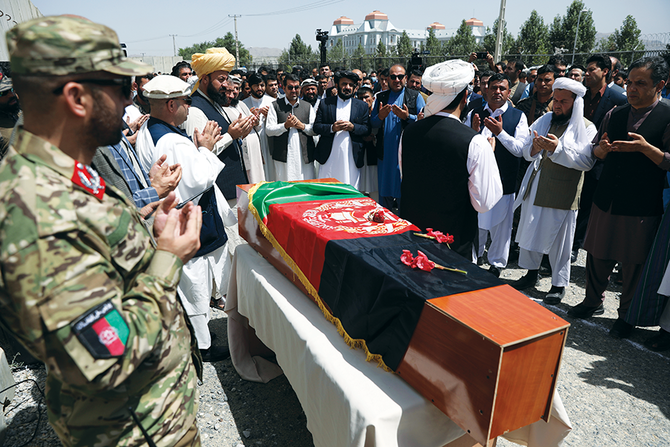
Afghans pray behind the body of Dawa Khan Menapal, director of the Information Media Center. The Taliban killed the top official in Kabul on Friday. (AP)
Short Url
Updated 08 August 2021
Follow

US asks citizens to leave ‘immediately’ as Taliban make rapid advances in Afghanistan

  • Follows a similar warning by Britain citing the ‘worsening security situation’

KABUL: The US on Saturday ordered its nationals to leave Afghanistan “immediately” as the Taliban widened control over several areas, taking over two towns from Afghan government forces.

“The US Embassy urges US citizens to leave Afghanistan immediately using available commercial flight options,” the US mission in Kabul said in a statement.

“Given the security conditions and reduced staffing, the embassy’s ability to assist US citizens in Afghanistan is extremely limited even within Kabul,” it added.

It follows a similar warning by Britain on Friday asking its nationals to “confirm their departure plans as soon as possible,” citing the “worsening security situation” in Afghanistan.

The Taliban have overrun dozens of districts, and border crossings with Pakistan, Iran and Central Asia, since the drawdown of US-led troops from Afghanistan began on May 1 to end nearly 20 years of occupation.

The group’s advances have sparked concerns it will regain power by force similar to its move in the 1990s, amid fears that the war-scarred nation could descend into another civil war when foreign troops complete their exit by month-end.

The development comes less than a day after UN special envoy for Afghanistan, Deborah Lyons, said that the war in Afghanistan had entered a “new, deadlier and more destructive phase” with more than 1,000 civilians killed in the past month during a Taliban offensive.

“This is now a different kind of war reminiscent of Syria, recently, or Sarajevo, in the not-so-distant past,” she said during a special meeting of the UN Security Council on Afghanistan in New York.

Major powers such as the US and Britain refused to “support the restoration of the Islamic Emirate” of the Taliban during the meeting.

FASTFACT

The fall of Zaranj would allow the Taliban to take control of another key trade border crossing with Iran and ‘earn tens of thousands of dollars in customs and revenue routinely.’

Since Friday, the group has overrun two provincial capitals and assassinated a top government spokesman in Kabul, intensifying its campaign to defeat the US-backed Kabul government since April, amid a breach left by departing foreign forces.

Taliban spokesman, Zabihullah Mujahid, took to social media on Friday, proclaiming victory over government forces in Afghanistan’s southwestern Nimruz province with the fall of its capital, Zaranj.

“The governor house, police HQ, intelligence HQ & all related buildings were cleared of stooge enemy presence,” Mujahid said in a Twitter post.

Zaranj became the first big town to fall to the Taliban since Washington reached a deal with the group in February 2020 for the pullout of troops, while Shiberghan city in Jawzjan became the second Afghan provincial capital to fall to the insurgents in less than 24 hours.

Shiberghan, which acts as a gateway to northern Afghanistan, is far from the Taliban’s traditional bastion of power in the south and southeastern regions.

Local security sources, requesting anonymity as they are not authorized to speak to the media, told Arab News that while Zaranj “fell to the Taliban without any resistance by government forces who fled to Iran,” Afghan forces and militia troops “put up some resistance in Shiberghan but could not prevent the Taliban’s advances.”

While the Taliban has consolidated its gains near the city of western Herat, Kandahar and Lashkar Gah in the south since last week, the fall of Zaranj and Shiberghan represents a massive blow to the government’s diminishing authority. The Taliban has reportedly freed hundreds of prisoners, including comrades, from prisons in both provincial capitals.

The fall of Zaranj would allow the Taliban to take control of another key trade border crossing with Iran and “earn tens of thousands of dollars in customs and revenue routinely.”

Government infighting, poor war management, corruption and Afghan leaders’ failure to supply troops with arms and essential supplies are being cited as reasons for the Taliban’s battlefield victories.

To avert the group’s advances and infiltration into large cities, President Ashraf Ghani announced a nighttime curfew in 31 of Afghanistan’s 34 provinces and offered to provide weapons and cash to local militia forces in the war against the Taliban.

Washington has also stepped up its air strikes to support local forces struggling hard to prevent the Taliban’s conquests, but it remains unclear if the US would continue to back Kabul once all foreign troops exit the country.

Experts say that the US and Britain’s measures to safeguard their citizens was a harbinger of “tough times ahead.”

“The order by the British and American embassies for the exit of their nationals from here is indicative that there will be some tough times ahead,” Taj Mohammad, a Kabul based analyst, told Arab News.

“They perhaps have taken this decision after realizing that the government is not capable of stopping the Taliban’s advances in major cities, and it is time that their nationals withdraw now ahead of the full exit of troops when things could possibly become worse and bloodier,” he added.


ASEAN’s top diplomats under pressure to end Myanmar war and manage South China Sea disputes

Updated 6 sec ago
Follow

ASEAN’s top diplomats under pressure to end Myanmar war and manage South China Sea disputes

  • ASEAN does not recognize the country’s military government, and its leaders are barred from attending the regional bloc’s meetings
  • ASEAN foreign ministers under pressure to conclude negotiations with China ahead of a self-imposed deadline this year on a so-called ‘code of conduct’
CEBU, Philippines: Southeast Asia’s top diplomats met Wednesday under growing pressure to push a peace plan that has so far failed to end Myanmar’s civil war, to beat a deadline to conclude talks on a nonaggression pact with China this year.
The Association of Southeast Asian Nations, a diverse 11-national bloc, has struggled to project unity and relevance for years. But it faced its latest setback last year when deadly fighting erupted between two members, Thailand and Cambodia, over a longtime border conflict.
Fighting ended with a ceasefire that was brokered by Malaysia and pushed through by pressure from US President Donald Trump, who threatened to withhold trade privileges unless they agreed. Helping sustain that fragile ceasefire is high on the agenda of the ASEAN’s foreign ministers’ annual meeting in the central Philippine city of Cebu.
The Philippines holds ASEAN’s rotating chair this year, taking what would have been Myanmar’s turn after the country was suspended from chairing the meeting after its army forcibly ousted Aung San Suu Kyi’s democratically elected government in 2021.
ASEAN is struggling to promote peace in Myanmar’s civil war
ASEAN does not recognize the country’s military government, and its leaders are barred from attending the regional bloc’s meetings, although lower-level career diplomats have been allowed to participate.
The resulting war has killed tens of thousands of people and displaced millions in a crisis that has emerged as one of ASEAN’ biggest challenges and source of embarrassment as Western governments demanded the bloc to do more.
Last week, Malaysian Foreign Minister Mohamad Hasan said that ASEAN leaders decided in their annual summit in October not to send observers to Myanmar’s recent elections because conditions for credible polls were not met, though some member countries, like Cambodia and Vietnam, chose to do so individually.
ASEAN leaders proposed a five-point peace plan in 2021, which demanded, among others, an immediate end to fighting and hostilities, but it has failed to end the violence or foster dialogue among contending parties.
Discussion on the peace plan was a top priority in the ministerial meetings in Cebu, according to the agenda, which was seen by the Associated Press.
Philippine Foreign Secretary Theresa Lazaro, who has been designated as the ASEAN’s special envoy to Myanmar, would report to her counterparts in Cebu the result of her recent visit to Myanmar, where she met the ruling generals among other officials. She would also discuss the result of a conference of various political and ethnic groups opposed to Myanmar’s military government that she recently organized in the Philippines in a bid to reach out to all contending sides.
Participants in the Philippine conference discussed enforcement of the peace plan, “including how to advance de-escalation, facilitate humanitarian assistance, effectively address transnational crime and foster political dialogue among relevant stakeholders,” the Department of Foreign Affairs in Manila said.
Deadline for South China Sea code of conduct looms
ASEAN foreign ministers were also under pressure to conclude negotiations with China ahead of a self-imposed deadline this year on a so-called “code of conduct” to manage disputes over long-unresolved territorial rifts in the South China Sea, where China makes expansive claims that overlap with those of four ASEAN members.
They hope to prevent the disputes, long regarded as a potential flashpoint, from degenerating into a major conflict that could drag in US forces.
Washington has no claims in the disputed waters but has warned China that it’s obligated to defend the Philippines, a longtime treaty ally, if Filipino forces come under an armed attack in the offshore region.
Negotiations on the proposed code of conduct have dragged on for more than two decades without any major breakthrough in the most contentious issues, including whether such an accord should be made legally binding. But the bloc resolved to conclude the negotiations by the end of 2026 at a meeting in
Analysts say concluding the talks will be an uphill climb.
“Even with a strong political will, concluding it will remain challenging,” said Australia-based analyst Lupita Wijaya, who has done extensive research on the South China Sea.
“The central roadblock is not the pace of negotiations, but more on fundamental differences between ASEAN claimant states and China over interpretations of international law or whether the COC should be legally binding,” she said.