

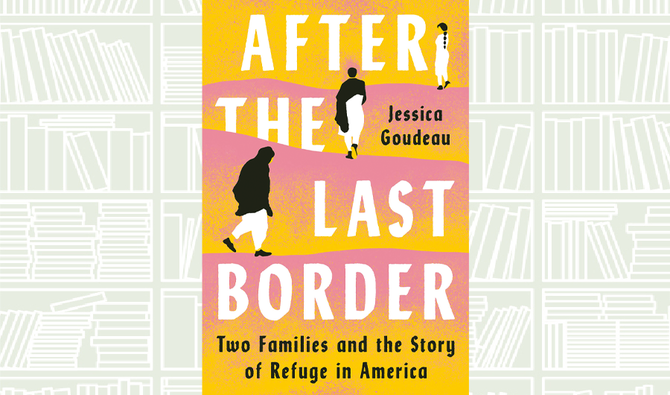
What We Are Reading Today: After the Last Border by Jessica Goudreau

Short Url
Updated 08 August 2021
Follow

What We Are Reading Today: After the Last Border by Jessica Goudreau

After the Last Border — written by Jessica Goudreau — is an intimate look at the lives of two women as they struggle for the 21st century American dream, having won the “golden ticket” to settle as refugees in Austin, Texas.

The book casts a light on the history of the refugee relocation process, and how it has changed throughout the 20th and 21st centuries.

The writer “tracks the human impacts of America’s evershifting refugee policy as both women narrowly escape from their home countries and begin the arduous but lifesaving process of resettling in Austin — a city that would show them the best and worst of what America has to offer,” said a review in goodreads.com.

“These women are so empowering. Their stories can give others a lot of inspiration,” it added.

After the Last Border “offers a crash course in how shifts in public attitudes and, in turn, US policy have helped and hindered people desperate to escape the poverty or violence in their homelands,” Mimi Swartz said in a review for The New York Times.


What We Are Reading Today: The Political Economy of Security by Stephen G. Brooks

Updated 04 March 2026
Follow

What We Are Reading Today: The Political Economy of Security by Stephen G. Brooks

In this book, Stephen Brooks provides a systematic empirical and theoretical examination of how economic factors influence security affairs. Empirically, he analyzes how economic variables of all kinds affect interstate war, terrorism, and civil war; in total, 16 pathways are examined.

Brooks shows that the relationship between economic factors and conflict is complex and multifaceted; discrete economic factors—such as international trade, economic development, and globalized manufacturing, to name a few—are sometimes helpful for promoting peace and stability, but at other times are detrimental.

Brooks also develops a stronger theoretical foundation for guiding future research on the economics-security interaction. 

Drawing on Adam Smith, he provides a more complete range of answers to the three key conceptual questions analysts must consider: how economic goals relate to security goals; what economic factors to focus on; and how economic actors influence security policies.

Combining an innovative theoretical understanding with empirical rigor, Brooks’s account will reshape our understanding of the political economy of security.