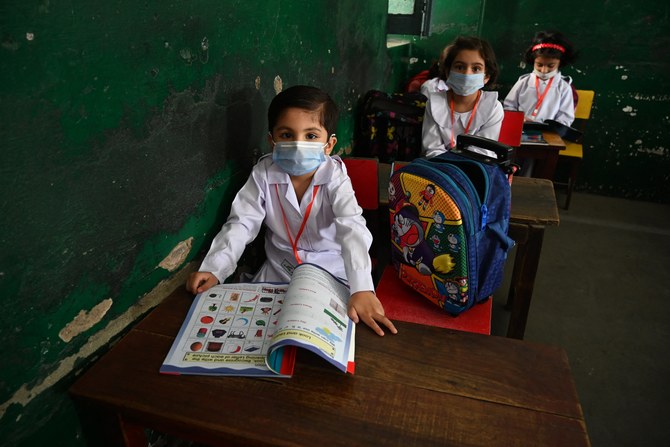

ISLAMABAD: As Pakistan began rolling out its single national curriculum (SNC) in Punjab province this week, educationists and critics of the policy have questioned whether it would boost learning practices and outcomes and raised concerns about an increase in religious education at mainstream schools.
The SNC rollout in Punjab started on Monday, paving the way for what officials say will be a “uniform” system of education in the country.
Since coming into power in 2018, Prime Minister Imran Khan has said he would recast the education system to ensure that private and public schools and religious seminaries followed a uniform curriculum. The aim, as the education ministry has argued, was a system under which “all children have a fair and equal opportunity to receive high quality education.”
But critics of the curriculum say the policy change is “more ideological than educational,” and have raised concerns that the same curriculum for schools and madrassas would necessitate an increase in the component of religion taught in mainstream schools.
Public policy expert Peter Jacob said religious content had been included in almost all new books that were part of the SNC, which was a violation of the rights of religious minorities under the constitution.
“Some subjects like Social Studies carry around 40 percent in part or whole Islamic content in different units and lessons,” Jacob told Arab News. “We have conveyed all this to the federal education ministry and hope to get it reversed.”
Jacob says he has identified religious content in all SNC books including subjects like mathematics, English, Urdu and General Knowledge: “In most instances such content is not directly linked with the students’ learning outcomes.”
On March 20, 2021, 140 human rights activists, parents and educationalists signed an open letter to PM Khan, saying choosing the kind of education parents wanted for their children was a “fundamental human right.”
Pervez Hoodbhoy, a renowned physicist and vocal critic of the SNC, told Arab News children needed to be taught to question and debate, rather than receive an education that was overbearingly “ideological” in nature.
“We need an open society that encourages critical debate on diverse subjects and issues,” he said. “We are seeing a moral decay in our society, and this can only be fixed if we allow our children to question things.”
While many education experts also fear the new curriculum will perpetuate rote learning and crush creativity, officials say promoting creative thinking was in fact one of the main goals of the SNC.
“One of the main objectives of the single national curriculum is to discourage rote learning and promote creative thinking,” Mohyuddin Ahmad Wani, additional secretary at the ministry of education, told Arab News. “This has been done by adding a number of activities to it to ensure project-based learning.”
Wani said the federal government had played its constitutional role by developing the curriculum in consultation with all provinces, saying it would improve learning processes and outcomes.
“All federating units, except Sindh, have endorsed the curriculum and agreed to adopt it,” Wahi added.
Sindh Education Minister Saeed Ghani did not respond to calls and text messages for a comment.
In Punjab, where the curriculum has initially been rolled out, it will apply to a total of 10.25 million children in 52,000 public and 103,800 private schools in the province.
Wani said the curriculum had been developed in three phases: The syllabus for Grade I to V had been rolled out so far in Punjab, while Grades VI to VIII would get their syllabus from the academic year 2022-23 and the curriculum for Grade IX and XII would be unveiled in 2023-24. The government aims that all provinces in the country will begin adopting the new syllabus gradually.
“This will ensure that all children get a fair and equal opportunity to receive high quality education since it will alleviate disparities in education content across multiple streams and provide equal opportunity for upward social mobility to everyone,” he added.
Kashif Mirza, president of All Pakistan Private Schools’ Federation, said the government had implemented the curriculum in Punjab in haste without recruiting new teachers and improving overall education infrastructure in the province.
“This curriculum is neither single, nor national, unfortunately,” he told Arab News. “The government has made the Qur’an a compulsory subject in all schools from this academic year, but the fact is neither the public nor private schools have hired teachers for it so far. The government’s only focus is to get political mileage by telling people they have fulfilled their election promise.”
Education consultant Taimur Bandey agreed, saying that while the idea and effort behind the new curriculum was welcome, the government needed to focus on existing problems such as out of school children and the quality of public schools in terms of facilities, resources and teachers to improve their overall quality.
Access to education is also a problem in Pakistan — 22.8 million of Pakistan’s over 70 million children are out of school, according to UNICEF. Experts say a big part of the problem is the quality of teaching at Pakistani schools, rather than the curriculum or a dearth of finances.
“The government just seems to be in a haste to implement the curriculum,” he said, “without paying heed to other much relevant aspects of children’s education.”