QUETTA: The Taliban on Friday closed a key border crossing with Pakistan while seeking visa-free travel for fellow Afghan nationals to the neighboring country, officials confirmed while talking to Arab News.
The insurgent group captured the strategic border town of Spin Boldak in southern Kandahar province on July 14 after clashes with Afghan border forces, prompting Pakistani authorities to temporarily suspend all trade and travel between the two countries through the Pak-Afghan Friendship Gate.
However, there was a resumption of border activities toward the end of July after the business community in both countries complained they were facing huge losses after dozens of trucks carrying Afghan transit trade goods from Pakistani port cities of Karachi and Gwadar got stuck in the country’s Chaman border town.
“Afghan citizens with Afghan refugee cards or Afghan national identity cards should be allowed to cross into Afghanistan without any restriction,” Haji Wafa, the Taliban shadow governor for Kandahar, said in a statement.
“The crossing will remain closed for pedestrians and transit trade until Pakistani border officials allow border movement from morning to evening and restore trade at the same level where it was before the Taliban took control of the Spin Boldak border crossing,” he added.
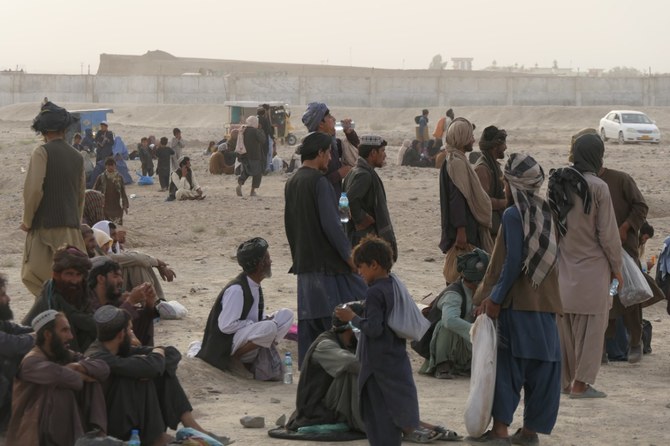
A Pakistani paramilitary official Ajab Khan told Arab News on Friday the abrupt closure of the Pak-Afghan border had left a large number of people stranded on both sides of the frontier.
He added the Taliban had blocked the border crossing by placing huge concrete blocks on their side.
“Dozens of people who want to travel to Afghanistan are now stranded in [Pakistani border town of] Chaman due to the Taliban decision,” he said.
The Afghan insurgent faction launched a major military offensive across the country, mounting a serious challenge to the administration in Kabul by capturing several towns and key districts, after the United States announced a complete withdrawal of its forces earlier this year.
According to a Reuters report, the group captured the capital of Nimroz province on Friday where it seized the governor's office, police headquarters and an encampment near the Iranian border.
“The cross-border movements, including the Pak-Afghan transit trade, was resumed by Pakistan in the last week of July after the Taliban took over the Afghan side of the frontier, but the insurgent faction recently voiced its reservations over the border crossing procedures before refusing to allow any movement,” a local official in Chaman, who requested anonymity, confirmed while talking to Arab News.
President Chaman Chamber of Commerce Haji Jalat Khan Achakzai said the border closure had once again created significant problems for the business community in the two countries since trucks loaded with goods were piling up on both sides of the border.
“We have spoken with the business community in Afghanistan, and they are trying to convince the Taliban to reconsider the decision since fruit consignments from Pakistan, particularly grapes, are likely to perish on their way to Afghan markets,” he told Arab News over the phone.


![]()

Taliban close Spin Boldak border crossing with Pakistan, seek visa-free travel for Afghans
Short Url
https://arab.news/gbcb6
Taliban close Spin Boldak border crossing with Pakistan, seek visa-free travel for Afghans
- A Pakistani business leader says Afghan traders are trying to convince the insurgent faction to reconsider its decision
- The Taliban captured the strategic border town of Spin Boldak in southern Kandahar province on July 14 after clashes with Afghan border forces
Latest updates


© 2026 SAUDI RESEARCH & PUBLISHING COMPANY, All Rights Reserved And subject to Terms of Use Agreement.