

UN says Afghan war has entered ‘deadlier, more destructive phase’

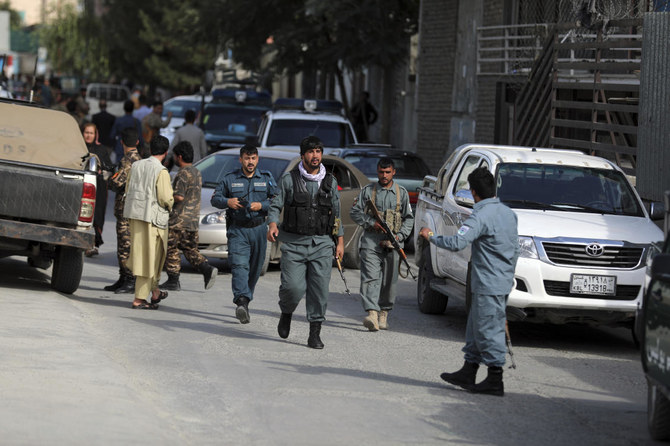
Afghan security personnel arrive at the area where the director of Afghanistan's Government Information Media Center Dawa Khan Menapal was shot dead in Kabul, Afghanistan, Friday, Aug. 6, 2021. (AP)
Short Url
Updated 07 August 2021
Follow

UN says Afghan war has entered ‘deadlier, more destructive phase’

  • The Taliban have stepped up their campaign to defeat the US-backed government since April as foreign forces complete their withdrawal after 20 years of war
  • The Taliban assassinated the government’s top media officer in Kabul on Friday

UNITED NATIONS: The UN special envoy for Afghanistan on Friday questioned the Taliban’s commitment to a political settlement, telling the UN Security Council the war has entered a “deadlier and more destructive phase” with more than 1,000 civilians killed in the past month during a Taliban offensive.
“A party that was genuinely committed to a negotiated settlement would not risk so many civilian casualties, because it would understand that the process of reconciliation will be more challenging, the more blood is shed,” Deborah Lyons said.
The Taliban have stepped up their campaign to defeat the US-backed government since April as foreign forces complete their withdrawal after 20 years of war. The Taliban captured an Afghan provincial capital and assassinated the government’s top media officer in Kabul on Friday.
“This is now a different kind of war, reminiscent of Syria, recently, or Sarajevo, in the not-so-distant past,” Lyons said.
“To attack urban areas is to knowingly inflict enormous harm and cause massive civilian casualties. Nonetheless, the threatening of large urban areas appears to be a strategic decision by the Taliban, who have accepted the likely carnage that will ensue,” she said.
Peace talks between the Afghan government and Taliban negotiators started last year in the Qatari capital of Doha, but have not made any substantive progress.

Opinion

This section contains relevant reference points, placed in (Opinion field)

Russia’s UN Ambassador Vassily Nebenzia told the council that the deteriorating situation in Afghanistan was of increasing concern and “with the withdrawal of foreign forces, the outlook looks grim.
“It is clear that there is no military solution to the Afghan situation, but in the current situation — given the absence of progress on the negotiation track — the prospects of Afghanistan slipping into full scale and protracted civil war, unfortunately, is a stark reality,” he said.
Senior US diplomat Jeffrey DeLaurentis urged the Taliban to halt their offensive, pursue a political settlement and protect Afghanistan’s infrastructure and people.
“The Taliban must hear from the international community that we will not accept a military takeover of Afghanistan or a return of the Taliban’s Islamic Emirate,” he said.
Afghanistan’s UN Ambassador Ghulam Isaczai urged the Security Council to act to “prevent a catastrophic situation.”
“We’re alarmed by reports and incidents of gross human rights violation by the Taliban and their foreign terrorist associates in almost half of our country and we are extremely concerned about the safety and security of people in cities under Taliban attacks,” he said.


In Bangladesh’s mangrove forest, villagers brave tigers to collect rare honey

Updated 4 sec ago
Follow

In Bangladesh’s mangrove forest, villagers brave tigers to collect rare honey

  • Honey is gathered from wild bee colonies deep in the Sundarbans
  • Producers made a debut at the biggest food fair in Jeddah this month


Dhaka

When the harvest begins, Mizanur Rahman gathers a few hundred men and sets out into the mangrove forest along the Bay of Bengal, where for months they climb trees to collect by hand a wild natural honey whose unique properties are only starting to attract global attention.

The honey is collected from wild bee colonies deep within the Sundarbans, the world’s largest mangrove reserve spanning parts of India and southwestern Bangladesh.

“Honey collection from this forest is mostly done in the Bangladesh part,” Rahman said. “All plants, trees, and the overall environment of this forest are natural. There is no human touch.”

Sundarban honey comes from an ecosystem where trees grow and bloom naturally, without the use of fertilizers or pesticides. Its collectors, known as mawalis, begin work in March for about three and a half months.

Rahman estimates there are about 4,000 mawalis in the local community. To enter the forest, they require special passes from the forest department.

“It’s a very risky job for the people who enter the forest,” he told Arab News. “It’s the only honey in the world where collectors risk their lives in the den of the mighty Bengal tiger to gather it. Sometimes, they also face the danger of poisonous snake bites.”

During the season, his team reaches up to 1,200 members who together manage to collect about 400 tons of honey.

“One hundred small boats start sailing together, each carrying eight to 10 people,” Rahman said. “Despite the dangers, it is a matter of pride to be part of these challenging tasks.”

Collected from a humid environment, Sundarban honey is thinner than other types. Its greenish-amber shade comes from the nectar of mangrove flowers, and the taste is less sweet than most commercial honeys, with a subtle citrus-like tanginess. The scent is mild.

Being raw and unprocessed, the honey retains more enzymes, antioxidants, and pollen.

“Some people can feel acidity similar to orange juice,” Rahman said. “It has a unique taste. If someone tastes this honey once, she or he will definitely love to taste it again and again.”

Well known locally in Bangladesh and parts of eastern India, where it has been harvested and consumed for generations, Sundarban honey is only starting to gain attention in organic and specialty food markets.

Earlier this month, it debuted at AgroFood Jeddah, Saudi Arabia’s leading international exhibition for the agriculture, food, and agritech industries.

The organic honey from the Sundarbans received an encouraging reception, according to Mohammed Saleh Uddin Bhuyan, chief category officer at Ghorer Bazar, one of the companies participating in the expo.

“We have been receiving good responses from the local buyers,” he said. “Saudi Arabia is a very promising market for us.”

Bangladeshi authorities recognize the honey’s export potential but also the fact that production still needs to be standardized to enter global markets.

Mahmudul Hasan, director of Bangladesh’s Export Promotion Bureau, told Arab News that there are plans to promote the organic practices behind the honey during future food fairs in the Gulf region.

“There is huge export potential for our mangrove honey in the Gulf countries, as Arab consumers are fond of honey. They just need to be assured of the quality in the production process,” he said.

“Our mangrove honey is undoubtedly an organic product. It has unique value, but the world is not very aware of it yet.”