

Taliban shoot dead Afghan government spokesman

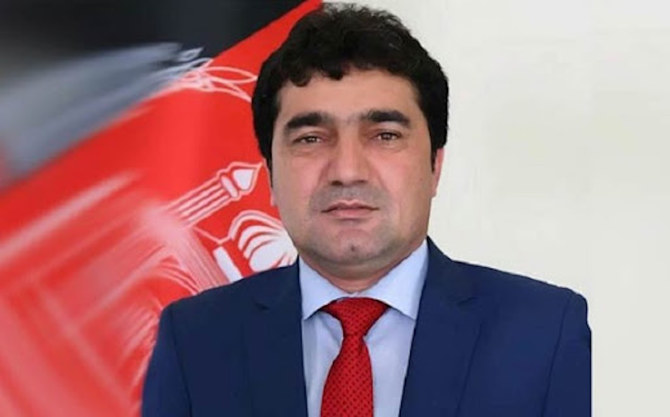
Dawa Khan Menapal, Director of Government Media & Information Centre, was assassinated this afternoon in Kabul city. (File/Internet)
Short Url
Updated 07 August 2021
Follow

Taliban shoot dead Afghan government spokesman

  • Officials say Menapal was killed at a mosque

KABUL: KABUL: A senior spokesman from the Afghanistan government was assassinated in Kabul on Friday, officials confirmed, while the Taliban claimed responsibility for the killing.

Dawa Khan Menapal was a spokesman for president Ashraf Ghani before he took over the country’s government information media center in April.

Officials say Menapal was killed at a mosque.

“The terrorists, enemies of Afghanistan, once again resorted to a cowardice act and killed Menapal during Friday prayers," Mirwais Stanekzai, a spokesman for the Afghanistan Ministry of Interior Affairs, told Arab News.

The killing on Friday came days after the Taliban had warned they would target administration officials. On Wednesday, eight civilians were killed in Kabul when the Taliban bombed the residence of Defense Minister Gen. Bismillah Mohammadi. The minister survived the attack.

Other attacks have been on the rise across Afghanistan since US-led troops began their withdrawal in May. As a result of the withdrawl, the Taliban have overrun scores of districts and several border crossings while the group has laid siege on key cities.

While Afghan officials declined to comment on the Taliban’s latest advances, reports on Friday said the militants had captured large swathes of Sheberghan, the capital of the northern Jowzan Province, and seized Zaranj, the provincial capital of Nimroz in the southwestern part of the country.

Opinion

This section contains relevant reference points, placed in (Opinion field)

The government estimates that tens of thousands of civilians have been forced to flee their homes across the country. The escalation of violence casts doubts over the future of US-sponsored, intra-Afghan peace talks that began nearly a year ago to reach a power-sharing agreement in the war-battered country as US-led foreign troops withdraw.

Hours before Menapal’s assassination, Ross Wilson, charge d'affaires of the US Embassy in Kabul, wrote on social media that the Taliban had no interest in peace.

“The Taliban’s violence and hate have never been sustainable forms of governance,” Wilson posted on Twitter. “The group’s previous beheadings as well as current offensives and targeted killings show that they only know violence and are scared of peace.”

The US will end its combat mission in Afghanistan by Aug. 31, nearly 20 years after it had invaded the country and toppled the Taliban for protecting former Al-Qaeda chief Osama bin Laden, the mastermind of the Sept. 11, 2001 attacks on America.


UK pays Guantanamo detainee ‘substantial’ compensation over US torture questions

Updated 5 sec ago
Follow

UK pays Guantanamo detainee ‘substantial’ compensation over US torture questions

  • Abu Zubaydah has been held at Guantanamo Bay without charge for 20 years
  • British security services knew he was subjected to ‘enhanced interrogation’ but failed to raise concerns for 4 years

LONDON: A Saudi-born Palestinian being held without trial by the US has received a “substantial” compensation payment from the UK government, the BBC reported.

Abu Zubaydah has been imprisoned at Guantanamo Bay in Cuba for almost 20 years following his capture in Pakistan in 2002, and was subjected to “enhanced interrogation” techniques by the CIA.

He was accused of being a senior member of Al-Qaeda in the aftermath of the Sept. 11 terror attacks on the US. The allegations were later dropped but he remains in detention.

The compensation follows revelations that UK security services submitted questions to the US to be put to Abu Zubaydah by their US counterparts despite knowledge of his mistreatment.

He alleged that MI5 and MI6 had been “complicit” in torture, leading to a legal case and the subsequent compensation.

Dominic Grieve, the UK’s former attorney general, chaired a panel reviewing Abu Zubaydah’s case.

He described the compensation as “very unusual” but said the treatment of Abu Zubaydah had been “plainly” wrong, the BBC reported.

Grieve added that the security services had evidence that the “Americans were behaving in a way that should have given us cause for real concern,” and that “we (UK authorities) should have raised it with the US and, if necessary, closed down co-operation, but we failed to do that for a considerable period of time.”

Abu Zubaydah’s international legal counsel, Prof. Helen Duffy, said: “The compensation is important, it’s significant, but it’s insufficient.”

She added that more needs to be done to secure his release, stating: “These violations of his rights are not historic, they are ongoing.”

Duffy said Abu Zubaydah would continue to fight for his freedom, adding: “I am hopeful that the payment of the substantial sums will enable him to do that and to support himself when he’s in the outside world.”

He is one of 15 people still being held at Guantanamo, many without charge. Following his initial detention, he arrived at the prison camp having been the first person to be taken to a so-called CIA “black site.”

He spent time at six such locations, including in Lithuania and Poland, outside of US legal jurisdiction. 

Internal MI6 messages revealed that the “enhanced interrogation” techniques he was subjected to would have “broken” the resolve of an estimated 98 percent of US special forces members had they been subjected to them.

CIA officers later decided he would be permanently cut off from the outside world, with then-President George W. Bush publicly saying Abu Zubaydah had been “plotting and planning murder.”

However, the US has since withdrawn the allegations and no longer says he was a member of Al-Qaeda.

A report by the US Senate Select Committee on Intelligence said Abu Zubaydah had been waterboarded at least 83 times, was locked in a coffin-like box for extended periods, and had been regularly assaulted. Much of his treatment would be considered torture under UK law.

Despite knowledge of his treatment, it was four years before British security services raised concerns with their American counterparts, and their submission of questions within that period had “created a market” for the torture of detainees, Duffy said.

A 2018 report by the UK Parliament’s Intelligence and Security Committee was deeply critical of the behavior of MI5 and MI6 in relation to Abu Zubaydah. 

It also criticized conduct relating to Guantanamo detainee Khalid Sheikh Mohammed, widely regarded as a key architect of the Sept. 11 attacks, warning that the precedent set by Abu Zubaydah’s legal action could be used by Mohammed to bring a separate case against the UK.

MI5 and MI6 failed to comment on Abu Zubaydah’s case. Neither the UK government nor Mohammed’s legal team would comment on a possible case over his treatment.