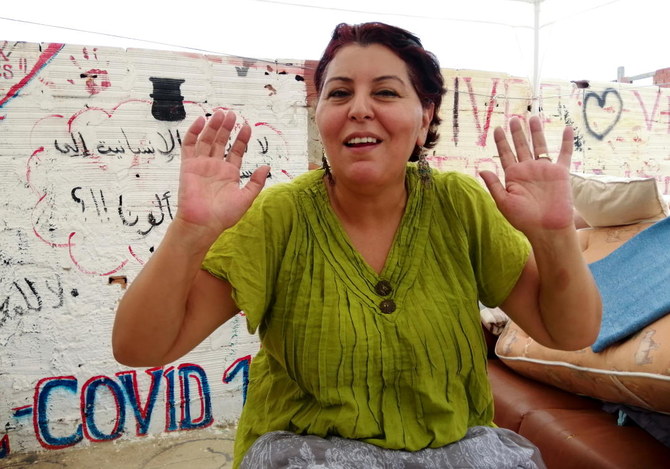
TUNIS: Sitting on her rooftop in Tunis, political activist Fatma Jgham said she and her comrades backed the Tunisian president’s seizure of governing powers but would maintain pressure on him if their demands were not met.
“We must hold a referendum on the constitution, and the demands of the people must not be turned around...not by you (the president) or anyone else,” said Jgham, a 48-year old art teacher.
She was one of the people who organized the wave of protests across Tunisian cities on July 25 that were cited by President Kais Saied later that day as he dismissed the prime minister and froze parliament. His opponents have called the moves a coup.
Saied’s actions have proved mostly popular, with thousands of people crowding the streets immediately afterwards to celebrate, but he has not given any details of how he plans to handle the crisis or Tunisia’s future.
The demonstrations represented a wave of anger that had built over years of economic stagnation and politically dysfunction, sharpened by a COVID-19 surge.
Though the protests were not very big, with hundreds rather than thousands of people braving the sweltering weather in each of the handful of cities where they took place, they also involved several attacks on offices of a major political party.
The moderate Islamist Ennahda, the most consistently successful party since the 2011 revolution that introduced democracy, has played a role in successive coalition governments and is blamed by many Tunisians for their economic problems.
“The demands were the overthrow of the entire failed system of government, especially the parliament, led by the gangs of the Ennahda Party and its coalitions,” Jgham said.
Some Ennahda officials have questioned whether the attacks on their offices were planned by Saied supporters as a pretext for his sudden intervention.
Jgham denies this. “People were angry and marginalized. It wasn’t planned but it was spontaneous,” she said.
The protests that day had not been backed by political parties but were organized by activists like Jgham on social media, she said.
Female activists, like Jgham, have played a prominent role throughout, reflecting Tunisia’s reputation as a leading center of women’s rights in Arab states.
Another activist, Emna Sahli, says that the role of women in protests has fundamentally changed. They are no longer led by men, she said.
“Today those who bear ideas are females and this is really great,” said the 35-year-old, who also took part in the July 25 protests.


![]()

Tunisian activists say they will keep up pressure on president
Short Url
https://arab.news/nwts8
Tunisian activists say they will keep up pressure on president
- “The demands of the people must not be turned around… not by you (the president),” said political activist Fatma Jgham
- Activist Emna Sahli says the role of women in protests has fundamentally changed


Latest updates


Recommended


© 2026 SAUDI RESEARCH & PUBLISHING COMPANY, All Rights Reserved And subject to Terms of Use Agreement.