AVAZA, Turkmenistan: The leaders of five Central Asian countries gathered for talks in Turkmenistan on Friday, with the spiral of war in neighboring Afghanistan topping their agenda as US-led forces lave the country.
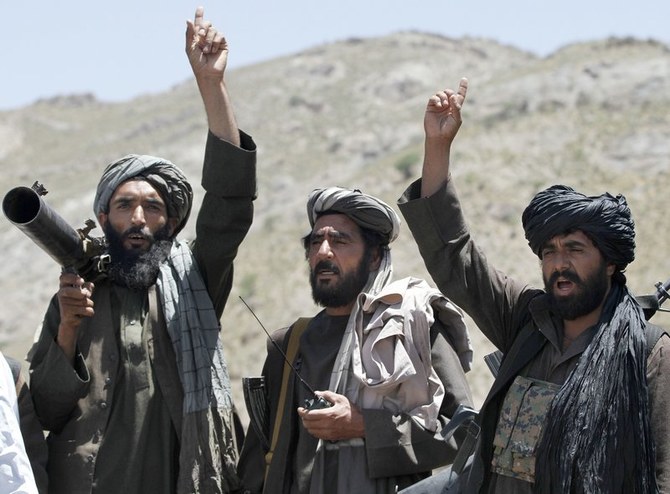
The talks in the Caspian Sea town of Avaza come as the Taliban challenges Afghan government forces in several large cities after weeks of gains in the countryside, including in provinces next to the three former Soviet ‘stans’ that border the country — Tajikistan, Turkmenistan and Uzbekistan.
Turkmen president Gurbanguly Berdymukhamedov called Afghanistan “the question that worries all of us” on Wednesday as state television showed him receiving his Tajikistan counterpart Emomali Rakhmon for bilateral talks ahead of the summit.
Russia, meanwhile, was involved in joint military drills close to Afghanistan’s borders in both Tajikistan and Uzbekistan as a top Kremlin military official flew into the region Thursday to observe the exercises and hold talks.
Fighting in Afghanistan’s long-running conflict began to intensify in May, when US and other foreign forces began the withdrawal due to be completed later this month.
In June, the Taliban captured Afghanistan’s main crossing with Tajikistan, Shir Khan Bandar, while Kabul’s troops have been forced to retreat into both Tajikistan and Uzbekistan in recent weeks during heavy fighting with the group.
The Taliban has insisted that it has no designs on Central Asia, and has established official contacts with both Uzbekistan and Turkmenistan as it casts itself as a government-in-waiting.
But analysts argue that a growing security vacuum in the country can pose its own threat to Central Asia, as well as the region’s growing economic cooperation with Kabul.
Valery Gerasimov, chief of the Russian military’s General Staff, arrived in Uzbekistan for talks Thursday, and to observe military drills that are expected to wrap up next week.
During a meeting with Uzbek counterpart Shukhrat Khalmukhamedov, Gerasimov said the drills took place “to practice actions to repel terrorist threats.”
“The main threat to the Central Asian region today comes from the Afghan direction,” Gerasimov said, noting that Moscow was increasing its supplies of weapons to the region.
The annual summit being held in Avaza is a rare instance of the Central Asian states convening for talks without powers from outside the region, such as Russia, China or the United States.

Central Asia’s leaders meet as Taliban advances in Afghanistan
https://arab.news/pc6pj
Central Asia’s leaders meet as Taliban advances in Afghanistan
- In June, the Taliban captured Afghanistan’s main crossing with Tajikistan while Kabul’s troops have been forced to retreat
Russian minister visits Cuba as Trump ramps up pressure on Havana
- The Russian embassy in Havana said the minister would “hold a series of bilateral meetings” while in Cuba
HAVANA: Russia’s interior minister began a visit to ally Cuba on Tuesday, a show of solidarity after US President Donald Trump warned that the island’s longtime communist government “is ready to fall.”
Trump this month warned Havana to “make a deal,” the nature of which he did not divulge, or pay a price similar to Venezuela, whose leader Nicolas Maduro was ousted by US forces in a January 3 bombing raid that killed dozens of people.
Venezuela was a key ally of Cuba and a critical supplier of oil and money, which Trump has vowed to cut off.
“We in Russia regard this as an act of unprovoked armed aggression against Venezuela,” Russia’s Interior Minister Vladimir Kolokoltsev told Russian state TV Rossiya-1 of the US actions after landing in Cuba.
“This act cannot be justified in any way and once again proves the need to increase vigilance and consolidate all efforts to counter external factors,” he added.
The Russian embassy in Havana said the minister would “hold a series of bilateral meetings” while in Cuba.
Russia and Cuba, both under Western sanctions, have intensified their relations since 2022, with an isolated Moscow seeking new friends and trading partners since its invasion of Ukraine.
Cuba needs all the help it can get as it grapples with its worst economic crisis in decades and now added pressure from Washington.
Trump has warned that acting President Delcy Rodriguez will pay “a very big price” if she does not toe Washington’s line — specifically on access to Venezuela’s oil and loosening ties with US foes Cuba, Russia, China and Iran.
On Tuesday, Russia’s ambassador to Havana, Victor Koronelli, wrote on X that Kolokoltsev was in Cuba “to strengthen bilateral cooperation and the fight against crime.”
The US chief of mission in Cuba, Mike Hammer, meanwhile, met the head of the US Southern Command in Miami on Tuesday “to discuss the situation in Cuba and the Caribbean,” the embassy said on X.
The command is responsible for American forces operating in Central and South America that have carried out seizures of tankers transporting Venezuelan oil and strikes on alleged drug-trafficking boats.
- Soldiers killed -
Cuba has been a thorn in the side of the United States since the revolution that swept communist Fidel Castro to power in 1959.
Havana and Moscow were close communist allies during the Cold War, but that cooperation was abruptly halted in 1991 with the dissolution of the Soviet bloc.
The deployment of Soviet nuclear missile sites on the island triggered the Cuban Missile Crisis of 1962, when Washington and Moscow came close to war.
During his first presidential term, Trump walked back a detente with Cuba launched by his predecessor Barack Obama.
Thirty-two Cuban soldiers, some of them assigned to Maduro’s security detail, were killed in the US strikes that saw the Venezuelan strongman whisked away in cuffs to stand trial in New York.
Kolokoltsev attended a memorial for the fallen men on Tuesday.


