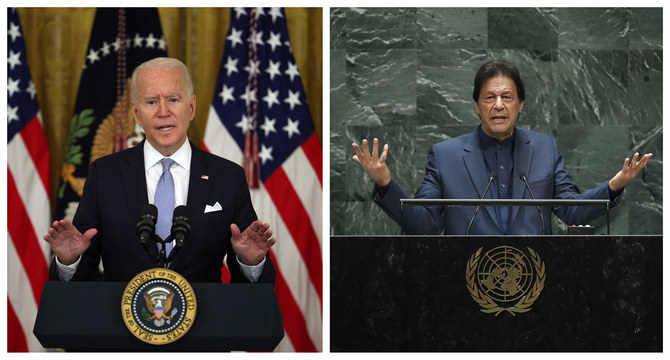
ISLAMABAD: Pakistani national security adviser Moeed Yusuf has complained in an interview with the Financial Times about Joe Biden’s failure to contact Prime Minister Imran Khan since being sworn in as president of the United States, saying Islamabad was struggling to “understand the signal” being sent by the lack of communication.
Yusuf’s comments come amid increasing violence in neighboring Afghanistan, where the Taliban have stepped up attacks ahead of a complete withdrawal of US forces from the war-battered country.
Washington is seeking Pakistan’s help to stop the Taliban taking over Afghanistan by force. The insurgent group has already captured swaths of territory across Afghanistan, with the government of Afghan president Ashraf Ghani openly accusing Pakistan of supporting the Taliban to secure its strategic interests in the region. Islamabad denies the accusations.
Washington has relied on Pakistan in the past to help bring senior Taliban leaders to the negotiating table and secure a deal to exit the country with few attacks on US soldiers. But despite calls from Khan to broaden US-Pakistan relations beyond Afghanistan, Biden has yet to call him since taking office this year.
“The president of the United States hasn’t spoken to the prime minister of such an important country who the US itself says is make-or-break in some cases, in some ways, in Afghanistan — we struggle to understand the signal, right?” Yusuf, Pakistan’s national security adviser, told the Financial Times in an interview at Pakistan’s embassy in Washington, published on Tuesday.
“We’ve been told every time that . . . [the phone call] will happen, it’s technical reasons or whatever. But frankly, people don’t believe it,” Yusuf added. “If a phone call is a concession, if a security relationship is a concession, Pakistan has options.”
A senior Biden administration official who was not named by the FT said: “There are still a number of world leaders President Biden has not been able to speak with personally yet. He looks forward to speaking with Prime Minister Khan when the time is right.”
Yusuf traveled to Washington as part of a delegation including the head of Pakistan’s ISI intelligence agency to discuss the Afghan crisis.
The perceived diplomatic affront the national security adviser spoke of marks the latest setback in US-Pakistan relations after the two nations’ cooperation during the ‘war on terror’ following the 9/11 attacks by Al-Qaeda, the militant group founded by Osama bin Laden.
In 2004, the US named Pakistan an official major non-Nato ally, spurred by Washington’s need for support to fight in Afghanistan. But US administrations have since regularly accused their ally of harboring Taliban insurgents, claims denied by Pakistan.
Under President Donald Trump’s administration, the US severed $2 billion in security assistance to Pakistan, with the then-president accusing Islamabad of “nothing but lies and deceit”. But after Trump made a deal with the Afghan Taliban that relied on help from Pakistan, he invited Khan to the White House.

Pakistan says struggling to understand ‘signal’ sent by Biden not calling PM Khan
https://arab.news/gc346
Pakistan says struggling to understand ‘signal’ sent by Biden not calling PM Khan
- National security adviser says Pakistan told phone call delayed over “technical reasons … but frankly, people don’t believe it”
- A senior Biden administration official says Biden “looks forward to speaking with Prime Minister Khan when the time is right”
Islamabad dismisses claims about paying up to 8 percent interest on foreign loans as ‘misleading’
- Pakistan has long relied on external loans to help bridge persistent gaps in public finances and foreign exchange reserves
- Pakistan’s total external debt, liabilities stand at $138 billion at an overall average cost of around 4 percent, ministry says
KARACHI: Pakistan’s finance ministry on Sunday dismissed as “misleading” claims that the country is paying up to 8 percent interest on external loans, saying the overall average cost of external public debt is approximately 4 percent.
Pakistan has long relied on external loans to help bridge persistent gaps in public finances and foreign exchange reserves, driven largely by a narrow tax base, chronic trade deficits, rising debt-servicing costs and repeated balance-of-payments pressures.
Over the decades, successive governments have turned to multilateral and bilateral lenders, including the International Monetary Fund, the World Bank and the Asian Development Bank, to support budgetary needs and shore up foreign exchange reserves.
The finance ministry on Sunday issued a clarification in response to a “recent press commentary” regarding the country’s external debt position and associated interest payments, and said the figures required contextual explanation to ensure accurate understanding of Pakistan’s external debt profile.
“Pakistan’s total external debt and liabilities currently stand at $138 billion. This figure, however, encompasses a broad range of obligations, including public and publicly guaranteed debt, debt of Public Sector Enterprises (both guaranteed and non-guaranteed), bank borrowings, private-sector external debt, and intercompany liabilities to direct investors. It is therefore important to distinguish this aggregate figure from External Public (Government) Debt, which amounts to approximately $92 billion,” it said.
“Of the total External Public Debt, nearly 75 percent comprises concessional and long-term financing obtained from multilateral institutions (excluding the IMF) and bilateral development partners. Only about 7 percent of this debt consists of commercial loans, while another 7 percent relates to long-term Eurobonds. In light of this composition, the claim that Pakistan is paying interest on external loans ‘up to 8 percent’ is misleading.
The overall average cost of External Public Debt is approximately 4 percent, reflecting the predominantly concessional nature of the borrowing portfolio.”
With respect to interest payments, public external debt interest outflows increased from $1.99 billion in Fiscal Year (FY) 2022 to $3.59 billion in FY2025, representing an increase of 80.4 percent, not 84 percent as reported. In absolute terms, interest payments rose by $1.60 billion over this period, not $1.67 billion, it said.
According to the State Bank of Pakistan’s records, Pakistan’s total debt servicing payments to specific creditors during the period under reference were as follows: the IMF received $1.50 billion, of which $580 million constituted interest; Naya Pakistan Certificates payments totaled $1.56 billion, including $94 million in interest; the Asian Development Bank received $1.54 billion, including $615 million in interest; the World Bank received $1.25 billion, including $419 million in interest; and external commercial loans amounted to nearly $3 billion, of which $327 million represented interest payments.
“While interest payments have increased in absolute terms, this rise cannot be attributed solely to an expansion in the debt stock,” the ministry said. “Although the overall debt stock has increased slightly since FY2022, the additional inflows have primarily originated from concessional multilateral sources and the IMF’s Extended Fund Facility (EFF) under the ongoing IMF-supported program.”
Pakistan secured a $7 billion IMF bailout in Sept. 2024 as part of Prime Minister Shehbaz Sharif’s efforts to stabilize the South Asian economy that narrowly averted a default in 2023. The government has since been making efforts to boost trade and bring in foreign investment to consolidate recovery.
“It is also important to note that the increase in interest payments reflects prevailing global interest rate dynamics. In response to the inflation surge of 2021–22, the US Federal Reserve raised the federal funds rate from 0.75-1.00 percent in May 2022 to 5.25–5.50 percent by July 2023. Although rates have since moderated to around 3.75 percent, they remain significantly higher than 2022 levels,” the finance ministry said.
“The government remains committed to prudent debt management, transparency, and the continued strengthening of Pakistan’s macroeconomic stability,” it added.