TORKHAM: Pakistan’s military said Tuesday it has completed 90 percent of a fence being constructed along the border with Afghanistan, vowing to complete the project this summer.
Pakistan says it is constructing the fence to prevent cross-border militant attacks.
The announcement by the Pakistan army comes amid increasing violence in neighboring Afghanistan, where the Taliban have stepped up attacks ahead of a complete withdrawal of American troops from the war-torn country.
Pakistan started the fence along the 2,611-kilometer (1,622-mile) border with Afghanistan — known as the Durand Line — in 2017 when militants repeatedly launched cross-border attacks on Pakistani posts.
On Tuesday, a Pakistani military official, Col. Rizwan Nazir, told a group of foreign journalists at the key Torkham border crossing that the remaining 10 percent of the fence at the western border will be complete this year.
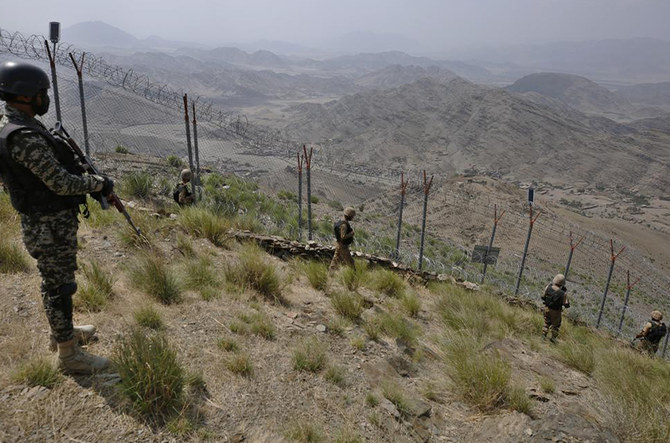
The border barrier between the two countries consists of two sets of chain-link fences separated by a 2-meter (6.5-foot) space that has been filled with concertina wire coils. The double fence is about 4 meters (13 feet) high. The military has installed surveillance cameras to check any movement along the border.
Afghanistan has never recognized the porous border that runs through the Pashtun heartland, diluting the power of Afghanistan’s largest ethnic group on both sides.
Pakistan and Afghanistan often accuse each other of turning a blind eye to militants operating along the frontier. Both deny the charges.
On Tuesday, Pakistani soldiers were seen patrolling one of the most dangerous regions in the county, where Pakistani Taliban and other local and foreign militants have a presence.

Pakistan army completes 90 percent of fence along Afghan border
https://arab.news/wkdkh
Pakistan army completes 90 percent of fence along Afghan border
- The announcement by the Pakistan army comes amid increasing violence in neighboring Afghanistan
- Double fence is about 4 meters high, surveillance cameras installed to check any movement along border
At least 13 civilians killed in Pakistan strikes in Afghanistan, UN says
- Pakistan said it launched the strikes after blaming recent suicide attacks on militants operating from Afghan territory
- The reported toll adds to fears of a renewed cycle of retaliation between the neighbors, threatening a fragile ceasefire
ISLAMABAD/KABUL: At least 13 civilians were killed and seven injured in Pakistani airstrikes in eastern Afghanistan, the United Nations said on Monday, as cross-border tensions escalated following a string of suicide bombings in Pakistan.
The reported toll adds to fears of a renewed cycle of retaliation between the neighbors, threatening a fragile ceasefire along their 2,600-km (1,600-mile) frontier and further straining ties as both sides trade blame over militant violence.
The United Nations Assistance Mission in Afghanistan (UNAMA) said it had received “credible reports” that overnight Pakistani airstrikes on February 21–22 killed at least 13 civilians and injured seven in the Behsud and Khogyani districts of Nangarhar province.
Taliban spokesman Zabihullah Mujahid earlier reported dozens killed or wounded in the strikes, which also hit locations in Paktika province. Reuters could not independently verify the reported toll.
Pakistan said it launched the strikes after blaming recent suicide attacks, including during Ramadan, on militants operating from Afghan territory.
Pakistan’s information ministry in a post on X said the “intelligence-based” operation struck seven camps of the Pakistani Taliban and Daesh (Islamic State) Khorasan Province and that it had “conclusive evidence” the militant assaults on Pakistan were directed by “Afghanistan-based leadership and handlers.”
Kabul has repeatedly denied allowing militants to use Afghan territory to launch attacks in Pakistan.
The strikes took place days after Kabul released three Pakistani soldiers in a Saudi-mediated exchange aimed at easing months of tensions along the border.
Afghanistan’s defense ministry condemned the strikes and called them a violation of sovereignty and international law, saying an “appropriate and measured response will be taken at a suitable time.” The Afghan foreign ministry said it had summoned Pakistan’s ambassador.
In a statement on the February 21-22 strikes, Afghanistan’s education ministry said eight school students; five boys and three girls, were killed in Behsud in Nangarhar province, and one madrasa student injured in Barmal in Paktika province, adding that dozens of other civilians were killed or wounded and educational centers destroyed. Reuters could not independently verify the information.
The latest strikes follow months of clashes and repeated border closures that have disrupted trade and movement along the rugged frontier.