
PESHAWAR: When Abdul Haq arrived in the United Arab Emirates to work as a laborer over two decades ago, he never imagined he would become a calligrapher, let alone one recognized by an Emirati royal court.
Born in Buner district of Khyber Pakhtunkhwa province in Pakistan’s northwest, Haq, now 47, moved to the Gulf state in 1998 where he bought and drove a cab for many years. When the taxi system was nationalized in 2006, Haq found a new job — as a bus driver at the Sharjah Culture Department, picking and dropping students at the Sharjah Center for the Art of Arabic Calligraphy and Ornamentation.
It was during that time that he developed a friendship with Syrian master of calligraphy Dr. Muhammad Farooq Al-Haddad. That friendship would go on to change Haq’s life.
“Dr. Farooq Al-Haddad started talking to me about learning calligraphy,” Haq told Arab News in an interview last week. “In 2007, he convinced me to register for basic courses.”
While still working as a bus driver, Haq took classes learning various script varieties of Islamic calligraphy.
“I enrolled in one course after the other and kept on polishing my skills in two major styles — Reqa and Diwani — besides also learning Diwani Jali,” he said, adding that had also been practicing the Thuluth style since 2018 but would only consider himself fluent when his teacher gave him permission to teach others.
“A teacher’s permission is like a certificate,” Haq said.
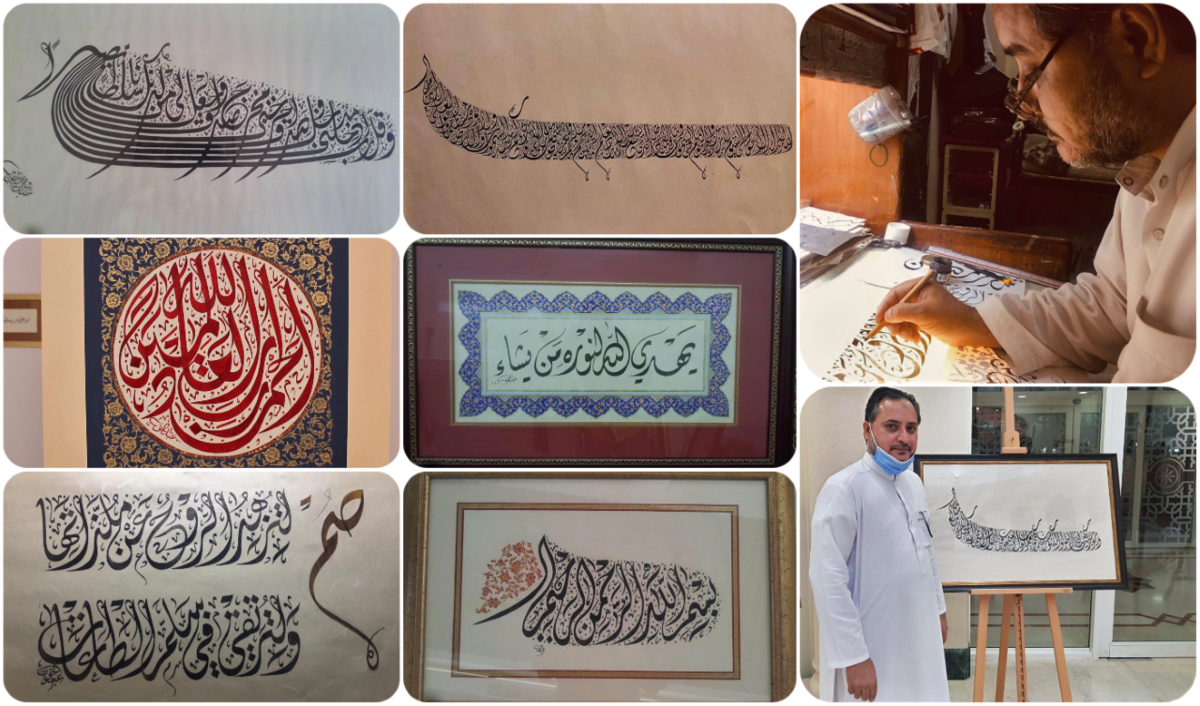
The combination of photos shows calligraphic work by Pakistani calligrapher and bus driver Abdul Haq. (AN photo)
For Al-Haddad, who also still teaches at the Sharjah center, it was Haq’s manners that first attracted his attention, the master told Arab News, saying he soon realized that his Pakistani student had the qualities and patience to succeed in an art form that since medieval ages had been considered by Muslim scholars as “the trustee” of Islamic thought.
“Abdul Haq is among those artists and calligraphers who started their journey with great efforts and struggles. He is a very humble and well-mannered person,” Al-Haddad said. “He has the skills and qualities to achieve more in calligraphy.”
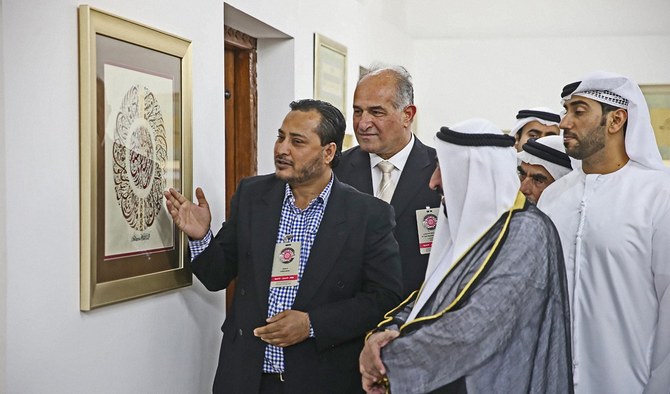
Success in calligraphy did not come immediately for Haq. Initially he hoped his newly minted skills would simply help him sustain his family, so he continued to practice it. Then a breakthrough came during the Sharjah International Calligraphy Exhibition in 2014 when Haq’s work was selected from among 3,000 entries for the contest’s final display, which was attended by the ruler of the Emirate of Sharjah, Sultan bin Muhammad Al-Qasimi.
“The exhibition director showed my artwork to His Highness Dr. Sultan bin Muhammad Al-Qasimi during his visit, and introduced me to him,” Haq said. “He started talking to me in Urdu and told his ministers that look at him, he is a bus driver who has invested his time in learning the calligraphy art. His Highness gave me $2,500 and took my artwork with him.”
After that encounter, Haq devoted himself to calligraphy: “His Highness is known the world over for his affection and efforts for the promotion of Islamic culture and art, including calligraphy. His encouragement and kindness inspired me to devote myself to the art of calligraphy.”
He continued to learn and at the same calligraphy exhibition two years later got even more attention.
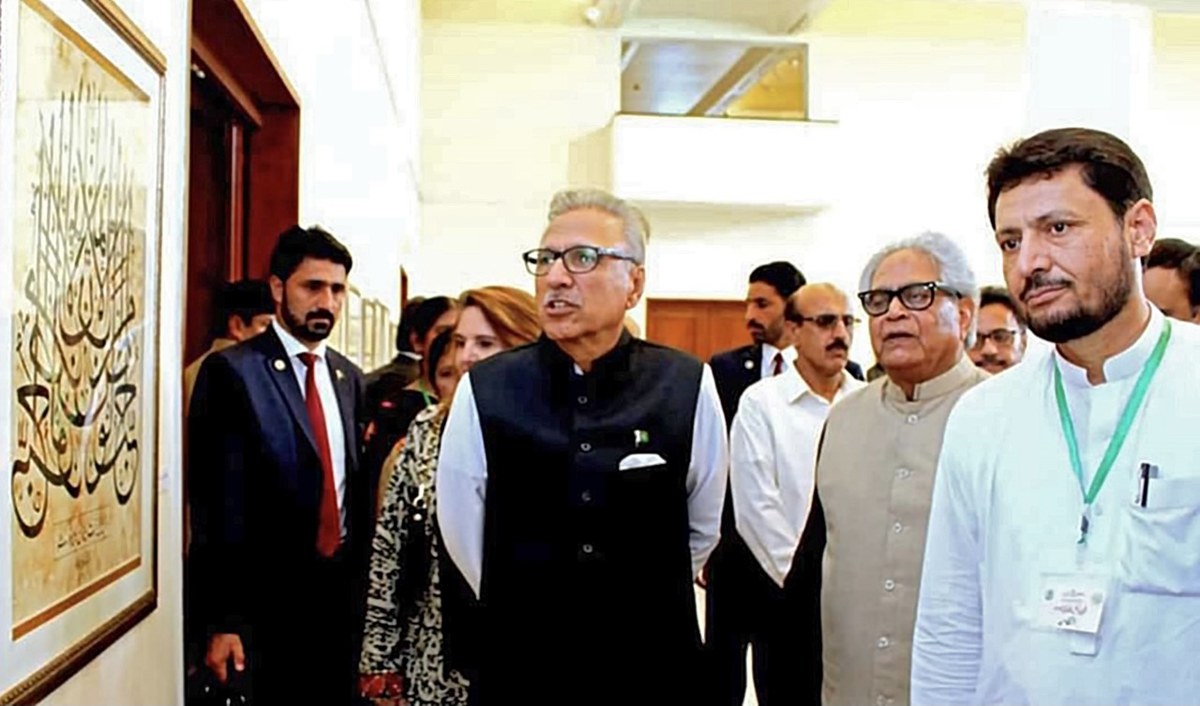
Pakistan President Dr. Arif Alvi looks at a calligraphic piece by Pakistani artist and bus driver Abdul Haq during the opening ceremony of the National Calligraphic Exhibition at the National Academy of Arts (NCA) in Islamabad, Pakistan, on September 25, 2019. (AN photo)
“Many important persons liked my work and asked me for calligraphy pieces,” Haq said. “Most importantly, Shiekh Sultan again honored me by appreciating my work. He told me: ‘Your work has greatly improved. Keep it up,’.”
Since he started his adventure with calligraphy, Haq has earned dozens of certificates, won many competitions, and displayed at various exhibitions. In September 2019, his work was appreciated by Pakistani President Dr. Arif Alvi during an exhibition at the National Academy of Arts (NCA) in Islamabad.
Haq’s teacher says the success is well deserved.
“This is the start. I believe he will achieve more success in the future,” Al-Haddad said.
But despite his achievements, Haq said he is still in the process of learning — and continues to earn his living as a bus driver.
“I still drive the bus and enjoy learning new skills at the center,” he said. “I can never thank the UAE, His Highness Dr. Sultan and the calligraphy center and its teachers for the opportunities they gave me.”