Pakistani family shares rare world record with nine birthdays on August 1

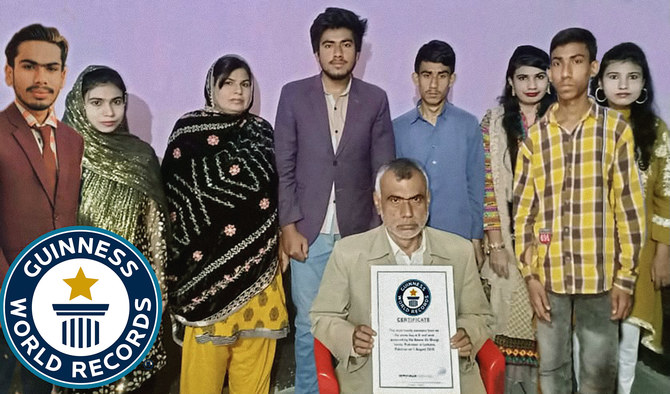
Ameer Ali Mangi, his wife Khadija and children pose with their Guinness Book of World Records certificate in Larkana, Sindh on July 17, 2021. (Photo courtesy: Amir Ali Mangi)
Short Url
Updated 01 August 2021
Follow

Pakistani family shares rare world record with nine birthdays on August 1

  • Ameer Ali Mangi, his wife Khadija and all of their children were born on Aug. 1
  • They made a Guinness world record as 'most family members born on the same day'

ISLAMABAD: The first day of August is the most special day of the year for Ameer Ali Mangi, his wife and their seven children: it's when all nine of them celebrate their birthday, which has recently given them entry in the Guinness Book of World Records.

Certified in July this year, the Mangis are now featured in the Guinness Book of World Records as "most family members born on the same day."

It took the family form Larkana, Sindh province, three years to finally be recognized and dethrone American citizens Carolyn and Ralph Cummins, who had held the Guinness record since 1966 with their five children born on Feb. 20.

"It was a hard fight. I applied for this record in 2018, when a friend told me to do so as it’s a unique that nine members of a family shared the same birthday,” Mangi, a 53-year-old schoolteacher, told Arab News on Saturday.

"After more than a year of follow ups, Guinness Book accepted my application on Aug. 1, 2019. Then it was a long journey of verifications and investigation. I provided each and every document they asked from me."


Nine members of the Mangi family celebrate their birthday in Larkana, Sindh on August 1, 2008. (Photo courtesy: Amir Ali Mangi)

Mangi was born on Aug. 1, 1968, his wife Khadija on Aug. 1, 1973, their first daughter Sindhu on Aug. 1, 1992, twin daughters Sassi and Sapna on Aug. 1, 1998, first son Amir on Aug. 1, 2001, second son Ambar on Aug. 1, 2002, and twin sons Amar and Ahmer on Aug. 1, 2003.

In December 2020, the Guinness Book of World Records informed the family that the verification was complete.

"They processed the certificate in March this year, which I received in July," Mangi said.

The first day of August, he says, is his luckiest date.

"I joined government education department and also got married on Aug. 1," he said, adding that at that time he did not know that Khadija was also born on the same day.

"The births of all my sons and daughters on the same date was also not planned rather it was from Allah."
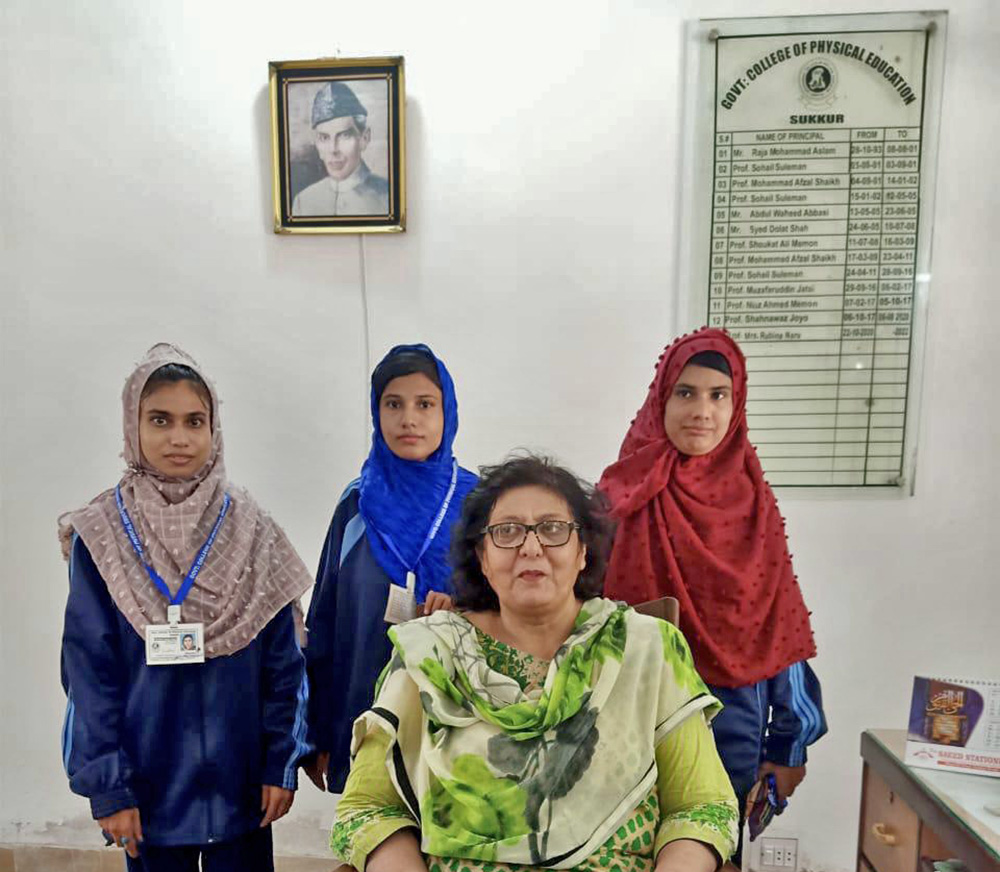


Ameer Ali Mangi's daughters Sindhu, Sapna Ameer and Sasui pose for a photo with their school principal Rubina Naru at the Physical Education College in Sukkur on April 15, 2021. (Photo courtesy: Amir Ali Mangi)

The children not only share their birthday with Mangi but also his love of learning. All of them have been enrolled in higher education institutes, mainly in engineering and science.

While it is almost impossible for all family members to be born on the same day, Mian Naeem, an astrologist, told Arab News the date being the first day of the month is additionally auspicious.

“(Number) 'one' is the universe's starting number," he said. "If it is your lucky number, it repeats in your life’s successful events.”


Bedbugs, termites spark Karachi entrepreneur’s women-focused home services business

Updated 5 sec ago
Follow

Bedbugs, termites spark Karachi entrepreneur’s women-focused home services business

  • Founder of Karachi-based ForiFix says service helped women take charge of household decisions
  • The company with mostly female backend staff has over 5,000 clients that it serves across the city

KARACHI: It all began with bedbugs and termites in a Karachi home two decades ago, a nuisance that eventually gave birth to what is now a thriving home maintenance business and, in its founder’s words, a small movement to empower women to make decisions inside their own households.
Samina Faisal Khan, 44, launched ForiFix in 2015, offering professional home maintenance services ranging from pest control to painting, heat-proofing and handyman work. Over time, the company built a clientele dominated by women and, according to Khan, gradually changed how many of them approached household decision-making.
Khan says the idea for the business emerged from her own experience after moving to Karachi in 2004 for work. Born in a village in Larkana district, she had spent 13 years in the Middle East before returning to Pakistan and pursuing a Master’s in Business Administration.
During her early years in Karachi, her home was infested with bedbugs and termites. Living with her mother and five sisters while her father worked abroad, Khan struggled to find reliable help for basic maintenance work, a challenge that planted the seed for what would eventually become ForiFix.
“With zero investment I started this business,” Khan told Arab News.
Being bedridden after an accident in 2008 gave her time to research pest control and home maintenance services, eventually revealing what she saw as a major gap in Pakistan’s market.
Khan began offering small services to friends and family that year but lacked the resources to formally launch the business until 2015, when she partnered with a family friend, Faisal Khan, whose family had worked in industrial pest control for three generations.
The company, whose name combines the Urdu word “fori” — or “immediate” — with “fix,” offers quick-fix solutions to day-to-day issues facing families not just in Karachi but also in other parts of the country.
“The first few women who reached out to me were single mums or women whose husbands or fathers lived abroad and they didn’t have any men in the house, just like my mother’s [household].”
One of her longtime clients, Ambreen Salman, whose husband frequently travels, said the company proved to be a reliable solution.
“Whenever I have contacted ForiFix, I have felt safe and secure despite being alone at home,” she said.
Today, Khan says women make up about 90-95 percent of her more than 5,000 clients, adding she has noticed a shift in how they approach decision-making over the years.
“Earlier, most women used to initiate the conversation and ask to talk about the rest with their husbands or brothers,” she said.
“I used to feel that despite being in charge of household affairs, women did not have the decision-making power,” she continued. “Women are called ‘homemakers’ and ‘queen of the kitchen’ but they still don’t have the power to make a financial decision or hire someone [for a task at home].”
ForiFix not only provided professional home maintenance services to these women, said Khan, but also led a movement to empower them.
“I wanted to make life easy for the woman who spends her day in the kitchen and cleans the house. Later down the lane, the male counterparts started calling and telling me they will not be around and the women in their homes will take care of things.”
At ForiFix, she has also tried to create opportunities for women in the workplace.
Speaking about the company’s workforce, Khan said her entire backend team consists of women working in roles ranging from customer service and social media to marketing, sales, business development and graphic design.
“I have given them the comfort to work at their convenience as long as they meet the deadline. This was something that I opted for myself and I understand how important it is for women to have that flexibility,” she said.
Khan also personally visits sites for certain clients, including single women, women who observe strict privacy norms, and overseas Pakistanis who require clear communication about work being done in their homes.
Her early efforts were not always easy. Initially, her mother was hesitant about her visiting distant work sites alone because of social perceptions about women working in such roles.
At the time, her business partner Faisal Khan proposed marriage so that the two could work together more freely, and the couple later married. They now have two children.
Faisal leads her company’s technical team of more than 25 permanent and project-based staff.
“Our major USP is the fact that all our technicians are background-checked [and] police-verified,” Khan said.
From just 10-12 clients a month in its early days, ForiFix now handles about 20-25 clients a day, she added.
“I started off with Rs35,000 annual profit in the first few years. It was very low-scale and I was doing other jobs simultaneously to help my family. Now, our annual turnover is around Rs3.5 million.”
Despite receiving inquiries from clients in other cities and even overseas, Khan says expansion is not an immediate priority.
The company has occasionally provided services in Islamabad and Lahore for Karachi-based clients who own homes there, but Khan says the business is currently focused on strengthening its operations in Karachi rather than expanding further.