

Rescuers pull 394 migrants from dangerously overcrowded boat off Tunisia

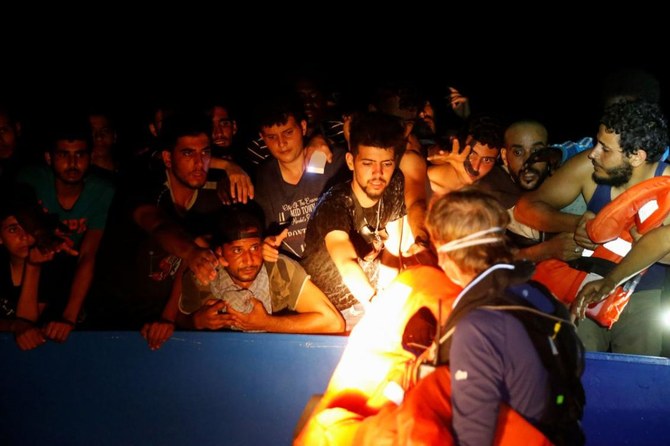
A RHIB (rigid hulled inflatable boat) crew member from the German NGO migrant rescue ship Sea-Watch 3 distributes life jackets to migrants on an overcrowded wooden boat. (File/Reuters)
Short Url
Updated 01 August 2021
Follow

Rescuers pull 394 migrants from dangerously overcrowded boat off Tunisia

  • It was not clear if there were any deaths or injuries among the migrants
  • Migrant boat departures have increased in recent months as weather conditions have improved

ABOARD SEA-WATCH 3, Mediterranean: Two humanitarian rescue ships pulled 394 migrants from a dangerously overcrowded wooden boat in the Mediterranean overnight on Sunday in an operation lasting about six hours, a Reuters witness said.

The German and French NGO ships Sea-Watch 3 and Ocean Viking rescued the migrants in Tunisian waters 68 km (42 miles) from the North African coast, near oil facilities and other ships.

Sea-Watch 3, which assumed command of the operation, took 141 of the survivors while Ocean Viking took the rest. The yacht Nadir, from the German NGO ResQ Ship, later gave support.

It was not clear if there were any deaths or injuries among the migrants who were in the wooden boat, which was crammed with migrants on deck and inside the hull.

The craft was taking in water and its engine was not working, the Reuters witness said.

Migrant boat departures from Libya and Tunisia to Italy and other parts of Europe have increased in recent months as weather conditions have improved.

According to the UN-affiliated International Organization for Migration, more than 1,100 people fleeing conflict and poverty in Africa and the Middle East have perished this year in the Mediterranean.

Many of the migrants in this latest rescue were seen jumping off the boat and trying to swim to Sea-Watch 3, the Reuters witness said.

The migrants were mainly men from Morocco, Bangladesh, Egypt and Syria.


Zindani govt begins reshaping security leadership

Yemeni Prime Minister Shaya Al-Zindani. (File/SABA News Agency)
Updated 7 sec ago
Follow

Zindani govt begins reshaping security leadership

  • US backing for the Yemeni Presidential Leadership Council’s efforts

ADEN: Yemen’s government under Prime Minister Shaya Al-Zindani has begun implementing a series of decisions to restructure the leadership of the security services, in a move seen as a significant step toward reorganizing state institutions in the temporary capital, Aden.

It comes amid renewed US support for the Presidential Leadership Council’s efforts to bolster stability, combat terrorism and safeguard international maritime routes.

The chairman of Yemen’s Presidential Leadership Council, Rashad Al-Alimi, issued two presidential decrees appointing Brig. Gen. Abdulsalam Qaid Abdulqawi Al-Jamali as commander of the Special Security Forces and Brig. Gen. Abdulsalam Abdulrab Ahmed Al-Omari as head of the Civil Defense Authority, with both officers promoted to the rank of major general.

The decisions are part of a broader Yemeni effort to rebuild the leadership structure of security institutions, while strengthening the state’s capacity to enforce security and stability in liberated areas amid the country’s multiple security challenges.

Alongside the presidential decrees, Yemeni Interior Minister Ibrahim Haidan issued a series of leadership changes within Aden’s security services, including the reassignment of several security officials, as part of a plan aimed at improving operational efficiency and strengthening coordination among units.

The decisions included reassigning Brig. Gen. Jalal Al-Rubaie from his post as commander of the National Security Forces to lead the Special Security Forces in Aden, as well as appointing Brig. Gen. Mohammed Abdo Al-Subeihi as deputy director general of Aden Police and assistant for security affairs.

The appointments also included Brig. Gen. Jalal Fadl Al-Qutaibi as assistant director general of Aden Police for human resources and financial affairs; Brig. Gen. Mohammed Khaled Haidara Al-Turki as assistant director general for operations; Brig. Gen. Hassan Mohsen Saleh Al-Omari as director of the Criminal Investigation Department, with Col. Fouad Mohammed Ali appointed as his deputy; and Lt. Col. Mayas Haidara Al-Jaadani as director of the Anti-Narcotics Department.

The Yemeni Ministry of Interior said the measures are intended to reorganize field operations, raise security readiness levels, accelerate response time to threats and improve institutional discipline within security agencies. It believes the changes will help consolidate stability in the temporary capital of Aden and improve security and service performance in the city.

Yemeni-American Partnership

The government’s steps coincided with a meeting between Al-Alimi and US Ambassador to Yemen Steven H. Fagin, during which they reviewed the latest developments at the local level.

The two sides also discussed the US and international support required to strengthen Yemen’s capacity to confront security and terrorist threats, protect vital facilities and secure international shipping lanes, noting that this is an issue of regional and global priority amid escalating tensions

According to an official media source, Al-Alimi reiterated his appreciation of the Yemeni-American partnership and praised Washington’s role in supporting the implementation of resolutions to prohibit the smuggling of Iranian arms to the Houthi militia, drying up their funding sources and curbing destabilizing operations.

Al-Alimi highlighted the importance of reinforcing joint deterrence against regional threats, including the need to strictly enforce international sanctions and to pursue financing, smuggling and arms networks, in support of the government’s efforts to extend state control across all Yemeni territory.

He added that the security of the Red Sea and Bab Al-Mandab Strait is a global concern that requires broad international coordination.

Al-Alimi said that the Yemeni government is exerting efforts to normalize economic and service conditions, and to implement plans designed to integrate forces and unify security and military decision-making processes. He added that the Kingdom of Saudi Arabia supported these efforts, as it has played a pivotal role in advancing stability and rebuilding state institutions.