

Pakistan’s Sindh province imposes lockdown in Karachi despite opposition from central government

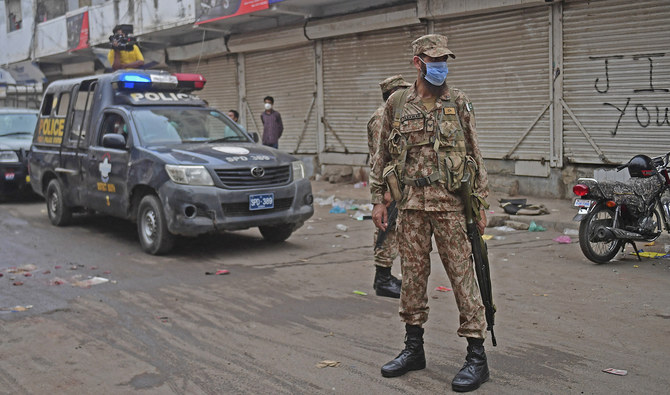
Army personnel and policemen arrive at a market to enforce an evening lockdown imposed amid rising Covid-19 coronavirus cases in Karachi on July 28, 2021. (AFP)
Short Url
Updated 30 July 2021
Follow

Pakistan’s Sindh province imposes lockdown in Karachi despite opposition from central government

  • The lockdown will be implemented from tomorrow and continue until August 8, says Chief Minister Murad Ali Shah
  • Pakistan’s information minister maintains the decision will be reviewed since it could undermine the livelihood of the common man

KARACHI: Pakistan’s southern Sindh province on Friday imposed an extensive lockdown in Karachi, the country’s commercial capital, to control the rising number of COVID-19 cases, caused mainly due to the spread of the delta variant of the coronavirus in the city, as the province’s chief minister said he had taken federal and other stakeholders into confidence before taking the decision.
“There will be a lockdown from July 31 to August 8,” Chief Minister Murad Ali Shah told the media after the meeting of the provincial coronavirus taskforce. “A partial lockdown will be imposed across the province, but Karachi city will get our greater focus.”
He maintained that lockdowns imposed during the first wave of the pandemic had proved effective in curbing the spread of the disease, adding: “I haven’t heard of anyone who died of hunger during those lockdowns, though COVID-19 continued to take people’s lives.”
Shah said the lockdown beginning Saturday would not be as severe as the one imposed last year in March.
“This lockdown will be in place until the 9th of August and will specifically focus on the retail industry in the city,” he continued. “Essential services will be open. Food and food-related industries will remain open, though restaurants will only be able to provide delivery services and no takeaway or dining facilities will be allowed. Health services will also remain open along with bakeries, meat, vegetable and grocery shops. Vaccination centers will continue to function as usual.”
The chief minister said that banks and ports did not fall under the jurisdiction of the provincial administration, though he requested them to operate with “minimal staff.”
“If we do not stop the spread of the virus, the capacity of our hospitals to admit more patients will end within the next five days,” he warned.
Defending his decision, Shah said the province had witnessed a surge in the daily number of infections from 500 cases in June to about 2,000 in the ongoing month.
“In the last three days, the daily average has reached 2,500 and Karachi, being the most densely populated city, is also the most affected one,” he added.
While Shah claimed his administration had informed Pakistan’s planning minister Asad Umar and health chief Dr. Faisal Sultan about the decision, the country’s information minister Fawad Hussain Chaudhry said the central government would review the measure since Prime Minister Imran Khan was against any step that negatively impacted the livelihood of people.
“[We are] closely reviewing the lockdown decision taken by the Sindh government,” he said in a Twitter post. “The prime minister’s policy is quite clear [on the issue]: We will oppose all measures that can severely impact the economy of the common man. The NCOC [National Command and Operations Center] and Sindh government must devise a strategy that has minimum impact on the livelihood and business of the ordinary man.”

Addressing the media in Islamabad a day earlier, the country's planning minister had also said that shutting down entire cities for weeks was not a solution to the pandemic.
“We realize that the working class, the laborers have to pay the price of this,” he maintained. “Closing down entire cities for weeks is not the solution.”
Speaking to Arab News, Dr. Qaiser Sajjad, general secretary of the Pakistan Medical Association, welcomed the decision of the Sindh administration, saying it could help control the spread of the disease.
“We had demanded a complete lockdown to prevent the health system from collapsing completely, but the government imposed a partial lockdown and allowed essential services to remain open,” he informed. “We welcome the development.”
However, an association of merchants in the province rejected the lockdown and said that traders were disappointed.
“We had requested a government delegation not to impose a complete lockdown,” Rizwan Irfan of the Tajir Action Committee said in a statement.
The Federation of Pakistan Chambers of Commerce and Industry (FPCCI) also urged the Sindh government to review its decision.


Pakistan raises fuel prices by Rs55 per liter as Middle East conflict drives oil surge

Updated 06 March 2026
Follow

Pakistan raises fuel prices by Rs55 per liter as Middle East conflict drives oil surge

  • Government says adequate fuel stocks in place despite global energy shock
  • Oil prices jump from about $78 to over $106 per barrel amid regional conflict

ISLAMABAD: Pakistan on Friday increased petrol and diesel prices by Rs55 ($0.20) per liter each as escalating conflict in the Middle East sent global oil prices sharply higher and disrupted energy supply routes, officials said.

Global oil markets have been rattled since coordinated strikes by the United States and Israel against Iran began last week, triggering retaliatory attacks across the region, raising fears of disruption to key energy shipping routes and pushing petroleum prices sharply upward.

The price adjustment in Pakistan was announced after a joint press conference by Finance Minister Muhammad Aurangzeb, Deputy Prime Minister and Foreign Minister Ishaq Dar and Petroleum Minister Ali Pervaiz Malik, who said the government was monitoring international energy markets and domestic supply conditions amid the crisis.

“So, the decision we have made by changing the levy a little bit is that we are going ahead with increasing the price of both fuels, petrol and diesel, by Rs55 ($0.20),” Malik told reporters. 

“And as soon as this matter settles, we will revise the prices downward with the same speed and take steps on how to increase people’s income and purchasing power.”

He said Pakistan entered the crisis with “comfortable energy reserves” due to earlier planning but rising global prices had forced the government to adjust domestic fuel rates to maintain supply continuity.

He said international petrol prices had climbed from roughly $78 per barrel on March 1 to around $106.8 per barrel, while diesel prices had risen to about $150 per barrel.

Malik added that the government had taken steps to minimize the burden on consumers, noting diesel plays a critical role in agriculture, transportation and public mobility.

Malik also warned that authorities would take strict action against anyone attempting to hoard fuel or manipulate supply for profiteering.

The minister said Pakistan was working with international partners to secure additional energy supplies, including arrangements with Saudi Aramco and the use of Pakistan National Shipping Corporation vessels to transport crude oil imports.

Finance Minister Aurangzeb said a high-level government committee formed by Prime Minister Shehbaz Sharif had been meeting daily to review developments in global petroleum markets and their potential impact on Pakistan’s economy.

“Pakistan currently maintains adequate energy stocks and macroeconomic stability,” Aurangzeb said, adding that the government’s response was based on preparedness rather than panic.

He said the committee, which includes senior ministers, the governor of the State Bank of Pakistan and other officials, was assessing short-, medium- and long-term implications of the crisis for inflation, foreign exchange reserves and broader economic indicators.

Deputy PM Dar said the regional conflict had significantly disrupted global energy markets, with international petroleum prices rising by as much as 50–70 percent in recent days.

The deputy prime minister added that Pakistan was also engaged in diplomatic efforts aimed at de-escalating tensions and restoring stability in the region.

Petroleum prices will now be reviewed more frequently, potentially on a weekly basis, and any reduction in global oil prices would be passed on to consumers.

Pakistan, which relies heavily on imported fuel to meet its energy needs, is particularly vulnerable to global oil price shocks that can quickly feed into inflation and pressure the country’s external accounts.