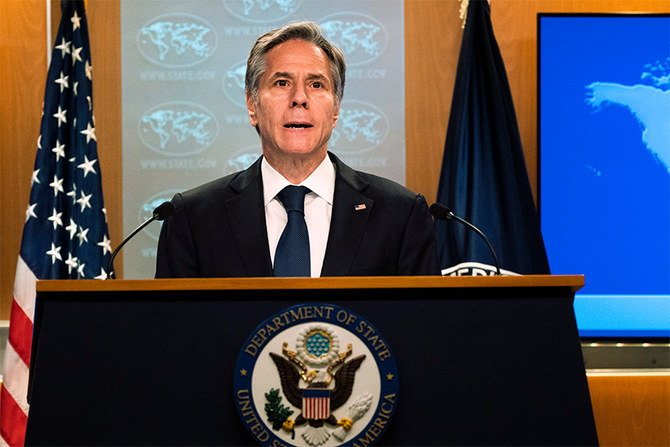
ISLAMABAD: US Secretary of State Antony Blinken said on Thursday Pakistan had a “vital role” to play in influencing the Taliban and ensuring the insurgent group did not take over Afghanistan by force.
In his first visit to India since joining US President Joe Biden’s administration, Blinken met his Indian counterpart, Foreign Minister Subrahmanyam Jaishankar, and other officials on Wednesday before calling on Prime Minister Narendra Modi.
His remarks about Pakistan come amid a key visit to Washington by Pakistan’s National Security Adviser Dr. Moeed Yusuf and the Director General of Inter-Services Intelligence, Lt. Gen. Faiz Hameed.
“Pakistan has a vital role to play in using its influence with the Taliban to do whatever it can to make sure that the Taliban does not seek to take the country by force,” the US secretary of state told the Times of India channel. “And it does have influence, and it does have a role to play, and we hope that it plays it,” he added.
In an interview with ABC News, Blinken said the entire world was hearing “deeply, deeply troubling” reports of atrocities in Afghanistan, which “certainly do not speak well of the Taliban’s intentions for the country as a whole.”
In an interview to Al Jazeera, Blinken said an Afghanistan that “does not respect the basic gains of the last 20 years, that Afghanistan will be a pariah in the international community.”
The interviews, released by the secretary’s office in Washington, reflect growing US concern that the Taliban were determined to take Kabul by force instead of coming in through a political settlement and a government that included all Afghan factions.
As the United States prepares to formally end its 20-year military mission in Afghanistan on August 31, Taliban insurgents are quickly seizing territory once controlled by the US-backed government of President Ashraf Ghani, raising fears they could eventually try to take the capital Kabul.
On Thursday, in a meeting with Afghan journalists, Prime Minister Imran Khan said Pakistan was neither “responsible” for the actions of the Afghan Taliban, nor a spokesperson for the group.
“What the Taliban are doing or are not doing has nothing to do with us and we are not responsible, neither are we the spokesperson of the Taliban,” Khan was quoted by Pakistan’s Express Tribune newspaper as saying.
He said a “military solution” in Afghanistan had been a “flawed strategy” of the United States, asking what the US could achieve from operating bases out of Pakistan which it could not achieve by operating in Afghanistan for two decades.
“It was a flawed strategy. They should have talked to the Taliban from a position of strength when there were 150,000 NATO soldiers present in Afghanistan. There is no reason for the US to operate from Pakistan,” Khan said, reiterating that Pakistan would not get dragged into more conflict in Afghanistan.

Pakistan has ‘vital role’ in ensuring Taliban don’t take Afghanistan by force — Blinken
https://arab.news/v2qxe
Pakistan has ‘vital role’ in ensuring Taliban don’t take Afghanistan by force — Blinken
- US secretary of state’s remarks come amid key visit to Washington by Pakistani national security adviser and spy chief
- Reflect growing US concern that Taliban determined to take Kabul by force and rejecting a political settlement
IMF staff to visit Pakistan Feb. 25 for key loan reviews as reforms stabilize economy
- Talks to cover third review under $7 billion bailout and climate resilience program
- Analysts warn tax shortfall, power tariff cuts could face scrutiny by lender
KARACHI: An International Monetary Fund (IMF) staff team will visit Pakistan from Feb. 25 to begin discussions on key program reviews, the lender said on Thursday, as authorities seek to lock in recent economic stabilization after a prolonged financial crisis.
The talks will cover the third review under Pakistan’s $7 billion Extended Fund Facility (EFF) bailout and the second review under the Resilience and Sustainability Facility (RSF), which supports countries dealing with climate vulnerabilities.
Pakistan has spent the past year implementing tough fiscal and structural reforms — including tax increases, subsidy cuts and a tighter monetary policy — to stabilize a fragile economy that faced record inflation, dwindling foreign reserves and default fears in 2023.
“We do have a staff team that is expected to visit Pakistan starting February 25th for discussions on the third review under the EFF and the second review under the RSF,” IMF communications director Julie Kozack said at a regular press briefing.
The IMF says the program aims to restore macroeconomic stability, rebuild external buffers and make Pakistan more resilient to climate shocks following devastating floods in recent years.
Kozack said Pakistan’s policy implementation had already produced measurable improvements.
“Pakistan’s policy efforts under the EFF have helped stabilize the economy and rebuild confidence,” she said.
She noted fiscal indicators were improving in line with program targets.
“Pakistan currently has a primary fiscal surplus of 1.3 percent of GDP in FY25, which was in line with program targets. Headline inflation has been relatively contained. And Pakistan posted its first current account surplus in 14 years in FY2025.”
Pakistani authorities have also cited improving macroeconomic trends.
Governor State Bank of Pakistan Jameel Ahmad has said growth could reach about 4.75 percent in the fiscal year ending June, while inflation, which peaked above 38 percent in May 2023, has fallen sharply over the past year following interest rate hikes and fiscal tightening.
The IMF official added that governance reforms remain a major component of the program.
“The governance and corruption diagnostic assessment report was recently published,” Kozack said.
“It includes proposals for reforms, including simplifying tax policy design, levelling the playing field for public procurement, and improving the asset declaration transparency.”
The upcoming review will determine whether Pakistan remains eligible for continued disbursements under the bailout program and help reinforce investor confidence.
Analysts say the review is likely to pass but may involve difficult negotiations on fiscal discipline and energy policy.
“This is expected to be a smooth sailing, however questions might arise,” Shankar Talreja, head of research at Karachi-based Topline Securities Limited, told Arab News.
Experts say the IMF could question whether Islamabad consulted the lender before reducing electricity tariffs by about Rs4 per unit for export-oriented industries, a move designed to support manufacturing but with fiscal implications.
He also flagged a revenue gap.
“Pakistan has missed” the IMF’s revenue target by Rs336 billion ($1.2 billion), he said.
“Tax revenue shortfall which is one of the indicative targets which Pakistan has missed.”
Muhammad Waqas Ghani, head of research at JS Global Capital Limited., said the next review may be “tough”:
“Although (Pakistan’s) macroeconomic indicators have improved since the start of the program, the IMF is still expected to press firmly on energy reforms and circular debt before clearing the next tranche, which the government is likely to secure after tough negotiations.”


