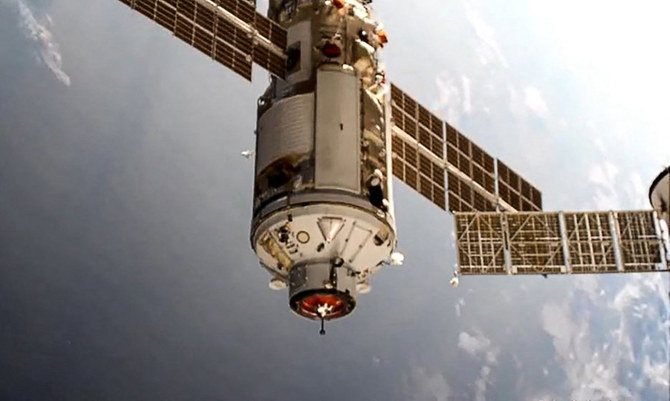
LOS ANGELES/MOSCOW: The International Space Station (ISS) was thrown briefly out of control on Thursday when jet thrusters of a newly arrived Russian research module inadvertently fired a few hours after it was docked to the orbiting outpost, NASA officials said.
The seven crew members aboard — two Russian cosmonauts, three NASA astronauts, a Japanese astronaut and a European space agency astronaut from France — were never in any immediate danger, according to NASA and Russian state-owned news agency RIA.
But the malfunction prompted NASA to postpone until at least Aug. 3 its planned launch of Boeing's new CST-100 Starliner capsule on an uncrewed test flight to the space station. The Starliner had been set to blast off atop an Atlas V rocket on Friday from the Kennedy Space Center in Florida.
Thursday's mishap began about three hours after the multipurpose Nauka module had latched onto the space station. The module's jets inexplicably restarted, causing the entire station to pitch out of its normal flight position some 250 miles above the Earth, US space agency officials said.
The "loss of attitudinal control" lasted for a little more than 45 minutes, until flight teams on the ground managed to restore the space station's orientation by activating thrusters on another module of the orbiting platform, according to Joel Montalbano, manager of NASA's space station program.
In its broadcast coverage of the incident, RIA cited NASA specialists at the Johnson Space Center in Houston, Texas, as describing the struggle to regain control of the space station as a "tug of war" between the two modules.
At the height of the incident, the station was pitching out of alignment at the rate of about a half a degree per second, Montalbano said hours later in a NASA conference call with reporters.
The Nauka engines were ultimately switched off, the space station was stabilized and its orientation was restored to where it had begun, NASA said.
Communication with the crew was lost briefly twice during the disruption, but "there was no immediate danger at any time to the crew," Montalbano said.
A drift in the space station's normal orientation was first detected by automatic sensors on the ground, and "the crew really didn't feel any movement," he said.
What caused the malfunction of the thrusters on the Nauka module, delivered by the Russian space agency Roscosmos, has yet to be determined, NASA officials said.
Montalbano said there was no immediate sign of any damage to the space station. The flight correction maneuvers used up more propellant reserves than desired, "but nothing I would worry about," he said.
After its launch last week from Kazakhstan's Baikonur Cosmodrome, the module experienced a series of glitches that raised concern about whether the docking procedure would go smoothly.
Roscosmos attributed Thursday's post-docking issue to Nauka's engines having to work with residual fuel in the craft, TASS news agency reported.
"The process of transferring the Nauka module from flight mode to 'docked with ISS' mode is underway. Work is being carried out on the remaining fuel in the module," Roscosmos was cited by TASS as saying.
The Nauka module is designed to serve as a research lab, storage unit and airlock that will upgrade Russia's capabilities aboard the ISS.
A live broadcast showed the module, named after the Russian word for "science," docking with the space station a few minutes later than scheduled.
"According to telemetry data and reports from the ISS crew, the onboard systems of the station and the Nauka module are operating normally," Roscosmos said in a statement.
"There is contact!!!" Dmitry Rogozin, the head of Roscosmos, wrote on Twitter moments after the docking.


International Space Station thrown out of control by misfire of Russian module — NASA

https://arab.news/pqtyr
International Space Station thrown out of control by misfire of Russian module — NASA


Saudi ambassador becomes first foreign envoy to meet Bangladesh’s new PM
- Tarique Rahman took oath as PM last week after landslide election win
- Ambassador Abdullah bin Abiyah also meets Bangladesh’s new FM
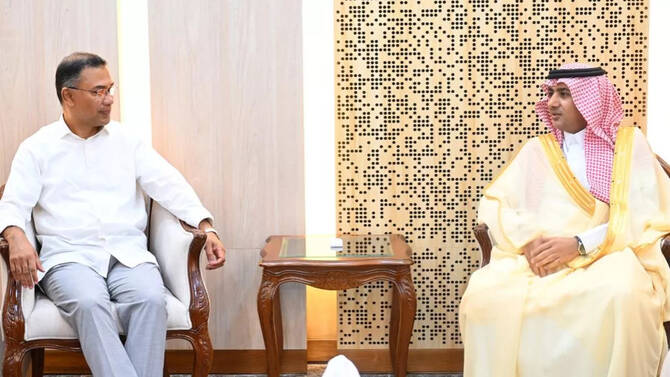
Dhaka: Saudi Arabia’s ambassador to Dhaka became on Sunday the first foreign envoy to meet Bangladesh’s new Prime Minister Tarique Rahman since he assumed the country’s top office.
Rahman’s Bangladesh Nationalist Party made a landslide win in the Feb. 12 election, securing an absolute majority with 209 seats in the 300-seat parliament.
The son of former Prime Minister Khaleda Zia and former President and BNP founder Ziaur Rahman, he was sworn in as the prime minister last week.
The Saudi government congratulated Rahman on the day he took the oath of office, and the Kingdom’s Ambassador Abdullah bin Abiyah was received by the premier in the Bangladesh Secretariat, where he also met Bangladesh’s new foreign minister.
“Among the ambassadors stationed in Dhaka, this is the first ambassadorial visit with Prime Minister Tarique Rahman since he assumed office,” Saleh Shibli, the prime minister’s press secretary, told Arab News.
“The ambassador conveyed greetings and best wishes to Bangladesh’s prime minister from the king and crown prince of Saudi Arabia … They discussed bilateral matters and ways to strengthen the ties among Muslim countries.”
Rahman’s administration succeeded an interim government that oversaw preparations for the next election following the 2024 student-led uprising, which toppled former leader Sheikh Hasina and ended her Awami League party’s 15-year rule.
New Cabinet members were sworn in during the same ceremony as the prime minister last week.
Foreign Minister Khalilur Rahman is a former UN official who served as Bangladesh’s national security adviser during the interim government’s term.
He received Saudi Arabia’s ambassador after the envoy’s meeting with the prime minister.
“The foreign minister expressed appreciation for the Saudi leadership’s role in promoting peace and stability in the Middle East and across the Muslim Ummah. He also conveyed gratitude for hosting a large number of Bangladeshi workers in the Kingdom and underscored the significant potential for expanding cooperation across trade, investment, energy, and other priority sectors, leveraging the geostrategic positions of both countries,” the ministry said in a statement.
“The Saudi ambassador expressed his support to the present government and his intention to work with the government to enhance the current bilateral relationship to a comprehensive relationship.”
Around 3.5 million Bangladeshis live and work in Saudi Arabia. They have been joining the Saudi labor market since 1976, when work migration to the Kingdom was established during the rule of the new prime minister’s father.
Bangladeshis are the largest expat group in the Kingdom and the largest Bangladeshi community outside Bangladesh and send home more than $5 billion in remittances every year.


