

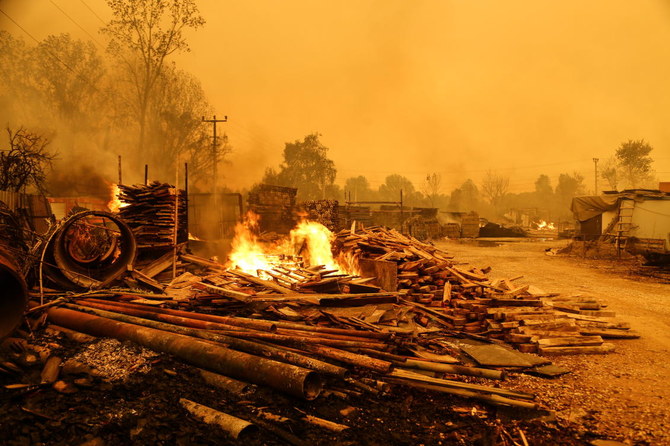

BEIRUT: Wildfires raged for a second day across pine forests in the mountainous north of Lebanon on Thursday.
George Abu Mousa, the head of the Civil Defense Service and Operations Division, told Arab News the “fires returned on Thursday mainly because of the heavy winds. We had extinguished most of the fires on Wednesday but the wind was not in our favor.”
With President Michel Aoun preoccupied with monitoring the response to the fires, the crisis has overshadowed efforts to form a new government, according to his media office.
This is adding a further complication to the negotiations to finally appoint a new authority, almost a year after the previous government resigned following the Aug. 4 explosion at Beirut’s port. Najib Mikati was appointed prime minister-designate on Monday following the resignation of his predecessor, Saad Hariri, after nine months of failed talks with Aoun over the composition of a new government. Comments from politicians in the past two days suggest that Mikati will not find the task any easier.
The main stumbling block remains the same: The distribution of government portfolios among the parties. The head of the Free Patriotic Movement, Gebran Bassil, raised the issue during a television interview on Wednesday night.
He insisted on the “blocking third,” which means control of a third of cabinet portfolios, giving the power to veto any proposal that requires a two-thirds majority. He said he “will not give his vote of confidence to the government if all portfolios are rotated except for the Ministry of Finance,” control of which Hezbollah and the Amal movement want to keep within the Shiite community.
Meanwhile efforts to extinguish the wildfires in the north of the country continue. Maj. Gen. Mohammed Khair, secretary-general of Lebanon’s High Relief Commission, said a request had been sent to Cypriot authorities for helicopters to help battle the blaze.
The fires, in Qobayat in Akkar governorate, have spread out of control in the past 24 hours, reaching the outskirts of the town of Hermel.
Amin Melhem, a young volunteer, died while helping to put out the flames in the town of Kafrtun. According to reports, he was 15 years old. Dozens of cases of suffocation were reported as the fires reached residential buildings.
Local mayors and residents of the affected areas complain that the state organizations fighting the fires lack logistical support because of the nation’s economic crisis. Fire departments and civil defense centers are suffering as a result of shortages of vital resources such as fuel, electrical power and even water.
Residents are working alongside professionals to help fight the fires. Church bells are being rung and WhatsApp messages sent urging people to try to contain the flames any way they can until fire trucks arrive. Still, the damage has been devastating.
“We lost a lot of the abundant forest wealth,” said Abu Mousa, the Civil Defense head. “Many trees caught fire, most of which are pines, oaks and olives, because of the dry weeds extending over large areas.”
He did not comment on whether or not the fire might have been started intentionally, as many residents believe.
“One fire erupted and expanded, not several fires,” he said. “We will now extinguish the flames and then wait for the investigation to find out the circumstances.”
Army helicopters joined the efforts to battle the blaze, with help from the Cypriot helicopters that had been requested.
The fires have spread across the border into Syria, where authorities put out the flames in the border towns of Shan and Ain Al-Dahab but their assistance did not extend beyond there, according to Michel Al-Murr, a first lieutenant in the Beirut Fire Brigade,.
“The rugged nature of the area makes it more difficult for the firefighters and civil defense forces to work,” he told Arab News. “Many valleys cannot be reached; we fear that volunteers and firefighters could get trapped by the fire there.
“The fire reached an army barracks in the Akkar region, as well as military checkpoints in the area.”
He added that an investigation will be needed to establish the cause of the fire.
The General Directorate of Civil Defense in the Ministry of Interior said that three civil defense workers were slightly injured on Wednesday and Thursday.
The Army Command announced on Twitter that the fires have been renewed in the Al-Ruwaymah and Al-Bustan areas, and spread to the vicinity of the houses in the forests of the Qaltabah-Qobayat area,
It added that the army units, with helicopter support, were working to extinguish the fires with help from civil defense teams and civilian volunteers.
“Four helicopters are working to put out the fires that broke out in Jabal Akrum in Akkar, and army units are participating in the extinguishing operations,” the Army Command said.
The flames ravaged the forests of Qobayat, Aandqet, Kafrtun, Akrum, Al-Ruwaymah, and mountain villages in the Beit Jaafar area, destroying tens of square kilometers of forests.
Abdo Abdo, the mayor of Qobayat, said: “About eight people were taken to hospital, and the Red Cross rescued more than 40 residents who were suffocating, and helped evacuate the area.”
The Civil Defense reported it has put out 52 forest fires in Beirut, Mount Lebanon, the North, the South, and the Bekaa Valley, during the past 24 hours.


