Pakistanis sacrificed animals worth around $2.5 billion on Eid Al-Adha, tanners say 

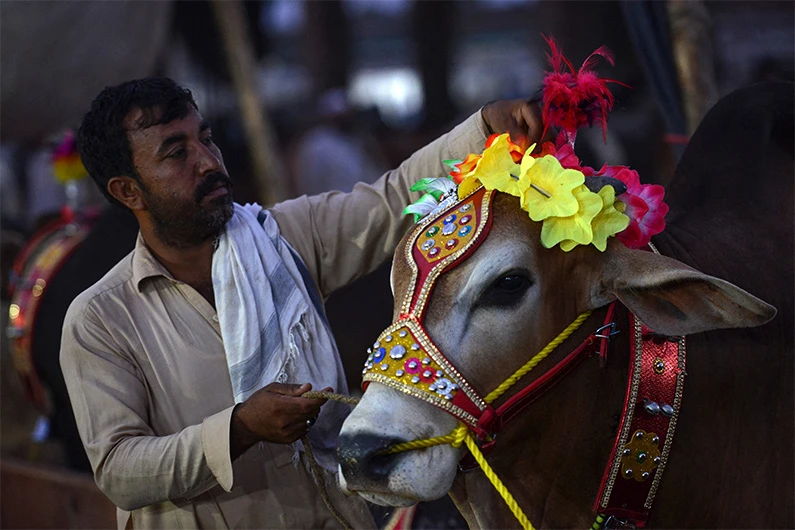
A livestock vendor stands with his cattle at a market ahead of the Muslim festival of Eid al-Adha in Peshawar on July 13, 2021. (AFP)
Short Url
Updated 29 July 2021
Follow

Pakistanis sacrificed animals worth around $2.5 billion on Eid Al-Adha, tanners say 

  • Up to 9 million animals including cows, sheep, goats and camels, were slaughtered this Eid 
  • Number of sacrifices on the rise since last year as people unable to go to Saudi Arabia for Hajj pilgrimage

KARACHI: Pakistanis sacrificed around nine million animals worth $2.5 billion on the Muslim festival of Eid Al-Adha last week, tanners and leather exporters have said, at least a one-billion-dollar increase from last year.
Eid Al-Adha, the second most important festival of Islam, was observed in Pakistan last Wednesday. Muslims traditionally mark the occasion by sacrificing livestock and distributing the meat among friends, family and the poor.
In Pakistan, the number of sacrificial animals has been on the rise since last year as people have been unable to go to Saudi Arabia to perform the Hajj pilgrimage due to coronavirus restrictions and have thus offered the ritual sacrifice in their home country.
Last year, the worth of sacrificial animals was estimated to be $1.5 billion.
“We estimate that around eight million to nine million animals including cows, sheep, goats and camels, were slaughtered on this Eid Al-Adha,” Abdul Salam, senior vice-chairman of the Pakistan Tanners Association (PTA), told Arab News. “Large number of Pakistanis who were unable to go for Hajj have offered the sacrifice rituals here in the country ... Sacrifices are more than our estimate of six million to seven million for this year.”
M. Danish Khan, chairman of the Pakistan Leather Garments Manufacturers and exporters Association (PLGMEA), told Arab News Rs400 billion ($2.5 billion) worth of animals were slaughtered this year. No official data was available.
“This growth is due to the restrictions on travel for Hajj,” Khan said.
Former PTA chairman Ejaz Ahmed Sheikh, who is chairman of leather supplier Bombal Leathers, said while exact figures were as yet unavailable, the overall value of sacrificial animals could be even higher than tanners’ estimates.
“It is estimated that around 3-4 million cows were slaughtered this year,” he told Arab News. “So, keeping average price at Rs 100,000, the overall value goes up to Rs300 billion, while if we add the value of goats, sheep, and camels, the value exceeds Rs400 billion.”
The rate of waste has also been higher this year, with data from the Lahore branch of PTA showing that Rs2 billion worth of hides and skins was wasted. 
PLGME’s chief Khan said material wastage was an annual problem.
“Huge quantities of hides and skins are wasted every year due to lack of proper facilities required to preserve the material,” he said.
Skins and hides from sacrificial animals are usually collected by Islamic seminaries and welfare organizations which sell them to leather exporters and tanners to meet their financial expenditures.
Qazi Sadaruddin, director at the Al-Khidmat Foundation, a non-governmental organization that provides humanitarian services across Pakistan, told Arab News the collection of skins, as well as their rates, had increased this year.
“The rates are comparatively higher this year and the collection of skins and hides has also increased,” he said.
Eid Al-Adha contributes around 20-30 percent of raw material to Pakistan’s leather industry, which PLGME expects will cross the $1 billion mark this year. In the previous fiscal year 2020-21, the leather sector contributed $833 million to Pakistan’s overall exports of $25.3 billion.
“Despite COVID-19, Pakistan’s export sector has performed very well during the last fiscal year,” PLGME’s Khan said. “We hope that this year Pakistan’s leather exports will hit the $1 billion mark”.


Pakistan launches digital tools to trace life insurance claims, tighten motor insurance enforcement

Updated 6 sec ago
Follow

Pakistan launches digital tools to trace life insurance claims, tighten motor insurance enforcement

  • SECP rolls out SMS-based Life Insurance Policy Finder, orders insurers to join Motor Insurance Repository
  • The regulator says centralized data will help authorities verify coverage, reduce long-unclaimed benefits

KARACHI: Pakistan’s securities regulator on Monday announced two digital initiatives aimed at overhauling how insurance data is stored and accessed, in a push to strengthen enforcement, improve transparency and make it easier for citizens to trace insurance coverage.

The Securities and Exchange Commission of Pakistan (SECP) announced in two separate statements it had introduced a nationwide Life Insurance Policy Finder to help families identify policies held by deceased relatives. It also directed all non-life insurers to join a centralized Motor Insurance Repository (MIR).

Both systems, developed with the Central Depository Company (CDC), seek to address longstanding gaps in a sector where weak records, low compliance and limited data-sharing have left motorists, policyholders and beneficiaries without reliable recourse.

“The Securities and Exchange Commission of Pakistan (SECP), in collaboration with the Central Depository Company of Pakistan Limited (CDC) and the Insurance Association of Pakistan (IAP), has introduced the Life Insurance Policy Finder Service,” it said in one of the statements. “This initiative is designed to facilitate the general public in locating life insurance policies of deceased loved ones.”

“The service addresses a long-standing challenge faced by families who remain unaware of life insurance policies held by their deceased relatives,” it added. “This lack of awareness often results in legitimate claims and benefits remaining unclaimed for years.”

The SECP said the initiative aims to strengthen consumer protection, promote transparency and provide structured and secure access to insurance benefits for rightful heirs and beneficiaries.

Under the new policy-finder service, which goes live on Dec. 15, individuals can send the CNIC number of the deceased via SMS to 99833.

If a policy exists, the relevant insurer will contact the beneficiary to verify details and guide them through the claims process. Life insurers and family takaful operators have also been instructed to participate fully and respond to queries within set turnaround times.

Separately, on the motor insurance side, all non-life insurers underwriting vehicle policies are required to sign a service-level agreement with the CDC within 60 days and begin uploading complete and validated policy data to the MIR.

The repository will allow provincial and federal authorities to verify third-party insurance coverage, a requirement that exists on paper but remains loosely enforced nationwide.

The SECP said the measures form part of its broader effort to promote digital transformation, improve compliance and safeguard consumer interest.

“A centralized and validated data repository will allow authorities to verify insurance coverage efficiently, addressing significant gaps in compliance,” it added.