NEW DELHI: US Secretary of State Antony Blinken met with a representative of Tibet’s spiritual leader, the Dalai Lama, in New Delhi on Wednesday, a State Department spokesperson said, a move that is likely to provoke anger in China.
Blinken met briefly with Ngodup Dongchung, who serves as a representative of Central Tibetan Administration (CTA), also known as the Tibetan government in exile, the spokesperson said.
Chinese troops seized Tibet in 1950 in what Beijing calls a “peaceful liberation.” In 1959, the Dalai Lama fled into exile in India following a failed uprising against Chinese rule.
The CTA and Tibetan advocacy groups have received a boost in international support in recent months amid rising criticism of China’s human rights record, particularly from the United States.
In November, Lobsang Sangay, the former head of the Tibetan government in exile, visited the White House, the first such visit in six decades.
A month later, the US Congress passed the Tibet Policy and Support Act, which calls for the right of Tibetans to choose the successor to the Dalai Lama, and the establishment of a US consulate in the Tibetan capital Lhasa.
Blinken’s meeting with Dongchung is the most significant contact with the Tibetan leadership since the Dalai Lama met then-president Barack Obama in Washington in 2016.
China’s foreign ministry did not immediately respond to a request for comment. Beijing says Tibet is a part of China and has labelled the Dalai Lama a dangerous separatist.
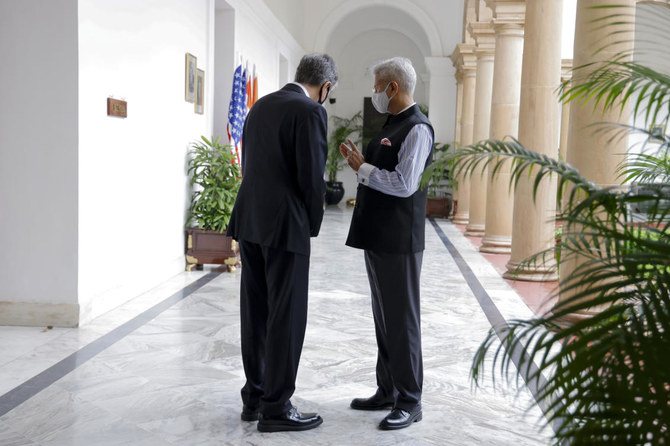
In his first visit to India since joining US President Joe Biden’s administration, Blinken also met his Indian counterpart, Foreign Minister Subrahmanyam Jaishankar, and other officials on Wednesday before heading to see Prime Minister Narendra Modi.
The two sides are expected to discuss supplies of COVID-19 vaccines, the security situation in Afghanistan, and India’s human rights record.
Speaking to a group of civil society leaders at a New Delhi hotel, Blinken said that the relationship between the United States and India was “one of the most important in the world.”
“The Indian people and the American people believe in human dignity and equality of opportunity, the rule of law, fundamental freedoms including freedom of religion and belief . . . these are the fundamental tenets of democracies like ours,” he said.
“And of course, both of our democracies are works in progress. As friends we talk about that.”
Indian foreign ministry sources said ahead of Blinken’s visit that the country was proud of its pluralistic traditions and happy to discuss the issue with him.
Modi’s government has faced allegations of suppressing dissent, pursuing divisive policies to appeal to its Hindu nationalist base and alienating Muslims, the country’s biggest minority.
Blinken arrived in India on Tuesday night and leaves for Kuwait later on Wednesday.

Risking China’s anger, Blinken meets representative of Dalai Lama in India
https://arab.news/b5s72
Risking China’s anger, Blinken meets representative of Dalai Lama in India
- US Secretary of State Antony Blinken also met his Indian counterpart, Foreign Minister Subrahmanyam Jaishankar
What is Trump’s ‘Board of Peace’?
- The Board of Peace’s charter does not appear to limit its role to the occupied Palestinian territory of Gaza
- Trump will be chairman but also “separately serve as inaugural representative of the United States of America”
BRUSSELS: US President Donald Trump’s government has asked countries to pay $1 billion for a permanent spot on his “Board of Peace” aimed at resolving conflicts, according to its charter seen by AFP.
The board was originally conceived to oversee the rebuilding of war-torn Gaza, but the charter does not appear to limit its role to the occupied Palestinian territory.
What exactly will it do? And who has been invited?
- To what end? -
The Board of Peace will be chaired by Trump, according to its founding charter.
It is “an international organization that seeks to promote stability, restore dependable and lawful governance, and secure enduring peace in areas affected or threatened by conflict,” reads the preamble of the charter sent to countries invited to participate.
It will “undertake such peace-building functions in accordance with international law,” it adds.
- Who’s boss? -
Trump will be chairman but also “separately serve as inaugural representative of the United States of America.”
“The Chairman shall have exclusive authority to create, modify, or dissolve subsidiary entities as necessary or appropriate to fulfill the Board of Peace’s mission,” the document states.
He will pick members of an Executive Board to be “leaders of global stature” to “serve two-year terms, subject to removal by the Chairman.”
He may also, “acting on behalf of the Board of Peace,” “adopt resolutions or other directives.”
The chairman can be replaced only in case of “voluntary resignation or as a result of incapacity.”
- Who can be a member? -
Member states have to be invited by the US president, and will be represented by their head of state or government.
Each member “shall serve a term of no more than three years,” the charter says.
But “the three-year membership term shall not apply to Member States that contribute more than USD $1,000,000,000 in cash funds to the Board of Peace within the first year of the Charter’s entry into force,” it adds.
The board will “convene voting meetings at least annually,” and “each member State shall have one vote.”
But while all decisions require “a majority of Member States present and voting,” they will also be “subject to the approval of the Chairman, who may also cast a vote in his capacity as Chairman in the event of a tie.”
- Who’s already in? -
The White House has said its members will include:
US President Donald Trump, chair
US Secretary of State Marco Rubio
Steve Witkoff, Trump’s special negotiator
Jared Kushner, Trump’s son-in-law
Tony Blair, former UK prime minister
Marc Rowan, billionaire US financier
Ajay Banga, World Bank president
Robert Gabriel, loyal Trump aide on the National Security Council
- Who’s been invited? -
The list of countries and leaders who say they have been invited include, but are not limited to:
Russia’s President Vladimir Putin
Canada’s Prime Minister Mark Carney
Egypt’s President Abdel Fattah El-Sisi
Argentina’s President Javier Milei
Jordan
Brazil
Paraguay
India
Pakistan
Germany
France
Italy
Hungary
Romania
Uzbekistan
Belarus
Greece
Morocco
Slovenia
Poland
- When does it start? -
The charter says it enters into force “upon expression of consent to be bound by three States.”


