

Facebook restores user’s account suspended over shared letter by grieving jailed Palestinian activist

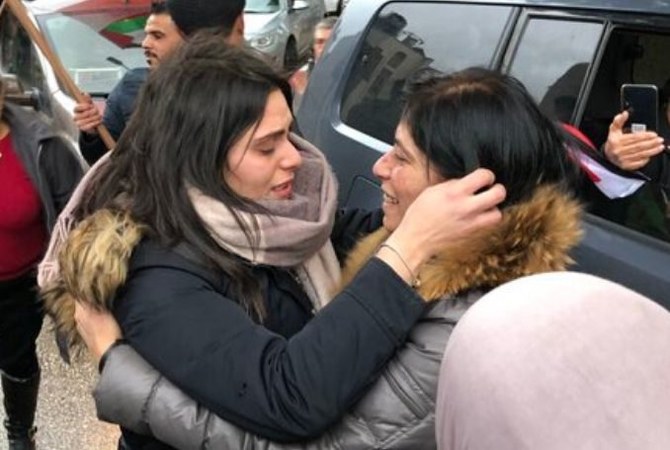
Omar Nazzal posted the letter on his personal Facebook page but his account was suspended for two months for “violating Facebook’s community standards.” (Twitter)
Short Url
Updated 27 July 2021
Follow

Facebook restores user’s account suspended over shared letter by grieving jailed Palestinian activist

  • Facebook restores the account of a Palestinian user who was temporarily blocked over the posting of a letter written by a jailed activist
  • The activist has been arrested and imprisoned several times by Israel, often being held without charge under administrative detention

LONDON: Facebook has restored the account of a Palestinian user the social networking company had temporarily blocked over the posting of a letter written by a jailed activist.

Omar Nazzal had shared online a poignant letter penned by Palestinian politician Khalida Jarrar after she was barred by Israel from attending her daughter Suha’s funeral.

Written from her cell in Damon Prison, Haifa, on July 13, Jarrar’s message had reportedly been read out at the funeral of her daughter who had died of heart failure.

It said: “Suha came into the world while her father was in jail, and she is leaving the world while her mother is in jail. Suha, my precious. They have stripped me from bidding you a final goodbye kiss, so I bid you farewell with a flower.”


Jarrar, 58, has been arrested and imprisoned several times by Israel, often being held without charge in what the Israelis call administrative detention. She is currently serving a two-year administrative detention sentence.

Her letter was widely shared on social media but when Nazzal, a close friend of the Jarrar family, posted it on his personal Facebook page his account was suspended for two months for “violating Facebook’s community standards.”

The company restored Nazzal’s account five days later.


Facebook’s move was the latest in a line of incidents involving the tech giant censoring Palestinian-related content on its platforms. In May alone, more than 700 cases of digital rights violations took place against Palestinians on social media including the deletion of personal accounts, removal of posts, and suspension of the accounts of journalists and news agencies.


Lebanon’s official media scale back Hezbollah coverage after Cabinet ban

Updated 12 March 2026
Follow

Lebanon’s official media scale back Hezbollah coverage after Cabinet ban

  • Information Minister Paul Morcos instructs outlets to comply with government decision
  • Journalists, social media urged to avoid content that could provoke hate speech, incitement

BEIRUT: Lebanon has begun implementing a Cabinet decision taken earlier this month to ban Hezbollah’s security and military activities by scaling back coverage of the group on official media platforms.

The measure, which was described in political circles as a significant and bold step, came after decades during which news about the party and the speeches of its leaders were published verbatim and broadcast live through official media outlets, like the state-run National News Agency, TV station Tele Liban and Radio Lebanon.

“No one is imposing censorship,” an official source told Arab News.

“Rather, there is a commitment to the decisions of the state. It is no longer possible for a speech that attacks the Lebanese government and the state to be published through its official media outlets.”

Information Minister Paul Morcos issued a circular instructing directors of official media outlets to comply with the government’s decision to ban the broadcast of speeches or statements by Hezbollah Secretary-General Sheikh Naim Qassem and statements issued by the group’s armed wing, particularly when they contain criticism of the state.

Morcos also ordered that Hezbollah statements be handled in the same manner as those issued by other political parties, meaning they should not be published verbatim. He further instructed media outlets to avoid using the term “Islamic resistance,” except when it appears directly within Hezbollah statements.

The first manifestations of the decision were Tele Liban’s abstention from live broadcasting a speech by Qassem and a statement made on Tuesday by lawmaker Mohammed Raad, who heads the Hezbollah parliamentary bloc.

The group’s supporters described the move as an attempt “to restrict the resistance, Hezbollah and its leadership in the official media.”

Some argued on social media that preventing the use of terms like “resistance” or “holy warriors (Mujahedin)” and replacing them with expressions such as “Hezbollah” and “fighters” was “aimed at brainwashing and stripping the party of its resistance identity.”

During a Cabinet session on Thursday, Morcos raised the issue of content circulating on social media that incites murder and sectarian strife. This comes against the backdrop of the war that Hezbollah waged from Lebanon against Israel on March 2, without state approval, which led to a sharp division in Lebanese public opinion.

Morcos, who is also Cabinet spokesperson, said after the session that what was being published “exceeds the bounds of freedom of opinion, the press and expression.”

Prime Minister Nawaf Salam considered it to fall under the penal code, specifically regarding crimes that harm national unity, he said, and that “we are against strife in all its forms.”

Morcos also urged journalists, influencers and social media users to remain aware of the sensitivity of the current situation and to avoid content that could provoke strife, hate speech or incitement.

He acknowledged, however, that, according to a legal study, he has no authority over social media, even on media-related matters.

“The Ministry of Information does not exercise a guardianship role and lacks judicial police powers,” he said.

“These authorities rest with the public prosecution offices, which are overseen by the minister of justice and fall within the domain of criminal law and criminal prosecution.”

The ban was agreed during a Cabinet session on March 2, after Hezbollah launched six rockets from Lebanese territory toward northern Israel, the first such attack since the November 2024 ceasefire, prompting retaliatory strikes.

The Cabinet reaffirmed that “the decision of war and peace rests exclusively with the Lebanese state and its constitutional institutions,” and called on Hezbollah to hand over its weapons to the state while limiting its role to political activity within the legal and constitutional framework.