

Umrah companies gear up to receive foreign pilgrims

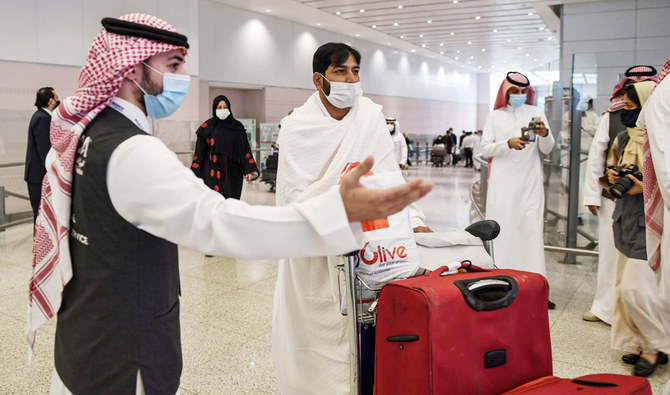
Following the temporary closure of Umrah due to the emergence of the pandemic, worshippers were allowed to perform the Umrah rituals in early October. (AFP/File)
Short Url
Updated 26 July 2021
Follow

Umrah companies gear up to receive foreign pilgrims

  • Industry workers could be trained to operate under pandemic conditions, says official

MAKKAH: Hundreds of companies are gearing up to receive fully immunized foreign pilgrims wishing to perform Umrah from Aug. 9.

Via an online platform, pilgrims will be given access to 500 businesses providing access to flights, transport, hotels and Umrah companies.
Hani Al-Omairi, a member of the National Committee for Hajj and Umrah and the Hotels Committee in Makkah, told Alarabiya that nearly 30 websites and platforms will be available for international reservations.
“Health courses and crowd management courses were given to all employees as several companies have commenced operations. Procedures for the rest of the companies and institutions are being finalized by the Ministry of Hajj and Umrah and other relevant authorities,” said Al-Omairi.
Commenting on the news, Mohsin Tutla, chairman of the World Hajj and Umrah Care Foundation, told Arab News the return of pilgrims could be ensured through training the industry to provide services under pandemic conditions. He added that the introduction of vigilance technology throughout the pilgrimage and further measures would help smoothen the process.
Tutla told Arab News that the demand from pilgrims to conduct rituals during the pandemic is not as high as people may think.

SPEEDREAD

• Via an online platform, pilgrims will be given access to 500 businesses providing access to flights, transport, hotels and Umrah companies. 

• Hani Al-Omairi, a member of the National Committee for Hajj and Umrah and the Hotels Committee in Makkah, says nearly 30 websites and platforms will be available for international reservations.

“Even though we can assume that people have been queuing to perform Hajj and Umrah, the reality is that people’s financial capability has been depleted.
“Where Hajj and Umrah were available and easy for the mass population and the middle income population, it is now only possible for the rich and thrifty savers.”

Tutla added: “The road to recovery and rejuvenation is not dependent on only demand, it is dependent on the development of global safety mechanisms such as the Hajj and Umrah Safe Corridor, which is currently being developed by the World Hajj and Umrah Care Foundation, and is being installed in 25 countries worldwide.

Demand from pilgrims to conduct rituals during the pandemic is not as high as people may think. 

Mohsin Tutla, Chairman of the World Hajj and Umrah Care Foundation

“Globally you will realize that demand would have dropped by approximately 40 percent for international Umrah and 15 percent for international Hajj pilgrimages.” Following the temporary closure of Umrah due to the emergence of the pandemic, worshippers were allowed to perform the Umrah rituals in early October. As many as 250,000 domestic pilgrims were able to register, book appointments and granted permits in the first phase.
Some 10,000 foreign pilgrims were gradually allowed back into the Kingdom in the third phase on Nov. 1 after a seven-month hiatus of strict regulations.


Experimental farm in Al-Lith looks into future of Saudi Arabian agriculture

Updated 02 February 2026
Follow

Experimental farm in Al-Lith looks into future of Saudi Arabian agriculture

  • Research initiative reflects strategic transformation

JEDDAH: An experimental farm in Saudi Arabia’s Al-Lith Governorate is one of the research initiatives reflecting the strategic transformation taking place in the Kingdom’s agricultural sector.

The farm uses highly efficient, sustainable production models that combine scientific research with commercial application, contributing to strengthening the country’s food security system and the sustainability of water resources.

Located in the Ghumaiqa Center on an area of about 10 hectares, the cutting-edge farm is a testing platform for modern agricultural technologies that tackle the challenge of water scarcity.

The farm includes developed open fields and modern greenhouses, supported by smart irrigation encompassing drip and sprinkler irrigation alongside surface and subsurface technologies.

All the systems operate via smart controls that enable the monitoring of water consumption and ensure improved efficiency, thereby achieving a balance between agricultural production and water conservation.

The farm also uses treated and diluted low-salinity seawater.

It aims to diversify agricultural water sources, reduce reliance on freshwater, and open new horizons for agriculture in coastal and semi-arid environments.

A view of the experimental farm in Al-Lith. (SPA)

The project represents a promising investment opportunity in the field of smart agriculture, enabling the development of commercially scalable production models, particularly for high-value vegetables and fruits, while reducing operational costs associated with water and energy, enhancing the economic feasibility of future agricultural projects.

In addition, the project contributes to transferring and localizing agricultural expertise, supporting local food supply chains, and creating an attractive environment for agricultural investment.

This aligns with Sustainable Development Goals and enhances the efficiency of the private sector in adopting innovative agricultural solutions.

Yahya bin Abdulrahman Al-Mahabi, the director of the Ministry of Environment, Water and Agriculture office in Al-Lith Governorate, told the Saudi Press Agency that the project represented the future of agriculture in the Kingdom.

He explained that the vision was based on investing in technology, enhancing the return on water per unit, and integrating scientific research with investment opportunities.

Al-Mahabi spoke of the experimental farm as a modern, scalable and replicable model applicable in several regions of the Kingdom, particularly in coastal environments.

Al-Mahabi highlighted the Ministry of Environment, Water and Agriculture’s commitment to supporting distinctive projects that contributed to achieving food security while developing rural areas and enhancing agricultural production efficiency, in line with the objectives of the Kingdom’s Vision 2030.