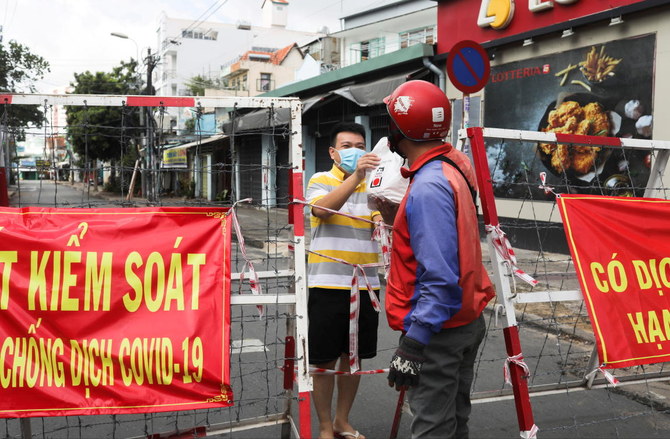
Vietnam locks down capital Hanoi for 15 days as COVID-19 cases rise

In the latest wave of COVID-19 since April, Vietnam has recorded over 83,000 infections and 335 deaths. (Reuters)
Short Url
Updated 24 July 2021
Follow

Vietnam locks down capital Hanoi for 15 days as COVID-19 cases rise

  • The lockdown order, issued late Friday night, bans the gathering of more than two people in public
  • In the latest wave of COVID-19 since April, Vietnam has recorded over 83,000 infections and 335 deaths

HANOI, Vietnam: Vietnam announced a 15-day lockdown in the capital Hanoi starting Saturday as a coronavirus surge spread from the southern Mekong Delta region.
The lockdown order, issued late Friday night, bans the gathering of more than two people in public. Only government offices, hospitals and essential businesses are allowed to stay open.
Earlier in the week, the city had suspended all outdoor activities and ordered non-essential businesses to close following an increase in cases. On Friday, Hanoi reported 70 confirmed infections, the city’s highest, part of a record 7,295 cases in the country in the last 24 hours.
Nearly 5,000 of them are from Vietnam’s largest metropolis, southern Ho Chi Minh City, which has also extended its lockdown until Aug. 1.
In the latest wave of COVID-19 since April, Vietnam has recorded over 83,000 infections and 335 deaths.
A meeting of the National Assembly that opened in Hanoi on Tuesday with 499 delegates is going ahead, although it was shortened to 12 from the original 17 days.
The delegates have been vaccinated, are regularly tested for the coronavirus and are traveling in a bubble, and are isolated at hotels, according to the National Assembly.


Sanchez hails Spain’s immigration approach as a model for EU

Updated 4 sec ago
Follow

Sanchez hails Spain’s immigration approach as a model for EU

  • Prime minister rejects critics who argue Spain’s stance fuels illegal migration to the country

MADRID: Prime Minister Pedro Sanchez has hailed Spain’s openness to immigration as a model for Europe, saying it has benefited the economy and bolstered state coffers.

While other European nations have tightened their borders against newcomers under pressure from right-wing parties, Spain has championed legal immigration.

The country has opened up paths for migrants to live and work in the country legally, even as it has pushed to police its borders and block irregular migration.

Migration accounts for 80 percent of Spain’s economic growth over the past six years, and accounts for 10 percent of the country’s social security revenues, Sanchez said.

“Spain will continue to defend a migration model that works, one that works for Spain and could also help awaken an aging Europe,” the Socialist premier told a gathering of Spanish ambassadors in Madrid.

“Our model works. There is no so-called ‘pull effect,’” Sanchez added, rejecting critics who argue Spain’s pro-immigration stance fuels illegal migration to the country.

Irregular migrant arrivals to Spain fell by 42.6 percent in 2025 from the previous year to 36,775, largely due to a sharp drop in arrivals along the Atlantic route to the Canary Islands, according to Interior Ministry figures.

Spain has reached cooperation agreements with several African nations that are key sources of irregular migration to bolster the fight against smuggling networks.

Spain, the EU’s fourth-largest economy, has outperformed its peers since 2021, supported by tourism, low energy costs, domestic consumption, and foreign investment.

The government forecasts the economy will expand by 2.9 percent in 2025, more than twice the euro zone average.