Egyptian government approves rise in fuel prices

1 / 2
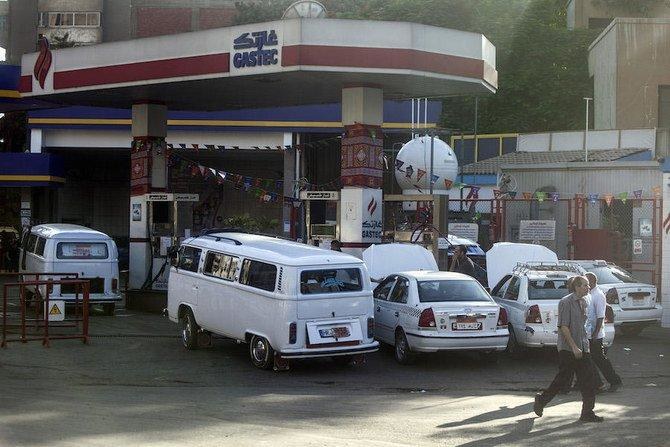
Consumers purchase fuel at a petrol station near Cairo Airport, Egypt.(REUTERS file photo)
2 / 2
In April, Egypt's price-setting committee raised domestic fuel prices for the first time since it was formed in October 2019. (AFP)
Short Url
Updated 24 July 2021
Follow

Egyptian government approves rise in fuel prices

  • Prices of all three grades raised by 0.50 Egyptian pounds each
  • Citizens who use public transportation will not be affected by latest move, official says

CAIRO: The Egyptian government has raised fuel prices from Friday based on the decisions of the Automatic Pricing Committee for Petroleum Products.

The committee, which meets every three months, issued a statement raising gasoline prices by 25 piasters ($0.016), with the price of a liter of 80 octane gasoline rising to EGP 6.75 ($0.43). The price of 92 octane gasoline is now EGP 8 per litre and high-quality 95 octane gasoline is EGP 9.

The price of diesel remains unchanged at EGP 6.75 per liter for public transport vehicles and EGP 3,900 per ton for the industrial sector.

The government implemented the new gasoline prices on Friday morning, according to a statement from the Ministry of Petroleum and Mineral Resources.

The last price hike was in April, in line with the Egyptian government’s plan to gradually stop subsidizing fuel products within the framework of a reform program supported by the International Monetary Fund.

Prices have remained stable over the past year after dropping in April 2020 and October 2019.

FASTFACT

The price of diesel remains unchanged at EGP 6.75 per liter for public transport vehicles and EGP 3,900 per ton for the industrial sector.

The Egyptian Ministry of Petroleum stated that the pricing committee reviewed the average prices of Brent crude in the global market and the exchange rate of the dollar against the Egyptian pound for the period from April to June 2021.

These are the two most important factors “influencing the cost of providing and selling petroleum products in the local market, in addition to other burdens and costs,” the ministry said.

It said the committee’s recommendations reflected the current conditions in the world, such as the severe fluctuation in global prices resulting from the pandemic and the reduction of crude production.

Hossam Arafat, head of the General Division for Petroleum Products, said that the rise was due to the rise in the dollar, the increase in direct and indirect expenses and the rise in the price of a barrel of oil.

He said the prices of diesel used in public and private transportation would remain fixed. It means transportation ticket prices will remain unchanged.

Ahmed Mohamed, a government employee, said that the rise in fuel prices will not affect him because he does not own a car.

He said that the Egyptian government has been very open with its citizens for years, as it had told them that it would gradually stop subsidizing petroleum products.


‘The future is renewables,’ Indian energy minister tells World Economic Forum

Updated 22 January 2026
Follow

‘The future is renewables,’ Indian energy minister tells World Economic Forum

  • ‘In India, I can very confidently say, affordability (of renewables) is better than fossil fuel energy,’ says Pralhad Venkatesh Joshi during panel discussion
  • Renewables are an increasingly important part of the energy mix and the technology is evolving rapidly, another expert says at session titled ‘Unstoppable March of Renewables?’

BEIRUT: “The future is renewables,” India’s minister of new and renewable energy told the World Economic Forum in Davos on Wednesday.
“In India, I can very confidently say, affordability (of renewables) is better than fossil fuel energy,” Pralhad Venkatesh Joshi said during a panel discussion titled “Unstoppable March of Renewables?”
The cost of solar power has has fallen steeply in recent years compared with fossil fuels, Joshi said, adding: “The unstoppable march of renewables is perfectly right, and the future is renewables.”
Indian authorities have launched a major initiative to install rooftop solar panels on 10 million homes, he said. As a result, people are not only saving money on their electricity bills, “they are also selling (electricity) and earning money.”
He said that this represents a “success story” in India in terms of affordability and “that is what we planned.”
He acknowledged that more work needs to be done to improve reliability and consistency of supplies, and plans were being made to address this, including improved storage.
The other panelists in the discussion, which was moderated by Godfrey Mutizwa, the chief editor of CNBC Africa, included Marco Arcelli, CEO of ACWA Power; Catherine MacGregor, CEO of electricity company ENGIE Group; and Pan Jian, co-chair of lithium-ion battery manufacturer Contemporary Amperex Technology.
Asked by the moderator whether she believes “renewables are unstoppable,” MacGregor said: “Yes. I think some of the numbers that we are now facing are just proof points in terms of their magnitude.
“In 2024, I think it was 600 gigawatts that were installed across the globe … in Europe, close to 50 percent of the energy was produced from renewables in 2024. That has tripled since 2004.”
Renewables are an increasingly important and prominent part of the energy mix, she added, and the technology is evolving rapidly.
“It’s not small projects; it’s the magnitude of projects that strikes me the most, the scale-up that we are able to deliver,” MacGregor said.
“We are just starting construction in the UAE, for example. In terms of solar size it’s 1.5 gigawatts, just pure solar technology. So when I see in the Middle East a round-the-clock project with just solar and battery, it’s coming within reach.
“The technology advance, the cost, the competitiveness, the size, the R&D, the technology behind it and the pace is very impressive, which makes me, indeed, really say (renewables) is real. It plays a key role in, obviously, the energy demand that we see growing in most of the countries.
“You know, we talk a lot about energy transition, but for a lot of regions now it is more about energy additions. And renewables are indeed the fastest to come to market, and also in terms of scale are really impressive.”
Mutizwa asked Pan: “Are we there yet, in terms of beginning to declare mission accomplished? Are renewables here to stay?”
“I think we are on the road but (its is) very promising,” Pan replied. There is “great potential for future growth,” he added, and “the technology is ready, despite the fact that there are still a lot of challenges to overcome … it is all engineering questions. And from our perspective, we have been putting in a lot of resources and we are confident all these engineering challenges will be tackled along the way.”
Responding to the same question, Arcelli said: “Yes, I think we are beyond there on power, but on other sectors we are way behind … I would argue today that the technology you install by default is renewables.
“Is it a universal truth nowadays that renewables are the cheapest?” asked Mutizwa.
“It’s the cheapest everywhere,” Arcelli said.