Pakistani barbers decorate camels with ancient motifs in elaborate Eid makeover 

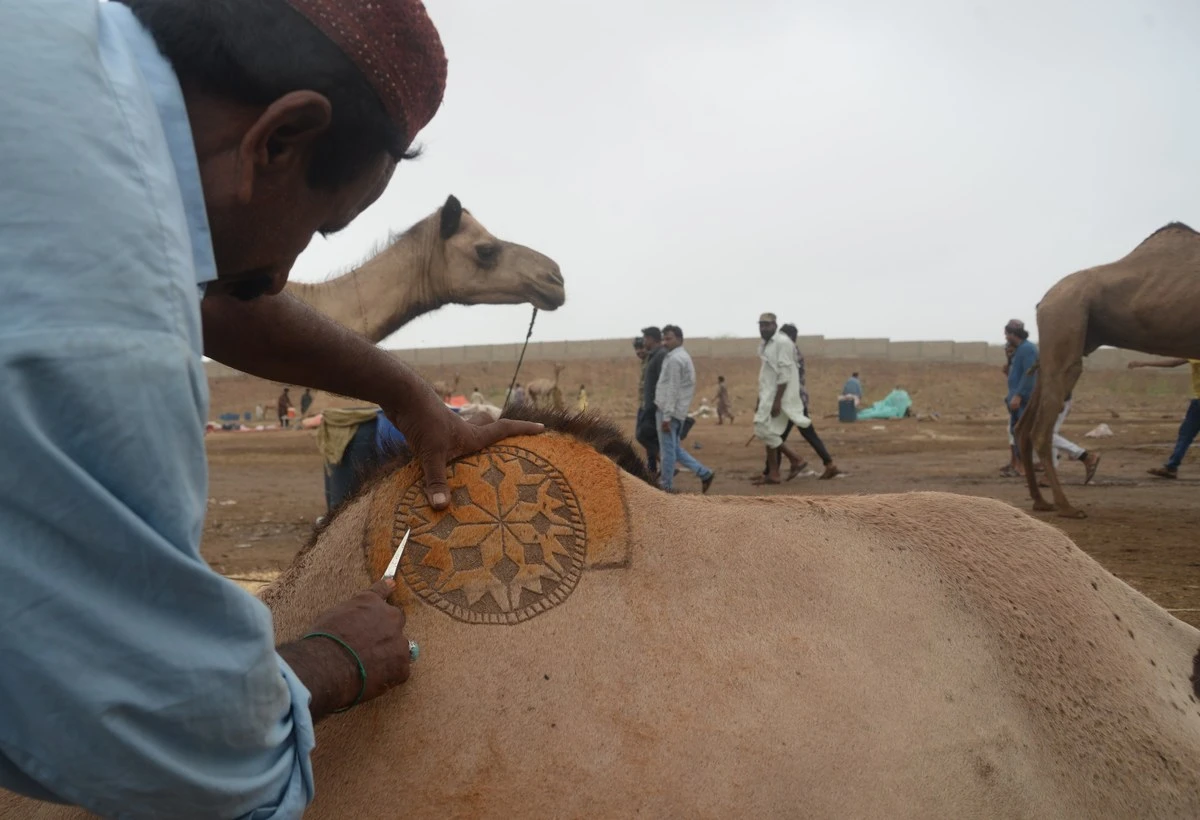
Artist Ali Hassan creates a design on a camel's hide in Karachi, Pakistan on July 20, 2021. (AN photo by S.A. Babar)
Short Url
Updated 23 July 2021
Follow

Pakistani barbers decorate camels with ancient motifs in elaborate Eid makeover 

  • Most of camel art designs are a continuation of Sindh's thousands of years old artistic heritage
  • Demand for camel barbering increases during Eid Al-Adha when Pakistanis want to buy the best and most beautiful sacrificial animals

KARACHI: When the season comes, Ali Hassan often switches off his phone as camel traders from rural Sindh flood him with orders to decorate their animals with elaborate haircuts and ancient Sindhi motifs.

Now in his fifties, Hassan has been practicing camel barbering for the past four decades and is one of the most famous masters of the art.

Demand for his craft usually peaks in the first weeks of January, and again during Eid Al-Adha when Pakistanis want to buy the best and most beautiful sacrificial animals.
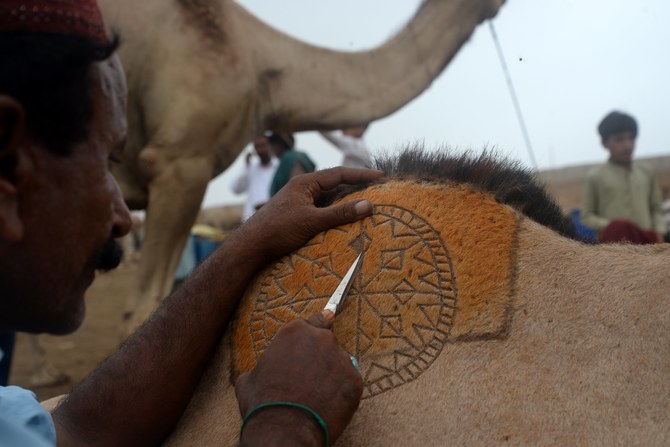


Ali Hassan says he knows exactly which motif would look best on each animal as he decorates a camel with a traditional Sindhi pattern in Karachi, Pakistan on July 20, 2021. (AN photo by S.A. Babar)

"People reach out to get their camels a new makeover, so much so that at times I have to switch off my phone to avoid the influx," Hassan told Arab News at a camel market in Karachi earlier this week, as he finished decorating a camel's hide with rilli, a complex embroidery pattern used in the traditional art of Sindh.

Camel barbering in Pakistan is a distinctive blend of art and symbolism. The artists make the patterns by cutting the rough hairy coat of the camels with scissors in multiple stages. Later, some of them apply natural henna dyes to color these motifs.
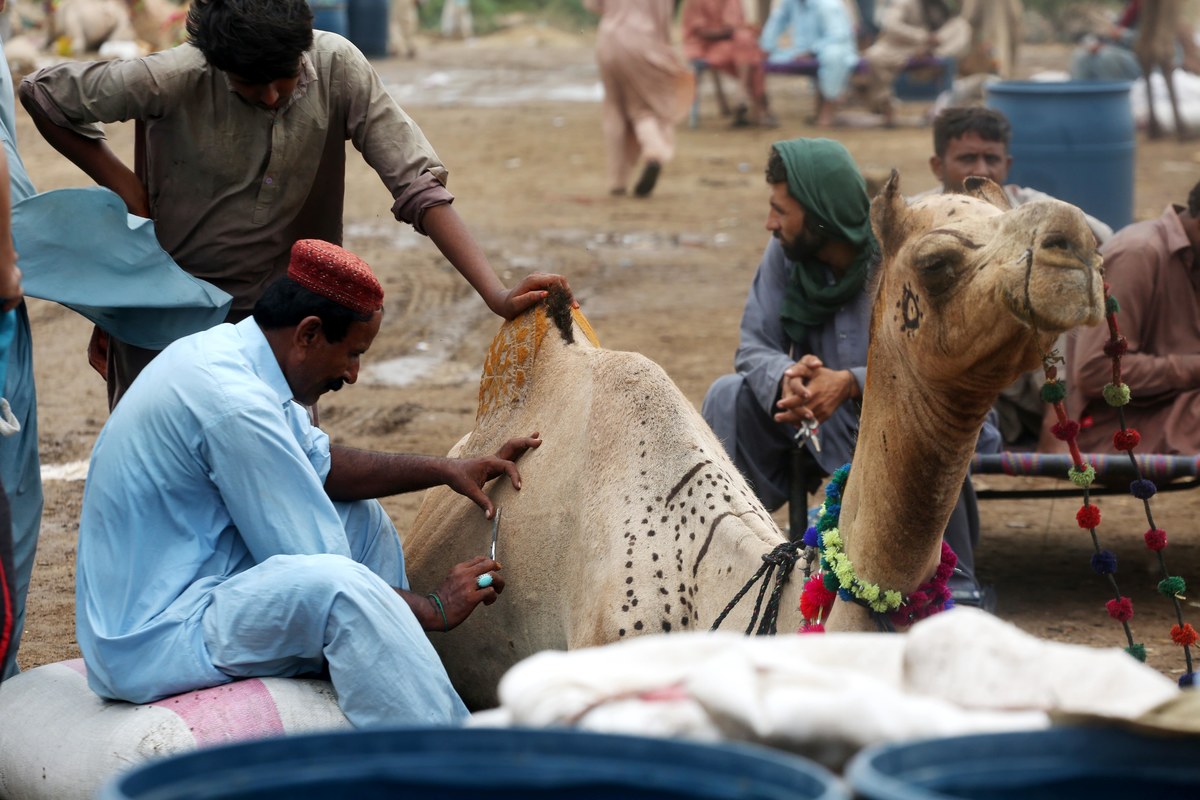


 Customers wait as barber Ali Hassan decorates their animal at a camel market in Karachi, Pakistan on July 20, 2021. (AN photo by S.A. Babar) 

"Not every barber is an artist," Hassan said, "but there are many whose artwork has breathed a new life to the Sindh’s traditional culture."

His hometown, Daulatpur in Shaheed Benazirabad district of Sindh, is particularly famous for camel barbering, with hundreds of craftsmen practicing it in the region. At least 40 of them are Hassan's students.

"I tell my students that you can only learn this craft if you are passionate about it," he said, as it takes lots of time, patience and precision to produce good designs.

Most of the designs are a continuation of Sindh's thousands of years old artistic heritage.

Hassan's customers usually choose Sindhi artwork patterns such rilli and the famous ajrak. But some also ask for ancient cities and forts. Or the moon and stars.
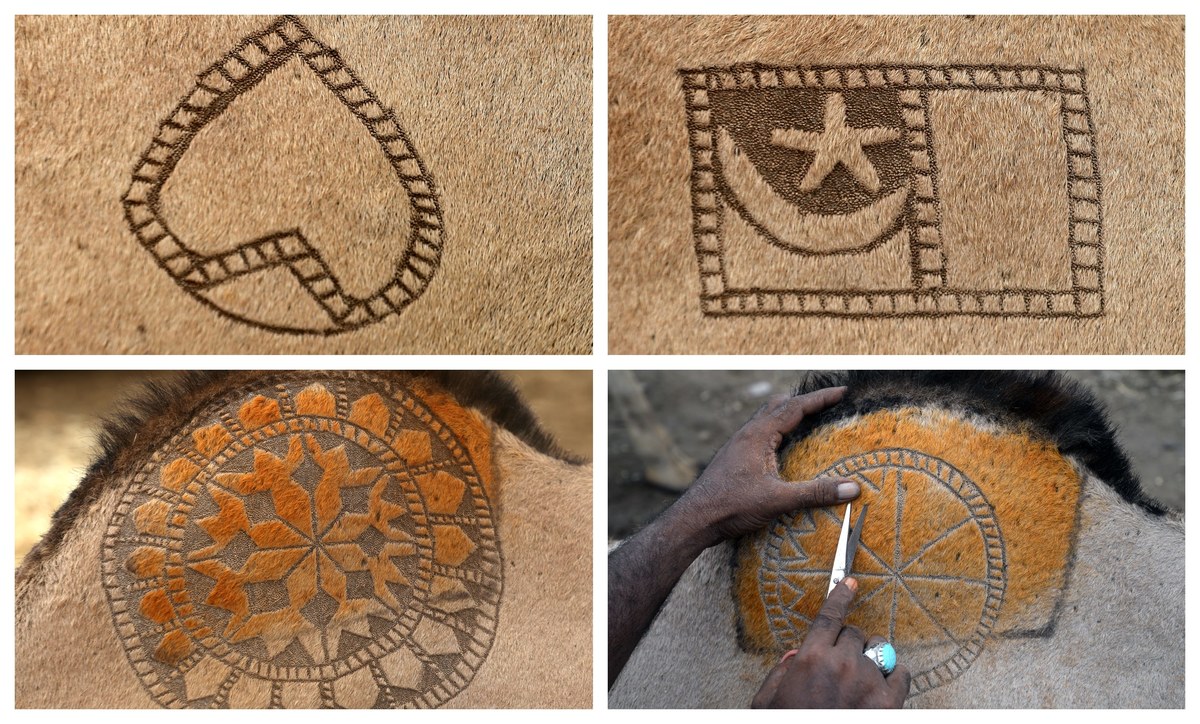


 Camel hair tattoo designs at a camel market in Karachi, Pakistan on July 20, 2021. (AN photo by S.A. Babar)

His prices range from Rs1,000 ($6) for Hassan said for a simple makeover to even Rs10,000 for special, more complicated designs.

Despite the price, camel owners still want their animals to be decorated by the best barbers whose touch everyone would notice.

"Artwork on camels costs much more than simple hair dressing, but everyone wants their camel to look different," Allah Bux, a camel owner, told Arab News.

Hassan knows exactly which motif would look best on the animal.

"When I glance at the camel, I instinctively know what to design," he said. "I've been doing this since my childhood. This scissor is my companion. I love the art."
Tens of thousands flee northwest Pakistan over fears of military operation

Updated 28 January 2026
Follow

Tens of thousands flee northwest Pakistan over fears of military operation

  • More than 70,000 people, mostly women and children, have fled remote Tirah region bordering Afghanistan 
  • Government says no military operation underway or planned in Tirah, a town in Khyber Pakhtunkhwa province

BARA, Pakistan: More than 70,000 people, mostly women and children, have fled a remote region in northwestern Pakistan bordering Afghanistan over uncertainty of a military operation against the Pakistani Taliban, residents and officials said Tuesday.

Pakistan’s Defense Minister Khawaja Mohammad Asif has denied the claim by residents and provincial authorities. He said no military operation was underway or planned in Tirah, a town in Khyber Pakhtunkhwa province.

Speaking at a news conference in Islamabad, he said harsh weather, rather than military action, was driving the migration. His comments came weeks after residents started fleeing Tirah over fears of a possible army operation.

The exodus began a month after mosque loudspeakers urged residents to leave Tirah by Jan. 23 to avoid potential fighting. Last August, Pakistan launched a military operation against Pakistani Taliban in the Bajau r district in the northwest, displacing hundreds of thousands of people.

Shafi Jan, a spokesman for the provincial government in Khyber Pakhtunkhwa, posted on X that he held the federal government responsible for the ordeal of the displaced people, saying authorities in Islamabad were retracting their earlier position about the military operation.

Khyber Pakhtunkhwa Chief Minister Suhail Afridi, whose party is led by imprisoned former Prime Minister Imran Khan, has criticized the military and said his government will not allow troops to launch a full-scale operation in Tirah.

The military says it will continue intelligence-based operations against Pakistani Taliban, who are known as Tehrik-e-Taliban Pakistan, or TTP. Though a separate group, it has been emboldened since the Afghan

Taliban returned to power in 2021. Authorities say many TTP leaders and fighters have found sanctuary in Afghanistan and that hundreds of them have crossed into Tirah, often using residents as human shields when militant hideouts are raided.

Caught in the middle are the residents of Tirah, who continued arriving in Bara.

So far, local authorities have registered roughly 10,000 families — about 70,000 people — from Tirah, which has a population of around 150,000, said Talha Rafiq Alam, a local government administrator overseeing the relief effort. He said the registration deadline, originally set for Jan. 23, has been extended to Feb. 5.

He said the displaced would be able to return once the law-and-order situation improves.

Among those arriving in Bara and nearby towns was 35-year-old Zar Badshah, who said he left with his wife and four children after the authorities ordered an evacuation. He said mortar shells had exploded in villages in recent weeks, killing a woman and wounding four children in his village. “Community elders told us to leave. They instructed us to evacuate to safer places,” he said.

At a government school in Bara, hundreds of displaced lined up outside registration centers, waiting to be enrolled to receive government assistance. Many complained the process was slow.

Narendra Singh, 27, said members of the minority Sikh community also fled Tirah after food shortages worsened, exacerbated by heavy snowfall and uncertain security.

“There was a severe shortage of food items in Tirah, and that forced us to leave,” he said.

Tirah gained national attention in September, after an explosion at a compound allegedly used to store bomb-making materials killed at least 24 people. Authorities said most of the dead were militants linked to the TTP, though local leaders disputed that account, saying civilians, including women and children, were among the dead.