

Three shot dead in riots as Iran regime runs out of water

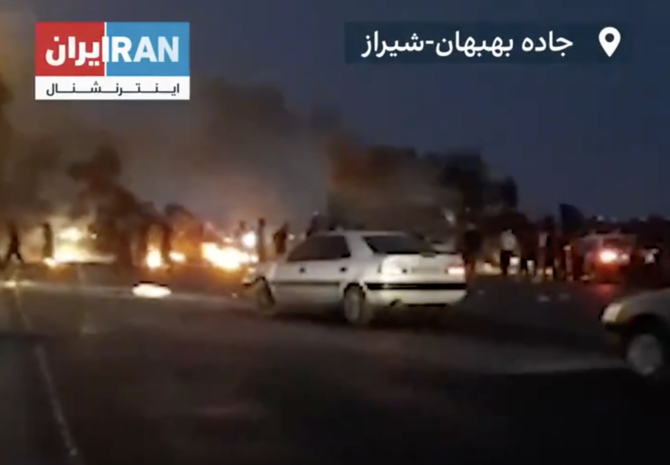
Protesters start fires on the highway from Behbahan, Khuzestan, as protests against a lack of water spread. (Screengrab from Iran International)
Short Url
Updated 22 July 2021
Follow

Three shot dead in riots as Iran regime runs out of water

  • Police officer among the dead in a week of violent protests in Khuzestan

JEDDAH: At least three people have been shot dead, one of them a police officer, in a week of rioting and protests over water shortages in the southwestern Iranian province of Khuzestan.

The police officer was killed in the port city of Mahshahr during what county governor Fereydoun Bandari described as “riots.”

In Izeh, local governor Hassan Nobovati said a “young person” was shot dead by “rioters” and 14 police officers were injured. Authorities in the town of Shadegan said a protester had been shot dead by “opportunists and rioters.”
“The people of Khuzestan are staging nightly protests, protests that have been festering for years,” the reformist newspaper Arman-e Melli said

Videos posted online have shown protests in Ahvaz, Hamidiyeh, Izeh, Mahshahr, Shadegan and Susangerd, with security forces violently dispersing protesters.
The videos show hundreds of people marching, chanting anti-regime slogans, while surrounded by riot police. In some, there is the sound of gunfire.
The reformist Etemad newspaper said the hashtag “I am thirsty” in Arabic was trending on social media to draw attention to Khuzestan’s plight. Khuzestan is home to a large Sunni Arab minority, which has frequently complained of marginalisation.
In 2019, the province was a hotspot of anti-government protests that also shook other areas of Iran.

“There were signs of protests and unrest in the province a long time ago, but the officials, like always, waited until the last minute to address them,” Etemad said.

The regime in Tehran sent a delegation of deputy ministers to Khuzestan last week address the water shortage. On Wednesday, state TV showed a long line of water trucks it said were from the Islamic Revolutionary Guard Corps, a day after army trucks did the same.
Over the years, blistering summer heatwaves and seasonal sandstorms have dried up Khuzestan’s once fertile plains. Scientists say climate change amplifies droughts.
President Hassan Rouhani said this month that Iran was going through an “unprecedented” drought, with average rainfall down 52 percent compared to the previous year.
This month, rolling blackouts began in the Tehran and several other large cities, in part over what authorities describe as a severe drought and surging demand for power. Rainfall has decreased by almost 50 percent in the past year, leaving hydroelectric power generation dams with dwindling water supplies.

Water worries in the past have sent angry demonstrators on to the streets in Iran. “As nearly 5 million Iranians in Khuzestan are lacking access to clean drinking water, Iran is failing to respect, protect, and fulfill the right to water, which is inextricably linked to the right to the highest attainable standard of health,” the group Human Rights Activists in Iran said.


Iraq announces complete withdrawal of US-led coalition from federal territory

Updated 3 sec ago
Follow

Iraq announces complete withdrawal of US-led coalition from federal territory

  • The vast majority of coalition forces had withdrawn from Iraqi bases under a 2024 deal between Baghdad and Washington
  • US and allied troops had been deployed to Iraq and Syria since 2014 to fight the Daesh group

BAGHDAD: Iraq said on Sunday US-led coalition forces had finished withdrawing from bases within the country’s federal territory, which excludes the autonomous northern Kurdistan region.
“We announce today... the completion of the evacuation of all military bases and leadership headquarters in the official federal areas of Iraq of advisers” of the US-led coalition, the military committee tasked with overseeing the end of the coalition’s mission said.
With the withdrawal, “these sites come under the full control of Iraqi security forces,” it said in the statement, adding that they would transition to “the stage of bilateral security relations with the United States.”
The vast majority of coalition forces had withdrawn from Iraqi bases under a 2024 deal between Baghdad and Washington outlining the end of the mission in Iraq by the end of 2025 and by September 2026 in the Kurdistan region.
US and allied troops had been deployed to Iraq and Syria since 2014 to fight the Daesh group, which had seized large swathes of both countries to declare their so-called “caliphate.”
The militant group, also known as “Islamic State,” was territorially defeated in Iraq in 2017 and in Syria in 2019, but continues to operate sleeper cells.
The vast majority of coalition troops withdrew from Iraq over previous stages, with only advisers remaining in the country.
The military committee on Sunday said Iraqi forces were now “fully capable of preventing the reappearance of IS in Iraq and its infiltration across borders.”
“Coordination with the international coalition will continue with regards to completely eliminating IS’s presence in Syria,” it added.
It pointed to “the coalition’s role in Iraq offering cross-border logistical support for operations in Syria, through their presence at an air base in Irbil,” the capital of Iraq’s Kurdistan region.
In December, two US soldiers and a civilian interpreter were killed in Syria in an attack blamed on IS, sparking fears of a resurgence in the country.
The statement added that anti-IS operations would be coordinated with the coalition through the Ain Assad base in Anbar province in western Iraq.
IS attacks in Iraq have massively declined in recent years, but the group maintains a presence in the country’s mountainous areas.
A UN Security Council report in August said: “In Iraq, the group has focused on rebuilding networks along the Syrian border and restoring capacity in the Badia region.”