

Three shot dead in riots as Iran regime runs out of water

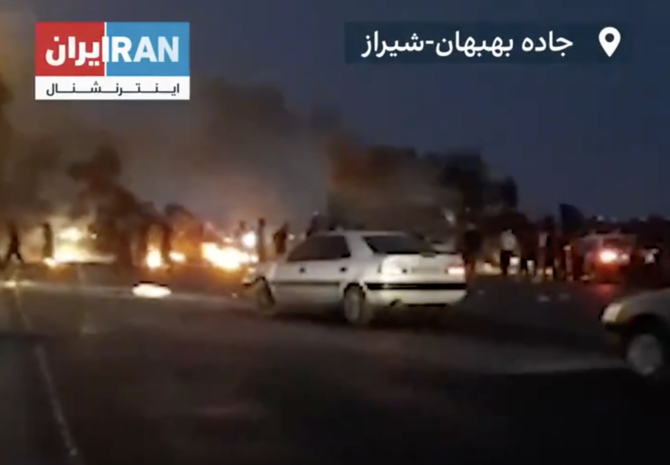
Protesters start fires on the highway from Behbahan, Khuzestan, as protests against a lack of water spread. (Screengrab from Iran International)
Short Url
Updated 22 July 2021
Follow

Three shot dead in riots as Iran regime runs out of water

  • Police officer among the dead in a week of violent protests in Khuzestan

JEDDAH: At least three people have been shot dead, one of them a police officer, in a week of rioting and protests over water shortages in the southwestern Iranian province of Khuzestan.

The police officer was killed in the port city of Mahshahr during what county governor Fereydoun Bandari described as “riots.”

In Izeh, local governor Hassan Nobovati said a “young person” was shot dead by “rioters” and 14 police officers were injured. Authorities in the town of Shadegan said a protester had been shot dead by “opportunists and rioters.”
“The people of Khuzestan are staging nightly protests, protests that have been festering for years,” the reformist newspaper Arman-e Melli said

Videos posted online have shown protests in Ahvaz, Hamidiyeh, Izeh, Mahshahr, Shadegan and Susangerd, with security forces violently dispersing protesters.
The videos show hundreds of people marching, chanting anti-regime slogans, while surrounded by riot police. In some, there is the sound of gunfire.
The reformist Etemad newspaper said the hashtag “I am thirsty” in Arabic was trending on social media to draw attention to Khuzestan’s plight. Khuzestan is home to a large Sunni Arab minority, which has frequently complained of marginalisation.
In 2019, the province was a hotspot of anti-government protests that also shook other areas of Iran.

“There were signs of protests and unrest in the province a long time ago, but the officials, like always, waited until the last minute to address them,” Etemad said.

The regime in Tehran sent a delegation of deputy ministers to Khuzestan last week address the water shortage. On Wednesday, state TV showed a long line of water trucks it said were from the Islamic Revolutionary Guard Corps, a day after army trucks did the same.
Over the years, blistering summer heatwaves and seasonal sandstorms have dried up Khuzestan’s once fertile plains. Scientists say climate change amplifies droughts.
President Hassan Rouhani said this month that Iran was going through an “unprecedented” drought, with average rainfall down 52 percent compared to the previous year.
This month, rolling blackouts began in the Tehran and several other large cities, in part over what authorities describe as a severe drought and surging demand for power. Rainfall has decreased by almost 50 percent in the past year, leaving hydroelectric power generation dams with dwindling water supplies.

Water worries in the past have sent angry demonstrators on to the streets in Iran. “As nearly 5 million Iranians in Khuzestan are lacking access to clean drinking water, Iran is failing to respect, protect, and fulfill the right to water, which is inextricably linked to the right to the highest attainable standard of health,” the group Human Rights Activists in Iran said.


STC announces dissolution

Updated 50 min 28 sec ago
Follow

STC announces dissolution

RIYADH: The Yemeni separatist group Southern Transitional Council (STC) has announced it will dissolve following talks in Saudi Arabia. Several STC members are in Riyadh for discussions on ending unrest in southern Yemen. The group praised Saudi Arabia’s efforts, while former STC leader Aidarous al-Zubaidi, now wanted by the Presidential Council for high treason, has fled Yemen and has not participated in the talks. 

A Yemeni source told Arab News: “this announcement and ease shown in the televised video statement shows that in fact Al Zubaidi was the obstacle, and that most southerners are open to resolving their matter via dialogue and discussion”

The members of the Southern Transitional Council (STC) in Yemen spoke during the Riyadh Southern Dialogue Conference on Friday.

During the meeting, the Council said military operations in Hadramout and Mahra harmed the Southern cause in Yemen. 

The Council said they did not participate in the decision for the military operations in Hadramout and Mahra. 

"We hope to reach a vision and concept for resolving the Southern issue at the Riyadh Conference,” said the Council.

The Council thanked Saudi Arabia for hosting the dialogue conference in Riyadh.

  • Below is a full translation of the STC announcement as reported by the Arabic language Yemeni news agency (SABA):  

Announcement of the Dissolution of the Southern Transitional Council

The Presidency of the Southern Transitional Council, the Supreme Executive Leadership, the General Secretariat, and the other affiliated bodies convened a meeting to assess the recent unfortunate events in the governorates of Hadramout and Al-Mahrah, and the subsequent rejection of all efforts toward de-escalation and resolution. These developments have led to serious and painful consequences. Referring to the statement issued by the Ministry of Foreign Affairs of the Kingdom of Saudi Arabia regarding its sponsorship of a southern dialogue to resolve the southern issue—and in order to safeguard the future of the southern cause and the right of the southern people to restore their state according to their will and aspirations, and to preserve peace and social security in the South and the broader region—we make the following declaration:

The Southern Transitional Council was established to carry the cause of the southern people, represent them, and lead them toward achieving their aspirations and restoring their state. We founded it with the belief that the goal was to achieve this mission—not to cling to it as a means of gaining power, monopolizing decision-making, or excluding others.

Since we were not involved in the decision to launch the military operation in Hadramout and Al-Mahrah—an operation that harmed southern unity and damaged relations with the coalition led by the Kingdom of Saudi Arabia, which has made and continues to make great sacrifices and provide ongoing political, economic, and military support—the continued existence of the Council no longer serves the purpose for which it was created. In light of this and our historical responsibility toward the southern cause, we hereby announce the dissolution of the Southern Transitional Council, the disbanding of all its main and subsidiary bodies, and the closure of all its offices inside and outside the country. We will instead work to achieve our just southern goal by preparing for and participating in the comprehensive southern conference under the Kingdom’s sponsorship.

We commend the Kingdom of Saudi Arabia for its clear and explicit commitments and the sincere concern it has shown for our cause in seeking solutions that meet the aspirations and will of the southern people.

We call on all active southern figures and leaders to engage in the path of the comprehensive southern dialogue conference, hoping that the participants will reach a vision and framework to resolve the southern issue and fulfill the people’s aspirations through their free will, and to establish an inclusive southern framework.

From this platform, we call on the people of the South, our colleagues in the capital Aden, and all the governorates of our beloved South to recognize the gravity of this moment, the sensitivity of the current phase, and the importance of uniting efforts to preserve our gains and protect the South from chaos or instability.

We reaffirm our continued commitment to serving the just and legitimate cause of the southern people and achieving their aspirations according to their will. We also extend our gratitude to the leadership and people of the Kingdom of Saudi Arabia for hosting the comprehensive southern dialogue conference and for their support of the South, its cause, and its people across all fields and stages.