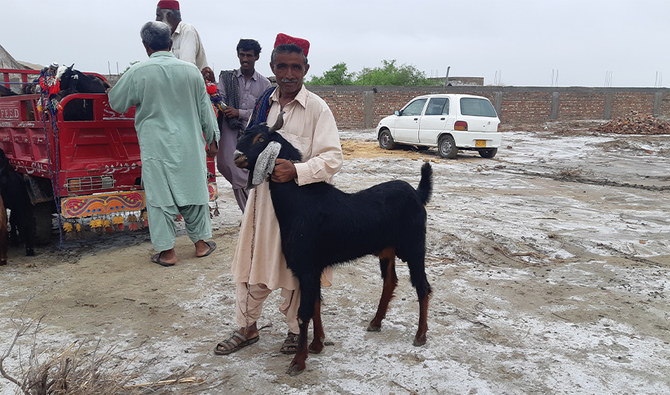

KHIPRO, SINDH: In the days leading up to the Muslim feast of Eid Al-Adha, thousands of livestock markets spring up across Pakistan where Muslims purchase cattle to sacrifice on the occasion as a religious obligation and distribute among family, friends and the poor.
But there is something special about the livestock markets in Achro Thar, or the white desert, in the southern Sindh province: the wide variety of animals sold there are raised on a pesticide-free, organic diet which officials, buyers and sellers say makes their meat particularly delicious.
“The Achro Thar region offers a wide variety of sacrificial animals which are fed organic food, making them uncommon in the country,” Ghulam Ali Jogi, a senior official of the Sindh Livestock Department, told Arab News.
“Unlike the rest of the country where animals are fed on fodder sprayed with chemicals and pesticides, desert livestock here graze upon herbal plants … their diet is purely organic. It improves their immunity and translates into tastier meat.”
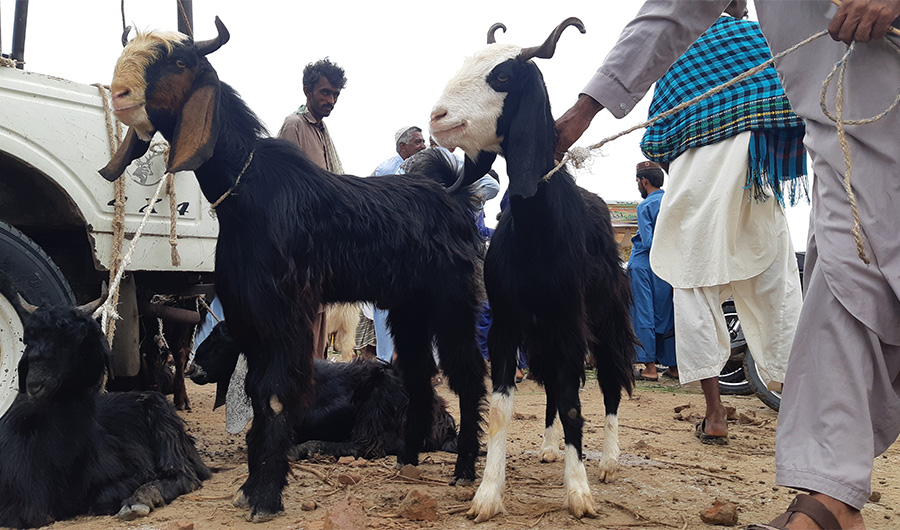
A pair of Achro Thar goats spotted at the Khipro animal market in the Sanghar district, Pakistan, on July 20, 2021. (AN photo)
Maula Baksh Junejo, a white desert herder selling his cattle at a livestock market in Khipro in Sindh’s Sanghar district, said getting a sacrificial animal from Achro Thar “doubled” Eid celebrations for buyers because of the animals’ “extraordinary meat and delicious taste.”
Experienced buyers such as Sameer Aziz are also aware of the prized commodity on offer and often travel hundreds of miles to purchase cattle from the Khipro market.
“There’s no accounting for taste,” Aziz, who traveled from Karachi, told Arab News, adding: “Animal rates were much more affordable than the Karachi market.”
Eid Al-Adha falls on Wednesday in the South Asian nation this year. It is observed by Muslims to commemorate their belief that prophet Ibrahim was willing to sacrifice his son as an act of obedience to God, before God replaced his son with a ram to be sacrificed instead.

A view of the Khipro animal market in Sanghar district, Pakistan, on July 20, 2021. (AN photo)
Muslims who can afford it sacrifice cattle. But it can also be a camel, goat, sheep or ram, depending on the region.
The coronavirus has cast a shadow over Eid in the last year and a half, with fears of another spike in infections this Eid prompting authorities to warn people to minimize movement, wear masks at cattle markets and refrain from public gatherings to witness the slaughter of sacrificial animals.
Sales at the Khipro animal market have also suffered due to the coronavirus and were low compared to 2019 before the pandemic struck, an administrator at the market said.
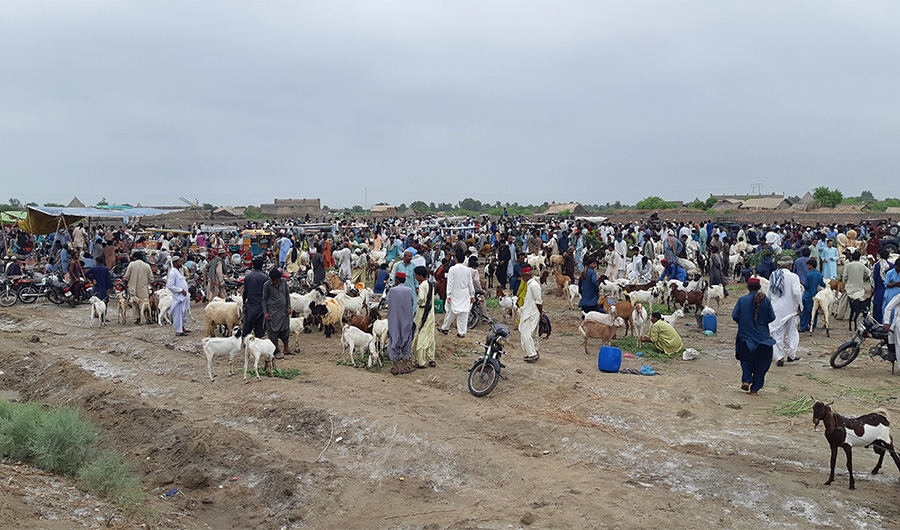
A view of the Khipro animal market in Sanghar district, Pakistan, on July 20, 2021. (AN photo)
“The market hasn’t recovered fully to pre-coronavirus times,” Asad Ali Bughio, a manager at the Khipro animal market, told Arab News. “Last year, there was a lockdown which brought hardship for herdsmen and traders. Buyers were also hesitant to visit the market. This year’s situation is comparatively better mainly because COVID-19 vaccination is underway.”
But social media has helped raising awareness about the area and its cattle.
“Very few knew about Achro Thar livestock’s distinctive qualities, and the area has remained under-reported due to its difficult geography, but now it is coming into the limelight thanks to social media,” Jan Muhammad Rajar, an active social media user from Achro Thar, told Arab News.
“For instance, during droughts, we highlighted the livestock being deprived of vaccines on social media, after which authorities did vaccinations. In addition, following posts during droughts, traders from Karachi visited the area to purchase animals at low rates.”
“Generally, animal posts also draw the attention of tourists,” Rajar added, “compelling them to visit the desert.”
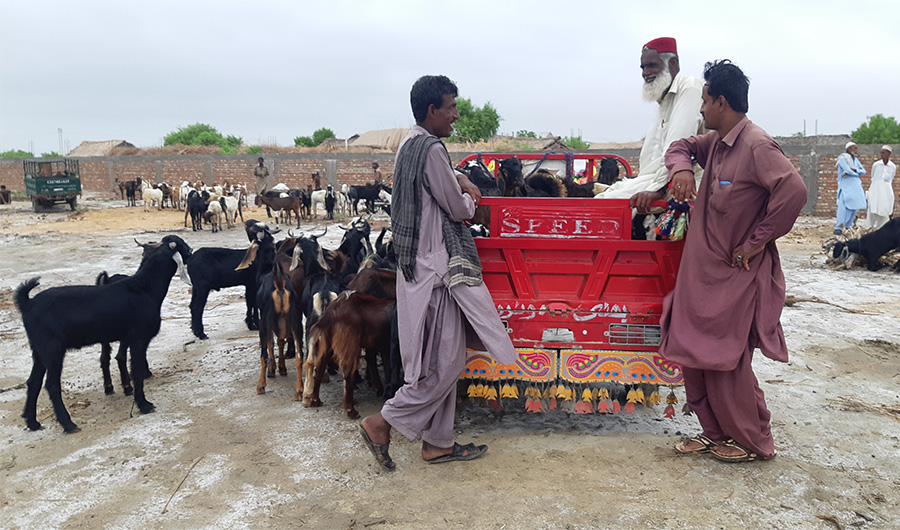
Achro Thar herdsmen arrive at Khipro animal market in Sanghar district, Pakistan, on July 20, 2021. (AN photo)
With no river water, the livelihoods of the nearly 300,000 inhabitants of Achro Thar are dependent on livestock. According to data from the Sindh Livestock Department, there are an estimated 2.4 million cattle in Achro Thar, which spreads across 32,000 square kilometers and is named after its distinctive white sands.
“Out of Achro Thar’s total livestock, goats are the highest number at 800,000 spread across Umerkot, Sanghar, Khairpur, Shaheed Benzairabad and Sukkur districts,” Jogi at the livestock department said. “The rest of the livestock comprises cows, sheep, camels, and buffaloes.”