

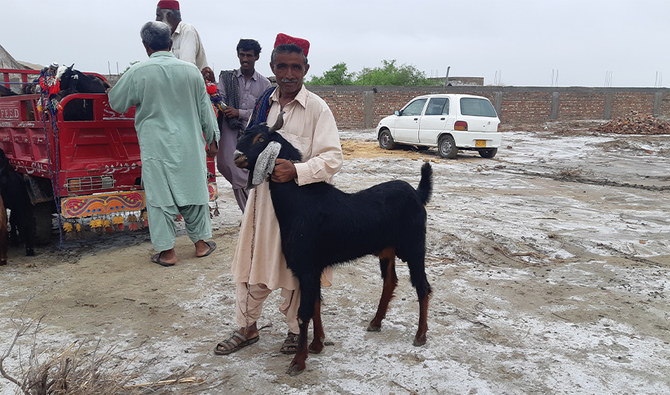
Sacrificial animals raised on organic diet ‘double’ Eid celebrations in Pakistan’s white desert

An Achro Thar herdsman poses with his goat at the Khipro animal market in Sanghar district, Pakistan, on July 20, 2021. (AN photo)
Short Url
Updated 20 July 2021
Follow

Sacrificial animals raised on organic diet ‘double’ Eid celebrations in Pakistan’s white desert

  • Cattle from Achro Thar are sought after for ‘extraordinary’ tasting meat that officials credit to pesticide-free food
  • With no river water, the livelihoods of 300,000 inhabitants of Achro Thar in Sindh province depend on livestock

KHIPRO, SINDH: In the days leading up to the Muslim feast of Eid Al-Adha, thousands of livestock markets spring up across Pakistan where Muslims purchase cattle to sacrifice on the occasion as a religious obligation and distribute among family, friends and the poor.
But there is something special about the livestock markets in Achro Thar, or the white desert, in the southern Sindh province: the wide variety of animals sold there are raised on a pesticide-free, organic diet which officials, buyers and sellers say makes their meat particularly delicious. 
“The Achro Thar region offers a wide variety of sacrificial animals which are fed organic food, making them uncommon in the country,” Ghulam Ali Jogi, a senior official of the Sindh Livestock Department, told Arab News.
“Unlike the rest of the country where animals are fed on fodder sprayed with chemicals and pesticides, desert livestock here graze upon herbal plants … their diet is purely organic. It improves their immunity and translates into tastier meat.”
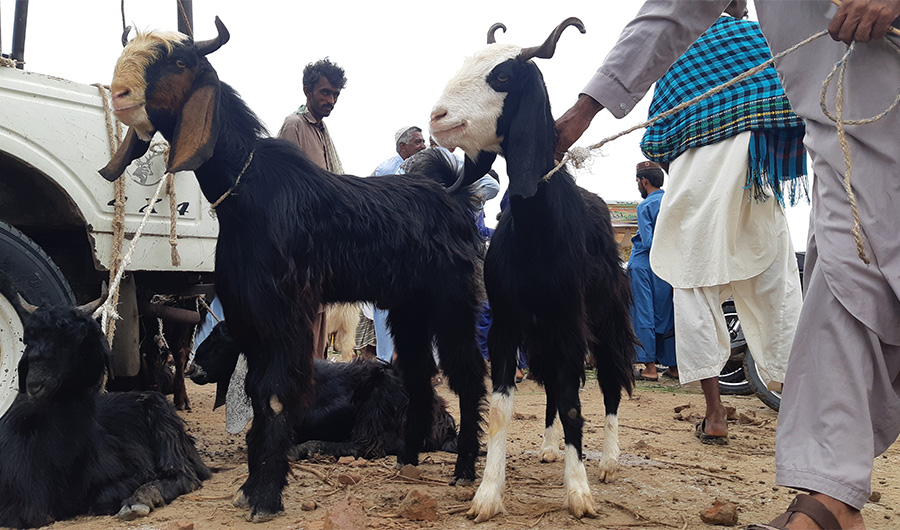


A pair of Achro Thar goats spotted at the Khipro animal market in the Sanghar district, Pakistan, on July 20, 2021. (AN photo)

Maula Baksh Junejo, a white desert herder selling his cattle at a livestock market in Khipro in Sindh’s Sanghar district, said getting a sacrificial animal from Achro Thar “doubled” Eid celebrations for buyers because of the animals’ “extraordinary meat and delicious taste.”
Experienced buyers such as Sameer Aziz are also aware of the prized commodity on offer and often travel hundreds of miles to purchase cattle from the Khipro market.
“There’s no accounting for taste,” Aziz, who traveled from Karachi, told Arab News, adding: “Animal rates were much more affordable than the Karachi market.”
Eid Al-Adha falls on Wednesday in the South Asian nation this year. It is observed by Muslims to commemorate their belief that prophet Ibrahim was willing to sacrifice his son as an act of obedience to God, before God replaced his son with a ram to be sacrificed instead.


A view of the Khipro animal market in Sanghar district, Pakistan, on July 20, 2021. (AN photo)

Muslims who can afford it sacrifice cattle. But it can also be a camel, goat, sheep or ram, depending on the region.
The coronavirus has cast a shadow over Eid in the last year and a half, with fears of another spike in infections this Eid prompting authorities to warn people to minimize movement, wear masks at cattle markets and refrain from public gatherings to witness the slaughter of sacrificial animals.
Sales at the Khipro animal market have also suffered due to the coronavirus and were low compared to 2019 before the pandemic struck, an administrator at the market said.
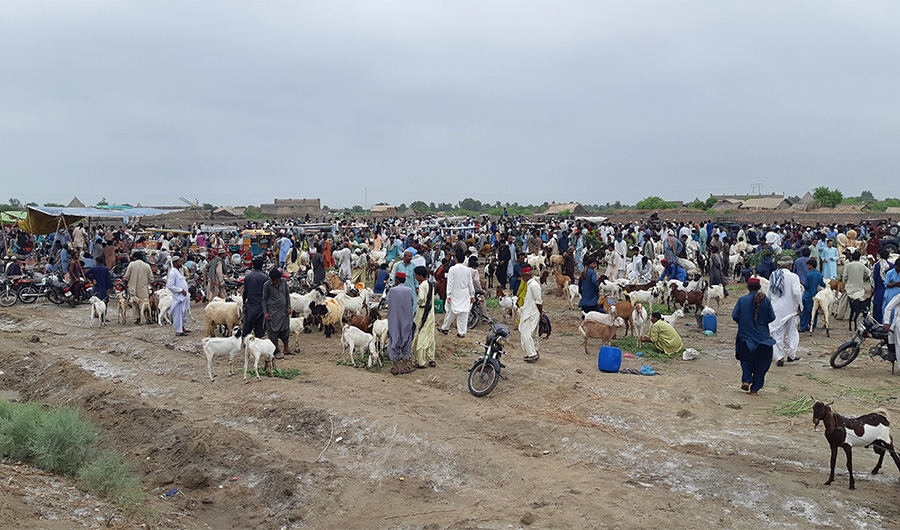


A view of the Khipro animal market in Sanghar district, Pakistan, on July 20, 2021. (AN photo)

“The market hasn’t recovered fully to pre-coronavirus times,” Asad Ali Bughio, a manager at the Khipro animal market, told Arab News. “Last year, there was a lockdown which brought hardship for herdsmen and traders. Buyers were also hesitant to visit the market. This year’s situation is comparatively better mainly because COVID-19 vaccination is underway.”
But social media has helped raising awareness about the area and its cattle.

“Very few knew about Achro Thar livestock’s distinctive qualities, and the area has remained under-reported due to its difficult geography, but now it is coming into the limelight thanks to social media,” Jan Muhammad Rajar, an active social media user from Achro Thar, told Arab News.
“For instance, during droughts, we highlighted the livestock being deprived of vaccines on social media, after which authorities did vaccinations. In addition, following posts during droughts, traders from Karachi visited the area to purchase animals at low rates.”
“Generally, animal posts also draw the attention of tourists,” Rajar added, “compelling them to visit the desert.”
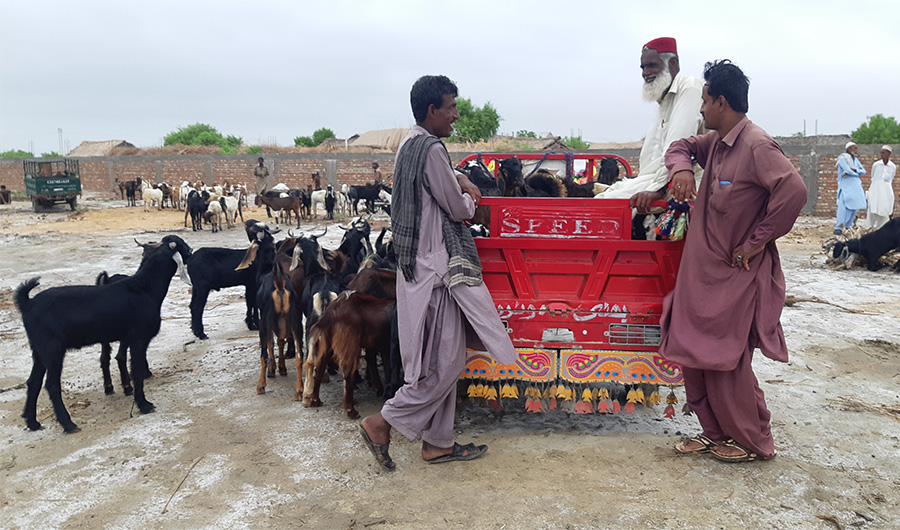


Achro Thar herdsmen arrive at Khipro animal market in Sanghar district, Pakistan, on July 20, 2021. (AN photo)

With no river water, the livelihoods of the nearly 300,000 inhabitants of Achro Thar are dependent on livestock. According to data from the Sindh Livestock Department, there are an estimated 2.4 million cattle in Achro Thar, which spreads across 32,000 square kilometers and is named after its distinctive white sands.
“Out of Achro Thar’s total livestock, goats are the highest number at 800,000 spread across Umerkot, Sanghar, Khairpur, Shaheed Benzairabad and Sukkur districts,” Jogi at the livestock department said. “The rest of the livestock comprises cows, sheep, camels, and buffaloes.”


Pakistan clears global crypto exchanges Binance, HTX under new regulatory framework

Updated 8 min 7 sec ago
Follow

Pakistan clears global crypto exchanges Binance, HTX under new regulatory framework

  • NOCs allow Binance, HTX to conduct engagement activities within Pakistan, says regulator PVARA
  • Says move allows entities to open subsidiaries in Pakistan but doesn’t constitute as operating license

ISLAMABAD: The Pakistan Virtual Assets Regulatory Authority (PVARA) announced on Friday that it has granted no objection certificates (NOCs) to global crypto exchanges Binance and HTX, the latest in a series of moves by Islamabad to regulate its fast-growing virtual assets market. 

PVARA said the NOCs were granted following a review process it conducted with public sector stakeholders which focused on governance structures, compliance frameworks, risk management controls and alignment with Pakistan’s emerging regulatory requirements for virtual asset activities.

Pakistan has been moving to regulate its fast-growing crypto and digital assets market by bringing virtual asset service providers (VASPs) under a formal licensing regime. Officials say the push is aimed at curbing illicit transactions, improving oversight and encouraging innovation in blockchain-based financial services.

“The introduction of this structured NOC framework demonstrates Pakistan’s commitment to responsible innovation and financial discipline,” Finance Minister Muhammad Aurangzeb was quoted as saying in a press release issued by PVARA. 

The regulatory authority said the NOCs allow Binance and HTX to conduct preparatory and engagement activities within Pakistan under “defined regulatory oversight,” clarifying that it does not constitute a “full operating license.”

The NOCs allow Binance and HTX to begin registration on the FMU goAML, Pakistan’s anti–money laundering reporting platform, as reporting entries. It also allows them to engage with the Securities and Exchange Commission of Pakistan (SECP) regulator to incorporate their subsidiaries in the country. 

HTX and Binance can also prepare and submit their full VASP license applications once licensing regulations are promulgated and provide anti-money laundering (AML) registered services after the completion of their goAML registration.

“PVARA will continue to engage with domestic and international stakeholders as it advances subsequent phases of its regulatory framework,” the authority said. 

“Additional guidance regarding licensing standards, compliance obligations and supervisory expectations for virtual asset service providers will be issued in due course.”

Chairman PVARA Bilal Bin Saqib said issuing the NOCs marks the first step toward a fully licensed and regulated environment for digital assets in Pakistan. 

“By adopting a phased and internationally aligned approach, Pakistan is ensuring that only well-governed, fully compliant global platforms progress toward full licensing,” Saqib was quoted as saying by PVARA.

According to PVARA, Pakistan already ranks at number three in crypto adoption and is home to an estimated 30 to 40 million users.

It said industry-wide assessments estimate that annual digital asset trading activity linked to Pakistan exceeds $300 billion. 

PAKISTAN, BINANCE SIGN MoU FOR BLOCKCHAIN-BASED INNOVATION

Separately, Pakistan’s finance ministry and Binance signed a memorandum of understanding (MoU) establishing a framework to explore potential collaboration on the tokenization and blockchain-based distribution of Pakistan’s real-world and sovereign assets, the Finance Division said. 

The Finance Division said the step was a significant one to leverage emerging financial technologies to strengthen Pakistan’s capital markets and enhance global investor access. 

These assets include government bonds, treasury bills, commodity reserves and other federally owned assets, the Finance Division said. 

“Subject to applicable laws, policies and regulatory approvals, the initiative may involve assets of up to $2 billion, with the objective of enhancing liquidity, transparency and international market accessibility,” it added. 

Under the proposed arrangement, Binance and/or its affiliates may provide technical expertise, advisory support, training and capacity building to enable Pakistan to assess modern, compliant blockchain infrastructure. 

The Finance Division said the collaboration aims to explore secure and transparent digital platforms that could facilitate broader participation by international investors, while fully respecting Pakistan’s regulatory framework and sovereign control.