Kabul/Islamabad: The head of Britain’s armed forces, General Sir Nick Carter, has been working to reset ties between Afghanistan and Pakistan, a senior Afghan official said on Monday, as part of an initiative that reportedly dates back more than a year, and has seen the general shuttling between Kabul and Islamabad and organizing a meeting between key Afghan and Pakistan officials.
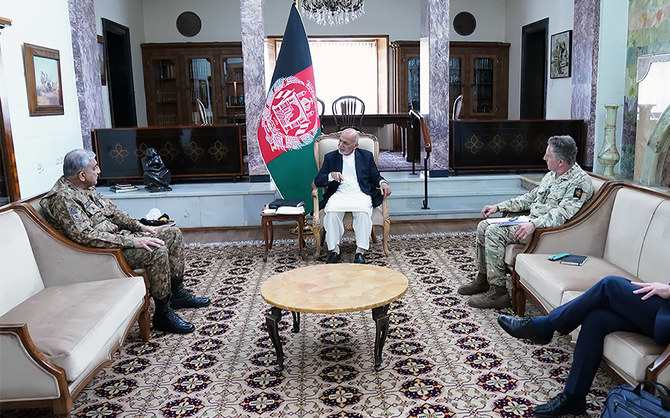
Carter and top Pakistani officials, including army chief General Qamar Javed Bajwa and spy chief Lt. Gen. Faiz Hameed, traveled to Kabul in May for talks with President Ashraf Ghani and other Afghan government leaders, the Guardian newspaper reported on Sunday.
The newspaper called it “a behind-the-scenes effort to stop Afghanistan sliding into full-blown civil war, and help bolster stalling US-brokered peace talks in Qatar.”
A senior Afghan official told the newspaper the aim of Carter’s meetings was to see if Pakistan could be persuaded to use its leverage with the Taliban to push the group back toward the negotiating table.
“Army chief Carter had come for the very purpose [mending ties between Kabul and Islamabad],” Dawa Khan Menapal, head of the Afghan government’s media center, told Arab News. “Let us see what will happen, but the demand of Afghanistan’s government is clear that as long as terrorists are supported there [Pakistan] … and Pakistan does not practically and honestly take measures [against terrorism], such efforts will not reach a conclusion,” he added.
At a press briefing on Monday, Pakistan’s Foreign Minister Shah Mahmood Qureshi and National Security Adviser Dr. Moeed Yusuf declined to comment on Carter’s visit.
Pakistan has repeatedly denied it harbors the Afghan Taliban or that the group operates out of Pakistan’s border areas.
Islamabad was one of three countries to recognize the Taliban government until it was ousted from power in a US-led invasion in 2001 for protecting Al-Qaeda chief Osama bin Laden, the mastermind of the September 11 attacks on the United States.


![]()

Afghanistan says top British general working to reset Kabul-Islamabad ties
Short Url
https://arab.news/9w2yr
Afghanistan says top British general working to reset Kabul-Islamabad ties
- Carter and Pakistan’s army and spy chiefs reportedly traveled to Kabul in May for talks with President Ghani
- Pakistani foreign minister, national security adviser decline to comment on the visit
Latest updates





© 2026 SAUDI RESEARCH & PUBLISHING COMPANY, All Rights Reserved And subject to Terms of Use Agreement.