

Seconds count for Saudi Red Crescent Authority’s Hajj rapid-response teams

1 / 4
In addition to its ambulances, the Saudi Red Crescent Authority (SRCA) has tactical emergency medical services (EMS) and hazardous materials incident vehicles on standby at the holy sites. (AN photo)
2 / 4
In addition to its ambulances, the Saudi Red Crescent Authority (SRCA) has tactical emergency medical services (EMS) and hazardous materials incident vehicles on standby at the holy sites. (AN photo)
3 / 4
In addition to its ambulances, the Saudi Red Crescent Authority (SRCA) has tactical emergency medical services (EMS) and hazardous materials incident vehicles on standby at the holy sites. (AN photo)
4 / 4
In addition to its ambulances, the Saudi Red Crescent Authority (SRCA) has tactical emergency medical services (EMS) and hazardous materials incident vehicles on standby at the holy sites. (AN photo)
Short Url
Updated 20 July 2021
Follow

Seconds count for Saudi Red Crescent Authority’s Hajj rapid-response teams

  • Emergency medicine technicians on motorcycles equipped with life-saving equipment can quickly get to sick pilgrims that bigger vehicles struggle to reach

ARAFAT: The Saudi Red Crescent Authority (SRCA) is making use of the latest mobile medical technology to better help sick pilgrims as quickly as possible during this year’s Hajj season.

“Motorbikes are equipped with the most advanced equipment and supplies, with all the medications a rapid-response task might require,” said Rayan Kassar, a member of the authority’s rapid response motorcycle team.

Each motorcycle is driven by an emergency medicine technician (EMT), who is accompanied by a medical specialist chosen depending on the nature of the reported emergency.

The SRCA, he said, provides the motorbikes and their crews to help people who are ill or injured in places that are difficult for larger vehicles to reach when a quick response is vital.

“We have some 15 motorbikes and we use them in the central area of the Grand Mosque and in the holy sites of Mina, Muzdalifah and Arafat, where ambulances find it difficult to reach an injured person or a patient who is in need of help from us in a very short time,” Kassar said.
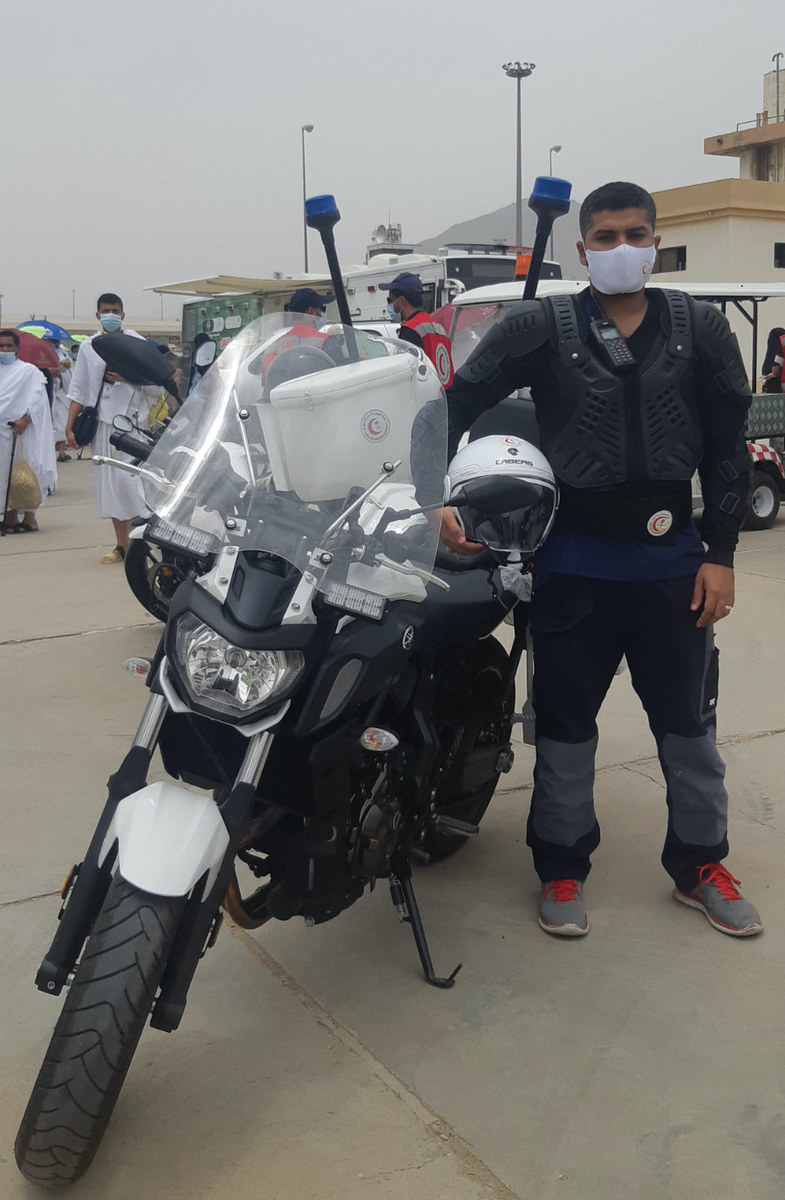


Rayan Kassar of the SRCA's  rapid response motorcycle team. (AN photo)

He added that the motorbikes were ready to respond in five different parts of Mount Arafat on Monday. When the pilgrims move to the Grand Mosque, Muzdalifah and Mina, the bikes are available to help them in those locations.

“When the pilgrims were in the Grand Mosque two days ago, we attended some cases that required us to move at the highest possible speed,” Kassar said. “Arriving at the scene, we found most of the pilgrims were either too tired to move or just had sunstroke.”

In addition to the motorcycle units, 15 other vehicles are available when required, including tactical emergency medical services (EMS) and hazardous materials incident vehicles.

Hussein Nafi’e, the supervisor of the SRCA center at the holy sites, said it is necessary to be prepared constantly to respond to medical emergencies with the latest medical technology and equipment that can save lives.

“We haven’t yet used these vehicles but we are ready to swiftly intervene, if need be,” he said. “In fact, this service is part of our preparation to enhance our services.”


Saudi Arabia says recent STC military movements in Hadramout, Al-Mahra were unilateral, uncoordinated

Updated 30 min 23 sec ago
Follow

Saudi Arabia says recent STC military movements in Hadramout, Al-Mahra were unilateral, uncoordinated

  • Saudi Arabia said the moves harmed the interests of the Yemeni people, as well as the southern cause and the coalition’s efforts.
  • The Kingdom said it coordinated with the United Arab Emirates, the president of the Presidential Leadership Council, and the Yemeni government to contain the situation.

RIYADH: Saudi Arabia on Thursday said that recent military movements in the Yemeni governorates of Hadramout and Al-Mahra carried out by the Southern Transitional Council (STC) were conducted unilaterally and without coordination with the Presidential Leadership Council or the coalition leadership.

“These movements resulted in an unjustified escalation that harmed the interests of all segments of Yemeni people, as well as the Southern cause and the coalition’s efforts,” read a statement published by the Saudi Press Agency.

The statement said Saudi Arabia has always prioritized preserving the unity of Yemen throughout recent developments, and that the Kingdom has spared no effort to reach peaceful solutions to resolve the situation in both governorates.

In this context, “the Kingdom worked with the brotherly United Arab Emirates, the president of the Presidential Leadership Council and the brotherly Yemeni government to contain the situation.

“A joint military team was sent from the Kingdom of Saudi Arabia and the United Arab Emirates to put the necessary arrangements in place with the Southern Transitional Council in Aden. These arrangements were made to ensure the return of the Southern Transitional Council forces to their previous positions outside the two governorates and hand over the camps in those areas to the Nation Shield Forces and the local authorities, in accordance with organized procedures under the supervision of the coalition forces.”

The statement said that these efforts remain in progress to restore the situation to its previous state.

Saudi Arabia also said it “hopes public interest will prevail through ending the escalation by the Southern Transitional Council and the withdrawal of its forces from the two governorates in an urgent and orderly manner.”