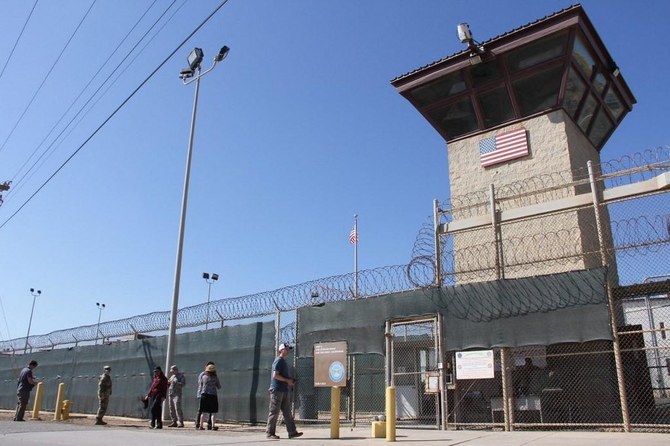
WASHINGTON: The Biden administration on Monday transferred a detainee out of the Guantánamo Bay detention facility for the first time, sending a Moroccan man back home years after he was recommended for discharge.
The Moroccan prisoner, Abdullatif Nasser, who’s in his mid-50s, was cleared for repatriation by a review board in July 2016 but remained at Guantanamo for the duration of the Trump presidency.
The Periodic Review Board process determined that Nasser’s detention no longer remained necessary to protect US national security, the Pentagon said Monday in a statement. The board recommended authorization for Nasser’s repatriation, but that couldn’t be completed before the end of the Obama administration, it said.
The transfer of Nasser could suggest President Joe Biden is making efforts to reduce the Guantanamo population, which now stands at 39. Presidents George W. Bush and Barack Obama supported the prisoner transfer process, but it stalled under President Donald Trump.
Trump said even before he took office that there should be no further releases from “Gitmo,” as Guantanamo Bay is often called. “These are extremely dangerous people and should not be allowed back onto the battlefield,” he said then.
The possibility that former Guantanamo prisoners would resume hostile activities has long been a concern that has played into the debate over releases. The office of the Director of National Intelligence said in a 2016 report that about 17 percent of the 728 detainees who had been released were “confirmed” and 12 percent were “suspected” of re-engaging in such activities.
But the vast majority of those re-engagements occurred with former prisoners who did not go through the security review that was set up under Obama. A task force that included agencies such as the Defense Department and the CIA analyzed who was held at Guantanamo and determined who could be released and who should continue in detention.
The US thanked Morocco for facilitating Nasser’s transfer back home.
“The United States commends the Kingdom of Morocco for its long-time partnership in securing both countries’ national security interests,” the Pentagon statement said. “The United States is also extremely grateful for the Kingdom’s willingness to support ongoing US efforts to close the Guantanamo Bay Detention Facility.”
Nasser initially got news he was going to be released in the summer of 2016, when one of his lawyers called him at the detention center and told him the US had decided he no longer posed a threat and could go home. He thought he’d returned to Morocco soon: “I’ve been here 14 years,” he said at the time. “A few months more is nothing.”
Nasser’s journey to the Cuban prison was a long one. He was a member of a nonviolent but illegal Moroccan Sufi Islam group in the 1980s, according to his Pentagon file. In 1996, he was recruited to fight in Chechyna but ended up in Afghanistan, where he trained at an Al-Qaeda camp. He was captured after fighting US forces there and sent to Guantanamo in May 2002.
An unidentified military official appointed to represent him before the review board said he studied math, computer science and English at Guantanamo, creating a 2,000-word Arabic-English dictionary. The official told the board that Nasser “deeply regrets his actions of the past” and expressed confidence he would reintegrate in society.

Joe Biden transfers first Guantanamo detainee to home country
Short Url
https://arab.news/c2n3u
Joe Biden transfers first Guantanamo detainee to home country
- Moroccan prisoner Abdullatif Nasser was cleared for repatriation by a review board in July 2016
- But he remained detained at Guantanamo for the duration of Donald Trump’s presidency
More than half the US threatened with ice, snow and cold in massive winter storm
Forecasters warned that the damage, especially in areas pounded by ice, could rival a hurricane
At least 177 million people were under watches or warnings for ice and snow and more than 200 million were under cold weather adviseries or warnings
WASHINGTON: It was too cold for school in Chicago and other Midwestern cities Friday as a huge, dayslong winter storm began to crank up that could bring snow, sleet, ice and bone-chilling temperatures as well as extensive power outages to about half the US population from Texas to New England.
Forecasters warned that the damage, especially in areas pounded by ice, could rival a hurricane. Airlines canceled thousands of flights, churches moved Sunday services online and the Grand Ole Opry in Nashville, Tennessee, decided to hold its Saturday night radio performance without fans. Carnival parades in Louisiana were canceled or rescheduled.
At least 177 million people were under watches or warnings for ice and snow and more than 200 million were under cold weather adviseries or warnings. In many places, those overlapped. Utility companies braced for power outages because ice-coated trees and power lines can keep falling long after a storm has passed.
“It’s going to be a big storm,” Maricela Resendiz said as she picked up chicken, eggs and pizzas at a Dallas store to get her, her 5-year-old son and her boyfriend through the weekend. Her plans: “Staying in, just being out of the way.”
Ice, snow and sleet could begin falling later Friday in Texas and Oklahoma. The storm was expected to slide into the South with freezing rain and sleet. Then it will move into the Northeast, dumping about a foot (30 centimeters) of snow from Washington, D.C., through New York and Boston, the National Weather Service predicted.
Arctic air is the first piece to fall in place
Arctic air that spilled down from Canada prompted schools throughout the Midwest to cancel classes Friday. With wind chills predicted to be as low as minus 40 degrees Fahrenheit (minus 40 Celsius) frostbite could set in within 10 minutes, making it too dangerous to walk to school or wait for the bus.
In Bismarck, North Dakota, where the wind chill was minus 41 Fahrenheit (minus 41 Celsius), Colin Cross cleaned out an empty unit for the apartment complex where he works.
“I’ve been here awhile and my brain stopped working,” said Cross, bundled up in long johns, two long-sleeved shirts, a jacket, hat, hood, gloves and boots.
Nationwide, more than 1,000 flights were delayed or canceled Friday, with well over half of them in Dallas, according to the flight tracking website FlightAware. About 2,300 Saturday flights were canceled.
In Oklahoma, Department of Transportation workers pretreated roads with salt brine while the Highway Patrol canceled troopers’ days off.
The federal government put nearly 30 search and rescue teams on standby. Officials have more than 7 million meals, 600,000 blankets and 300 generators placed throughout the area the storm was expected to cross, according to the Federal Emergency Management Agency.
Ice could take down power line
s and pipes could freeze
Once ice and snow end, the frigid air from the north will head south and east. It will take a while to thaw out, an especially dangerous prospect because ice can add hundreds of pounds to power lines and branches and make them more susceptible to snapping, especially if it’s windy.
In at least 11 Southern states from Texas to Virginia, a majority of homes are heated by electricity, according to the US Census Bureau.
A severe cold snap five years ago took down much of the power grid in Texas, leaving millions without power for days and resulting in hundreds of deaths. Gov. Greg Abbott said Thursday that won’t happen again, and utility companies were bringing in thousands of employees to help keep the power on.
Pipes are also at risk.
In Atlanta, where temperatures could dip to 10 degrees Fahrenheit (minus 12 Celsius) and stay below freezing for 36 hours, M. Cary & Daughters Plumbing co-owner Melissa Cary ordered all the pipe and repair supplies she could get. She said her daily calls could go from about 40 to several hundred.
“We’re out there; we can’t feel our fingers, our toes; we’re soaking wet,” Cary said. “I keep the hot chocolate and soup coming.”
Northeast prepares for heavy snow
The Northeast could see its heaviest snow in years.
Boston declared a cold emergency through the weekend, and Connecticut was working with neighboring New York and Massachusetts in case travel restrictions are needed on major highways.
Connecticut Gov. Ned Lamont urged people to go grocery shopping now and “stay home on Sunday.”
Philadelphia announced schools would be closed Monday. Superintendent Tony B. Watlington Sr. told students, “It’s also appropriate to have one or two very safe snowball fights.”
People are hunkering down
Stephen McDonald, who hasn’t had a home in three years, was hoping to get out of the cold in Jackson, Mississippi. But the Shower Power homeless shelter was adding spray foam insulation and ceiling heaters, keeping it closed until Saturday.
Friday night’s forecast called for lows near freezing. “Your hands get frozen solid, and they hurt real bad,” said McDonald,. “It’s not good.”
At the University of Georgia in Athens, sophomore Eden England was staying on campus to ride out the weather with her friends, even as the school encouraged students to leave dorms and go home because of concerns about losing power.
“I was texting my parents and we kind of just realized that whether I’m here or at home, it’s going to suck either way,” England said. “So I’d rather be with my friends, kind of struggling together if anything happens.”
At least 177 million people were under watches or warnings for ice and snow and more than 200 million were under cold weather adviseries or warnings
WASHINGTON: It was too cold for school in Chicago and other Midwestern cities Friday as a huge, dayslong winter storm began to crank up that could bring snow, sleet, ice and bone-chilling temperatures as well as extensive power outages to about half the US population from Texas to New England.
Forecasters warned that the damage, especially in areas pounded by ice, could rival a hurricane. Airlines canceled thousands of flights, churches moved Sunday services online and the Grand Ole Opry in Nashville, Tennessee, decided to hold its Saturday night radio performance without fans. Carnival parades in Louisiana were canceled or rescheduled.
At least 177 million people were under watches or warnings for ice and snow and more than 200 million were under cold weather adviseries or warnings. In many places, those overlapped. Utility companies braced for power outages because ice-coated trees and power lines can keep falling long after a storm has passed.
“It’s going to be a big storm,” Maricela Resendiz said as she picked up chicken, eggs and pizzas at a Dallas store to get her, her 5-year-old son and her boyfriend through the weekend. Her plans: “Staying in, just being out of the way.”
Ice, snow and sleet could begin falling later Friday in Texas and Oklahoma. The storm was expected to slide into the South with freezing rain and sleet. Then it will move into the Northeast, dumping about a foot (30 centimeters) of snow from Washington, D.C., through New York and Boston, the National Weather Service predicted.
Arctic air is the first piece to fall in place
Arctic air that spilled down from Canada prompted schools throughout the Midwest to cancel classes Friday. With wind chills predicted to be as low as minus 40 degrees Fahrenheit (minus 40 Celsius) frostbite could set in within 10 minutes, making it too dangerous to walk to school or wait for the bus.
In Bismarck, North Dakota, where the wind chill was minus 41 Fahrenheit (minus 41 Celsius), Colin Cross cleaned out an empty unit for the apartment complex where he works.
“I’ve been here awhile and my brain stopped working,” said Cross, bundled up in long johns, two long-sleeved shirts, a jacket, hat, hood, gloves and boots.
Nationwide, more than 1,000 flights were delayed or canceled Friday, with well over half of them in Dallas, according to the flight tracking website FlightAware. About 2,300 Saturday flights were canceled.
In Oklahoma, Department of Transportation workers pretreated roads with salt brine while the Highway Patrol canceled troopers’ days off.
The federal government put nearly 30 search and rescue teams on standby. Officials have more than 7 million meals, 600,000 blankets and 300 generators placed throughout the area the storm was expected to cross, according to the Federal Emergency Management Agency.
Ice could take down power line
s and pipes could freeze
Once ice and snow end, the frigid air from the north will head south and east. It will take a while to thaw out, an especially dangerous prospect because ice can add hundreds of pounds to power lines and branches and make them more susceptible to snapping, especially if it’s windy.
In at least 11 Southern states from Texas to Virginia, a majority of homes are heated by electricity, according to the US Census Bureau.
A severe cold snap five years ago took down much of the power grid in Texas, leaving millions without power for days and resulting in hundreds of deaths. Gov. Greg Abbott said Thursday that won’t happen again, and utility companies were bringing in thousands of employees to help keep the power on.
Pipes are also at risk.
In Atlanta, where temperatures could dip to 10 degrees Fahrenheit (minus 12 Celsius) and stay below freezing for 36 hours, M. Cary & Daughters Plumbing co-owner Melissa Cary ordered all the pipe and repair supplies she could get. She said her daily calls could go from about 40 to several hundred.
“We’re out there; we can’t feel our fingers, our toes; we’re soaking wet,” Cary said. “I keep the hot chocolate and soup coming.”
Northeast prepares for heavy snow
The Northeast could see its heaviest snow in years.
Boston declared a cold emergency through the weekend, and Connecticut was working with neighboring New York and Massachusetts in case travel restrictions are needed on major highways.
Connecticut Gov. Ned Lamont urged people to go grocery shopping now and “stay home on Sunday.”
Philadelphia announced schools would be closed Monday. Superintendent Tony B. Watlington Sr. told students, “It’s also appropriate to have one or two very safe snowball fights.”
People are hunkering down
Stephen McDonald, who hasn’t had a home in three years, was hoping to get out of the cold in Jackson, Mississippi. But the Shower Power homeless shelter was adding spray foam insulation and ceiling heaters, keeping it closed until Saturday.
Friday night’s forecast called for lows near freezing. “Your hands get frozen solid, and they hurt real bad,” said McDonald,. “It’s not good.”
At the University of Georgia in Athens, sophomore Eden England was staying on campus to ride out the weather with her friends, even as the school encouraged students to leave dorms and go home because of concerns about losing power.
“I was texting my parents and we kind of just realized that whether I’m here or at home, it’s going to suck either way,” England said. “So I’d rather be with my friends, kind of struggling together if anything happens.”
© 2026 SAUDI RESEARCH & PUBLISHING COMPANY, All Rights Reserved And subject to Terms of Use Agreement.


