

Taliban supreme leader says 'favors' political settlement in Afghanistan despite military gains

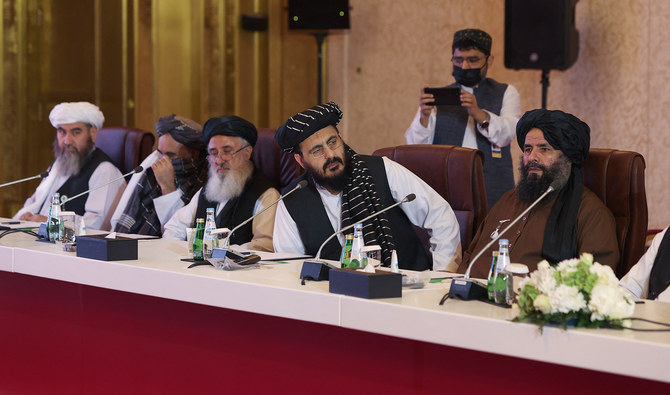
A delegation of Afghanistan's Taliban movement attends a session of the peace talks between the Afghan government and the Taliban in the Qatari capital Doha, on July 17, 2021. (AFP)
Short Url
Updated 18 July 2021
Follow

Taliban supreme leader says 'favors' political settlement in Afghanistan despite military gains

  • In message ahead of Eid Al-Adha, Akhundzada says wants “strong” ties with all nations including United States
  • Says Taliban will "create appropriate environment for female education” within framework of Islam in post-withdrawal Afghanistan

KABUL: Taliban supreme leader Mullah Hibatullah Akhundzada said on Sunday the group sought “strong” diplomatic, political and economic ties with the world, including the United States, after the withdrawal of foreign forces, and preferred a political settlement in Afghanistan despite capturing large swathes of territory in recent weeks.

The Taliban have overrun dozens of districts in Afghanistan since the start of the final phase of the withdrawal of US and NATO troops, after a 20-year military presence. The US says its withdrawal is 95% complete.

“In spite of the military gains and advances, the Taliban strenuously favors a political settlement in the country, and every opportunity for the establishment of an Islamic system, peace and security," Akhundzada said in his message ahead of the Muslim religious holiday of Eid Al-Adha next week. 

He added that the Taliban sought “good and strong diplomatic, economic and political relations in the framework of reciprocal interaction and mutual agreements with all world countries, including America, following the withdrawal of all foreign forces.”

Akhundzada said the establishment of the Taliban’s political office in Doha in 2013 was aimed at finding a peaceful settlement with Afghan government delegates and national leaders, but accused them of “wasting time” since US-sponsored intra-Afghan talks began in Qatar in September.

Akhundzada, whose whereabouts have been kept a secret by the Taliban, reiterated in his message that based on the deal with Washington, the Taliban would not permit “anyone to pose a security threat to any other country using our soil."

He said the Taliban did not want enmity with local factions provided they accepted the group's demand for “a pure Islamic system." He, however, vowed to “pay particular attention to and strive to create an appropriate environment for female education within the framework of sublime Islamic law."

The group imposed repressive policies on women when it ruled Afghanistan for five years until its government was toppled after the US invasion of the country in 2001.

Since then, Afghan women have regained the right to education, voting, and working outside their homes.


94 million need cataract surgery, but access lacking: WHO

A Somali patient undergoes free cataract surgery at Al Nuur eye Hospital in Mogadishu, on February 16, 2015. (AFP)
Updated 6 sec ago
Follow

94 million need cataract surgery, but access lacking: WHO

  • Of the 94 million affected, fewer than 20 percent are blind, while the rest suffer from impaired vision

GENEVA: More than 94 million people suffer from cataracts, but half of them do not have access to the surgery needed to fix it, the World Health Organization said Wednesday.
Cataracts — the clouding of the eye’s lens that causes blurred vision and can lead to blindness — are on the rise as populations get older, with age being the main risk factor.
“Cataract surgery — a simple, 15-minute procedure — is one of the most cost-effective medical procedures, providing immediate and lasting restoration of sight,” the WHO said.
It is one of the most frequently performed surgeries undertaken in high-income countries.
However, “half of the world’s population in need of cataract surgery don’t have access to it,” said Stuart Keel, the UN health agency’s technical lead for eye care.
The situation is worst in the WHO’s Africa region, where three in four people needing cataract surgery remain untreated.
In Kenya, at the current rate, 77 percent of people needing cataract surgery are likely to die with their cataract blindness or vision impairment, said Keel.
Across all regions, women consistently experience lower access to care than men.
Of the 94 million affected, fewer than 20 percent are blind, while the rest suffer from impaired vision.

- 2030 vision -

The WHO said that over the past two decades, global cataract surgery coverage had increased by 15 percent.

In 2021, WHO member states set a target of a 30-percent increase by 2030.
However, current modelling predicts that cataract surgery coverage will rise by only about 8.4 percent this decade.
To close the gap, the WHO urged countries to integrate eye examinations into primary health care and invest in the required surgical equipment.
States should also expand the eye-care workforce, training surgeons in a standardised manner and then distributing them throughout the country, notably outside major cities.
The WHO was on Wednesday launching new guidance for countries on how to provide quality cataract surgery services.
It will also issue guidance to help support workforce development.
Keel said the main issue was capacity and financing.
“We do need money invested to get rid of this backlog, which is nearly 100 million people,” he told a press conference.
While age is the primary risk factor for cataracts, others include prolonged UV-B light exposure, tobacco use, prolonged corticosteroid use and diabetes.
Keel urged people to keep up regular eye checks as they get older, with most problems able to be either prevented or diagnosed and treated.
The cost of the new lens that goes inside the eye can be under $100.
However, out-of-pocket costs can be higher when not covered by health insurance.
“Cataract surgery is one of the most powerful tools we have to restore vision and transform lives,” said Devora Kestel, head of the WHO’s noncommunicable diseases and mental health department.
“When people regain their sight, they regain independence, dignity, and opportunity.”