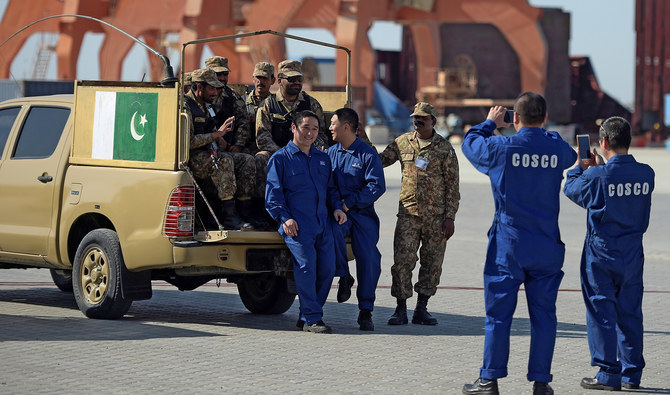
ISLAMABAD: Pakistan’s interior minister Sheikh Rashid Ahmed said on Saturday the government had once again promised “fool-proof security” to Chinese nationals involved in various infrastructure projects under the $62 billion China-Pakistan Economic Corridor (CPEC) initiative.
The assurance was formally communicated to the administration in Beijing during a lengthy phone call between the Pakistani minister and his Chinese counterpart Zhao Kezhi.
The conversation transpired only a few days after a blast on a bus in Pakistan’s northwestern region that killed 13 people, including nine Chinese workers, and sent the vehicle crashing into a ravine.
The foreign office of Pakistan earlier claimed that the explosion was caused by a mechanical failure. However, the country’s information minister Fawad Hussain Chaudhry later maintained in a Twitter post that investigators had found “traces of explosives” and it was difficult to rule out the possibility of terrorism.
Ahmed echoed the same view during a news conference in Islamabad, saying that the incident was orchestrated right ahead of the China-Pakistan Joint Cooperation Committee (JCC) meeting for maximum impact.
The meeting was canceled by officials in Beijing after the bus incident.
The Pakistani minister said he had briefed the Chinese official regarding the progress during the investigation which, he added, was in its final stage.
Ahmed noted such incidents could not jeopardize the strong bond which existed between Pakistan and China, adding that the “culprits and hidden hands” would soon be identified and brought to justice.


Pakistan promises ‘fool-proof security’ to Chinese nationals after bus incident
https://arab.news/yykht
Pakistan promises ‘fool-proof security’ to Chinese nationals after bus incident

- The assurance was formally conveyed to Beijing during a phone call between the Pakistani interior minister and his Chinese counterpart
- Nine Chinese nationals working on a CPEC project were killed earlier this week when an explosion on their bus sent the vehicle crashing into a ravine

Pakistan’s president condemns Kabul blast, accuses Taliban of allowing militant ‘safe havens’
- President Zardari links attack on Chinese-run restaurant to Kabul’s failure to meet Doha commitments
- He highlights the ‘failure’ of Afghanistan’s Taliban to establish a ‘broad-based and inclusive government’
KARACHI: President Asif Ali Zardari on Monday condemned a blast that ripped through a Chinese-run restaurant in Kabul, killing at least seven people, while criticizing Afghanistan’s Taliban administration for allowing “safe havens” to militant groups to export extremist violence in the region.
The explosion struck the restaurant in Kabul’s Shahr-e-Naw commercial district, an area considered one of the safest in the Afghan capital, killing one Chinese national and six Afghans and wounding several others, including a child, according to Afghan authorities.
The Afghan affiliate of Daesh militant group claimed responsibility, saying the attack was carried out by a suicide bomber.
“The Taliban regime in Afghanistan has failed to honor the commitments made under the Doha Peace Agreement, particularly the obligation to prevent the use of Afghan soil for the export of terrorism,” Zardari said in a statement circulated by his office.
“Pakistan has repeatedly stressed that no terrorist groups should be allowed safe havens in Afghanistan and that regional peace and security must be upheld,” he continued, adding that “it is not just Pakistan but other neighbors of Afghanistan, including Tajikistan, [that] have recently been affected by the terrorists operating out of Afghan soil.”
Pakistan has frequently accused Afghanistan of sheltering proscribed armed factions such as the Tehreek-e-Taliban Pakistan and the Balochistan Liberation Army, and of facilitating attacks on Pakistani civilians and security forces, allegations the Taliban deny.
The two countries witnessed major border skirmishes in October last year, followed by talks mediated by Qatar and Türkiye.
Pakistan subsequently closed its border and suspended bilateral and transit trade with Afghanistan, a move that led to a 17% drop in “cross-border attacks,” according to the Center for Research and Security Studies.
Late November also saw a series of deadly incidents along the Tajikistan–Afghanistan border, with militants on the Afghan side firing across the frontier into Tajikistan, killing five Chinese workers employed on Chinese–Tajik mining and construction projects.
In December, Tajik border forces clashed with armed individuals who crossed from Afghanistan, killing several assailants but losing a border guard in the fighting.
Zardari paid tribute to Chinese nationals working in Afghanistan “despite rising insecurity” and expressed solidarity with the victims and their families, while reiterating calls for political reform in Kabul.
“The failure to establish a broad based and inclusive government by the Taliban is contrary to the Doha Agreement,” he said in the statement.


