MOSCOW: Russian officials hailed a “miracle” on Friday after a passenger plane made an emergency landing in a Siberian field and all 18 people on board emerged, suffering only cuts and bruises.
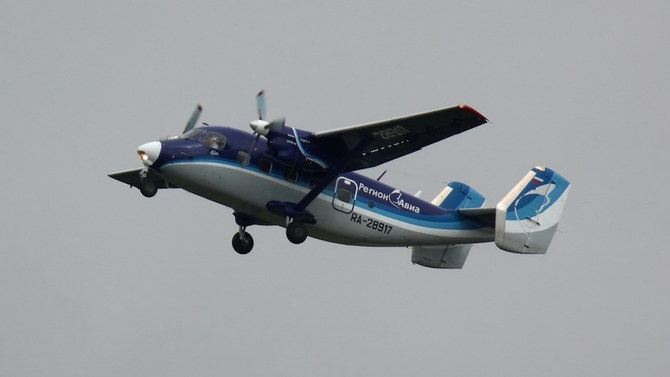
The An-28 plane, operated by Siberian Light Aviation (SiLA), was flying from the town of Kedrovy to Tomsk when communication was lost, Governor Sergei Zhvachkin’s office said.
The emergencies ministry announced later that the plane had been found, apparently after making a “hard landing,” and that survivors had been spotted.
The aviation agency said the plane had been found 155 kilometers (96 miles) from the airstrip in Tomsk.
Zhvachkin’s office announced that everyone on board, including three crew, were alive and that medics had “recorded mainly bruises and abrasions.”
“We all believed in a miracle. And thanks to the professionalism of the pilots, it came true: everyone is alive,” the governor said.
Images circling on social media showed the plane flipped upside down with dirt inside the cabin and its nose destroyed.
Zhvachkin said that all of the passengers and crew would be taken to the regional capital Tomsk, where they would be examined by doctors.
The Interfax news agency cited a local official as saying that six passengers refused to take a helicopter from the crash site to Tomsk and would be traveling instead by minibus.
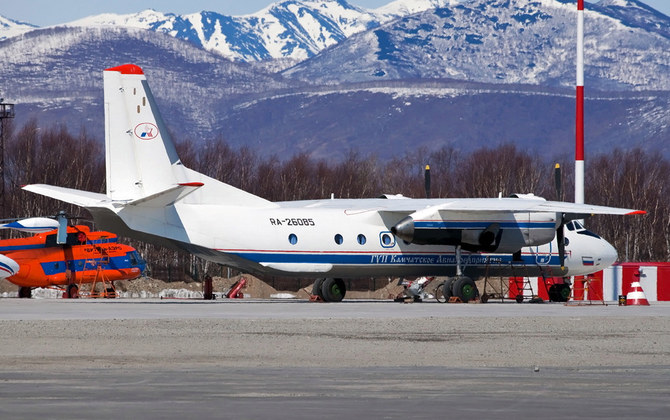
The incident comes just 10 days after the crash of an An-26 plane in Russia’s far eastern Kamchatka peninsula, killing all 28 people on board.
Antonov planes were manufactured during the Soviet era and are still used throughout the former USSR for civilian and military transport. They have been involved in a number of accidents in recent years.
News agency TASS reported that the An-28 plane had passed all safety checks but cited a SiLA executive as saying that the flight had been delayed by 10 hours because of bad weather.
The An-28 is a twin-engine light turboprop plane with a usual capacity of 17 passengers.
A local transport source told the Interfax news agency that the plane was built in 1989 and used by Russian airline Aeroflot and in ex-Soviet Kyrgyzstan before going into service with SiLA in 2014.
Russia, once notorious for plane accidents, has improved its air traffic safety record in recent years.
But poor aircraft maintenance and lax safety standards persist.
In May 2019 a Sukhoi Superjet belonging to the flag carrier airline Aeroflot crash-landed and caught fire on the runway of a Moscow airport, killing 41 people.
In February 2018, a Saratov Airlines An-148 aircraft crashed near Moscow shortly after take-off, killing all 71 people on board. An investigation later concluded that the accident was caused by human error.
Flying in Russia can also be dangerous in the vast country’s isolated regions with difficult weather conditions such as the Arctic and the Far East.


![]()
![]()

All 18 on missing Russian plane found alive in ‘miracle’
Short Url
https://arab.news/9pcew
All 18 on missing Russian plane found alive in ‘miracle’
- Governor Sergei Zhvachkin: We all believed in a miracle. And thanks to the professionalism of the pilots, it came true: everyone is alive
- Six passengers refused to take a helicopter from the crash site to Tomsk and would be traveling instead by minibus


Latest updates


© 2026 SAUDI RESEARCH & PUBLISHING COMPANY, All Rights Reserved And subject to Terms of Use Agreement.