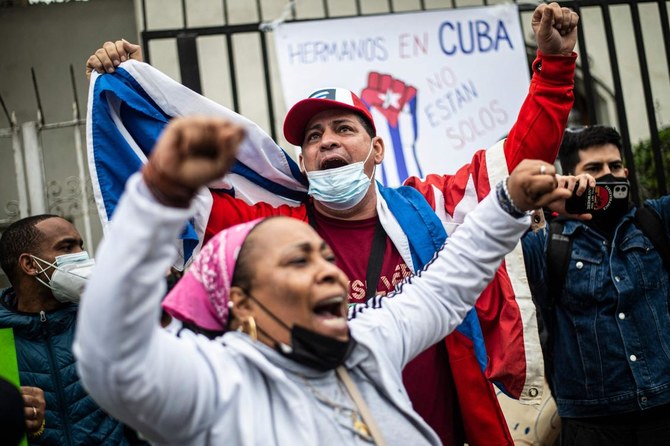
GENEVA: The UN human rights chief voiced alarm Friday at the alleged use of excessive force during unpre`cedented street demonstrations in Cuba, demanding that all those detained simply for protesting be freed.
Michelle Bachelet urged the government to address the protesters’ grievances and also called for the lifting of sanctions against the island.
One person has died and at least 100 people have reportedly been arrested since massive protests erupted across Cuba on Sunday.
“I am very concerned at the alleged use of excessive force against demonstrators in Cuba and the arrest of a large number of people, including several journalists,” UN High Commissioner Michelle Bachelet said in a statement.
“It is particularly worrying that these include individuals allegedly held incommunicado and people whose whereabouts are unknown,” she said, stressing that “all those detained for exercising their rights must be promptly released.”
The rallies are the largest since the Cuban revolution of the 1950s and come as the country endures its worst economic crisis in 30 years, with chronic shortages of electricity, food and medicine, just as it records a spike in coronavirus infections.
Cuba’s San Isidro free speech protest movement published late Monday a list of 144 people held or reported as disappeared following the demonstrations in dozens of cities and towns.
A 36-year-old man died during a protest on the outskirts of Havana on Monday, the interior ministry said Tuesday.
“I deeply regret the death of one protester in the context of protests in Havana,” Bachelet said.
“It is important that there be an independent, transparent, effective investigation, and that those responsible are held accountable.”
She also urged Cuban authorities to ensure Internet access is fully restored, after it was cut for several days earlier this week.
The UN rights chief pointed to the difficult economic context of the demonstrations, with protesters demanding the lifting of economic measures that have restricted access to food, medicines and Covid vaccines.
“I urge the Government to address the protesters’ grievances through dialogue, and to respect and fully protect the rights of all individuals to peaceful assembly and to freedom of opinion and expression,” she said.
Havana, under US sanctions since 1962, has blamed the show of discontent on Washington pursuing a “policy of economic suffocation to provoke social unrest.”
In her statement, Bachelet reiterated her call for the lifting of unilateral sanctions on the country, “given their negative impact on human rights, including the right to health.”


UN condemns alleged excessive force in Cuba protests
https://arab.news/2rp6u
UN condemns alleged excessive force in Cuba protests

- A 36-year-old man died during a protest on the outskirts of Havana on Monday, the interior ministry said Tuesday


Hundreds in London protest against Beijing ‘mega embassy’
- Protesters, their faces mostly covered with scarves or masks, chanted “No to Chinese embassy“
- The latest protest came ahead of an expected decision this week
LONDON: Hundreds of people on Saturday rallied in London against Beijing’s controversial new “mega” embassy, days ahead of a decision on the plan.
Protesters, their faces mostly covered with scarves or masks, chanted “No to Chinese embassy” and waved flags reading “Free Hong Kong. Revolution now.”
Others held up placards with slogans such as “MI5 warned. Labour kneeled,” referring to the UK’s domestic intelligence agency and Prime Minister Keir Starmer’s ruling party.
Others read: “CCP (Chinese Communist Party) is watching you. Stop the mega embassy.”
China has for several years been trying to relocate its embassy, currently in the British capital’s upmarket Marylebone district, to the sprawling historic site in the shadow of the Tower of London.
The move has sparked fierce opposition from nearby residents, rights groups and critics of China’s ruling Communist Party.
The latest protest came ahead of an expected decision this week.
Benedict Rogers, head of the human rights group Hong Kong Watch said if it got the go-ahead it was “highly likely” that the site “will be used for espionage,” citing the sensitive underground communications cables close to the site.
He said China had already been “carrying out a campaign of transnational repression against different diaspora communities” and other critics and predicted that that would “increase and intensify.”
Beijing ‘operations base’ -
A protester who gave his name only as Brandon, for fear of reprisals, said the plans raised a “lot of concerns.”
The 23-year-old bank employee, originally from Hong Kong but now living near Manchester in northwestern England, said many Hong Kongers had moved to the UK “to avoid authoritarian rule in China.”
But they now found there could be an embassy in London serving as an “operations base” for Beijing.
“I don’t think it’s good for anyone except the Chinese government,” he said.
Another demonstrator, who did not to give her name, called on Starmer to “step back and stop it (the plan) because there is a high risk to the national security of the UK, not only Hong Kongers.”
The 60-year-old warehouse worker, also originally from Hong Kong and now living in Manchester, said the embassy would be a “spy center not only to watch the UK but the whole of Europe.”
Speakers at the rally throwing their weight behind the campaign to stop the embassy included Kemi Badenoch, leader of the main opposition Conservative Party.
British MPs voiced major security concerns earlier this week after a leading daily reported the site would house 208 secret rooms, including a “hidden chamber.”
The Daily Telegraph said it had obtained unredacted plans for the vast new building which would stand on the historical site of the former Royal Mint.
It showed that Beijing reportedly plans to construct a single “concealed chamber” among “secret rooms” underneath the embassy which would be placed alongside the underground communications cables.