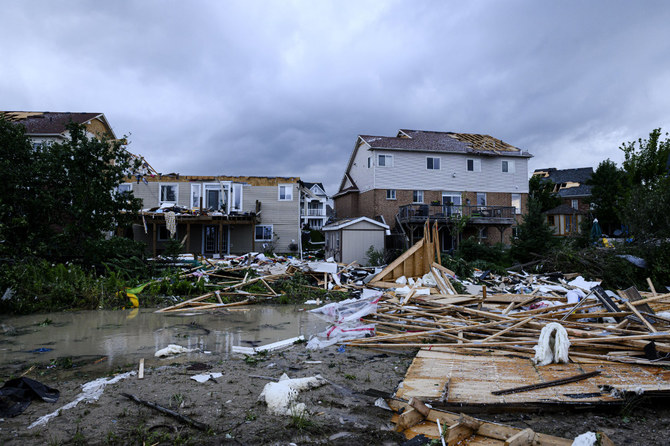
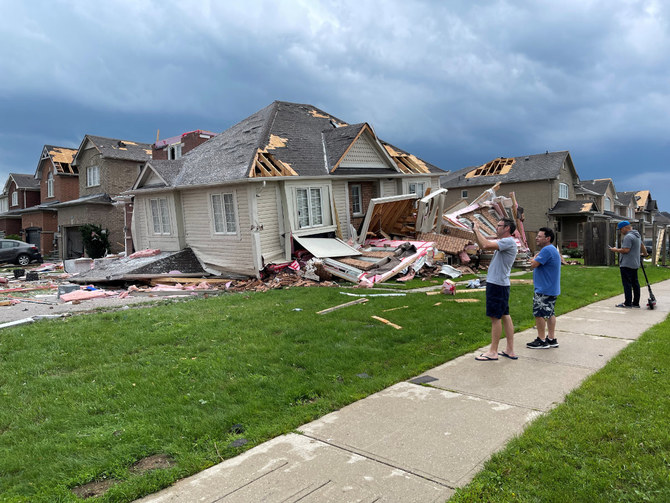
BARRIE, Ontario: Several people were injured and many more displaced Thursday after a tornado ripped through part of a city in the south of the Canadian province of Ontario, its mayor said as he expressed relief that no lives had been lost in the destruction.
Barrie Mayor Jeff Lehman said that while the tornado that hit a neighborhood in the city’s south end caused extensive property damage, as of Thursday evening, no deaths were reported and no one appeared to be unaccounted for.
“I can’t tell you how incredible it is that nobody has been killed, and I hope that as all the secondary searches are completed and the patients are treated in the hospital, that that continues to be the case,” he said.
Paramedics said eight people were taken to hospital, including four who suffered serious injuries. Seven of those hospitalized were being treated for trauma and one for a medical condition, they said.
Others who suffered more minor injuries were treated at the scene, said Andrew Robert, the chief of paramedic services.
Fire officials said up to 25 buildings suffered significant damage, with roughly 20 considered uninhabitable at this time and two or three “completely destroyed.”
Earlier Thursday, police spokesman Peter Leon said the tornado had also damaged gas lines and caused power outages.
The tornado tore through Anita Heyworth’s neighborhood, ripping up her fence and carrying her backyard trampoline away as she pulled into her driveway with her six-year-old daughter, 16-year-old son and 70-year-old mother in tow.
“I saw the funnel cloud with my trampoline in it and I saw it go down my street, and I’m yelling, ‘duck!’ because all I could see was my debris coming toward my car,” Heyworth said.


Tornado rips through Canadian city, causing heavy destruction

https://arab.news/mjeej
Tornado rips through Canadian city, causing heavy destruction

- Mayor says several people were hurt but fortunately no lives had been lost


Is the United States after Venezuela’s oil?
- Companies from the US have pumped Venezuelan crude from the first discoveries there in the 1920s
- Venezuela exports about 500,000 barrels per day on the black market, mainly to China and other Asian countries
CARACAS: As US forces deployed in the Caribbean have zoned in on tankers transporting sanctioned Venezuelan oil, questions have deepened about the real motivation for Donald Trump’s pressure campaign on Caracas.
Is the military show of force really about drug trafficking, as Washington claims? Does it seek regime change, as Caracas fears? Could it be about oil, of which Venezuela has more proven reserves than any other country in the world?
“I don’t know if the interest is only in Venezuela’s oil,” Brazil’s leftist President Luiz Inacio Lula da Silva, who has offered to mediate in the escalating quarrel, said last week.
The US president himself has accused Venezuela of taking “all of our oil” and said: “we want it back.”
What we know:
- Oil ties -
Companies from the United States, now the world’s leading oil producer, have pumped Venezuelan crude from the first discoveries there in the 1920s.
Many US refineries were designed, and are still geared, specifically for processing the kind of heavy crude Venezuela has in spades.
Until 2005, Venezuela was one of the main providers of oil to the United States, with some monthly totals reaching up to 60 million barrels.
Things changed dramatically after socialist leader Hugo Chavez took steps in 2007 to further nationalize the industry, seizing assets belonging to US firms.
- And now? -
Down from a peak of more than three million barrels per day (bpd) in the early 2000s, Venezuela today produces about a million barrels per day — roughly two percent of the global total.
US firm Chevron extracts about 10 percent of the total under a special license.
Chevron is the only company authorized to ship Venezuelan oil to the United States — an estimated 200,000 barrels per day, according to a Venezuelan oil sector source.
The South American country’s domestic industry has declined sharply due to corruption, under-investment and US sanctions in place since 2019.
Analysts say the high investment required to rebuild Venezuela’s crumbling oil rigs would be unappetizing for US firms, given the steady global supply and low prices.
According to Carlos Mendoza Potella, a Venezuelan professor of petroleum economics, Washington’s actions were likely “not just about oil” but rather about the United States “claiming the Americas for itself.”
“It’s about the division of the world” between the United States and its rivals, Russia and China,” he added.
Venezuela exports about 500,000 barrels per day on the black market, mainly to China and other Asian countries, according to Juan Szabo, a former vice president of state oil company PDVSA.
- Blockade -
Trump on December 16 announced a blockade of sanctioned oil vessels sailing to and from Venezuela.
Days earlier, US forces seized the M/T Skipper, a so-called “ghost” tanker transporting over a million barrels of Venezuelan oil, reportedly destined for Cuba.
Washington has said it intends to keep the oil, valued at between $50 and $100 million.
Over the weekend, the US Coast Guard seized the Centuries, identified by monitoring site TankerTrackers.com as a Chinese-owned and Panama-flagged tanker.
An AFP review did not find the Centuries on the US Treasury Department’s sanctions list, but the White House said it “contained sanctioned PDVSA oil” — some 1.8 million barrels of it.
On Sunday, officials said the Coast Guard was pursuing a third tanker, identified by news outlets as the Bella 1 — under US sanctions because of alleged ties to Iran.
The PDVSA insists its exports remain unaffected by the blockade.
This was critical, according to Szabo, as the company only has capacity to store oil for several days if exports stop.
- Impact -
Whatever Trump’s goal with Venezuelan oil, the blockade, if it continues, is likely to scare off shipping companies and push up freight rates.
Szabo expects Venezuela’s oil exports will fall by nearly half in the coming months, slashing critical foreign currency income from Venezuela’s black market sales.
This would asphyxiate the already struggling economy of Venezuela, piling more pressure on Nicolas Maduro.
The Trump administration has tip-toed around explicitly demanding for Maduro to leave.
While Trump has said he does not anticipate “war” with Venezuela, he did say Maduro’s days “are numbered.”
US Homeland Security Secretary Kristi Noem told Fox News on Monday that the oil tanker seizures send “a message around the world that the illegal activity that Maduro’s participating in cannot stand, he needs to be gone.”


