



KARACHI: Pakistan’s foreign office has said a blast on a bus that killed 13 passengers, among them nine Chinese nationals and two Pakistani soldiers, on Wednesday was the result of a mechanical failure, after China said it wanted Islamabad to “thoroughly” investigate the incident.
The bus was carrying Chinese workers to a dam project in the northwestern Kohistan district, one of many such projects Chinese engineers and Pakistani construction workers have been working on for years as part of Beijing’s Belt and Road Initiative in the remote province of Khyber Pakhtunkhwa and elsewhere in Pakistan.
“This morning a bus carrying Chinese workers in Khyber Pakhunkhwa Province, plunged into a ravine after a mechanical failure resulting in leakage of gas that caused a blast. Further investigations are underway,” the Pakistani foreign office said, extending condolences to the families of the Chinese and Pakistani workers who had died.
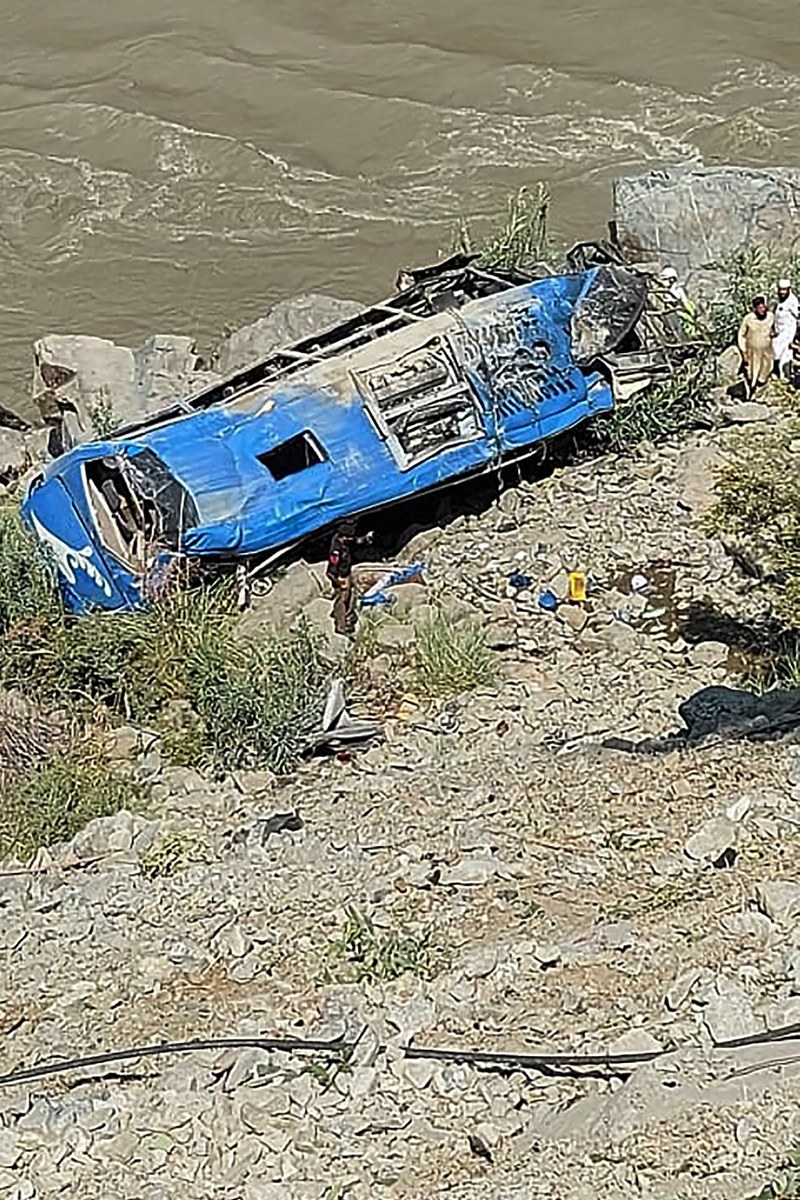
People stand next to a wreck after a bus plunged into a ravine following a bomb attack, which killed 12 people including 9 Chinese workers, in Kohistan district of Khyber Pakhtunkhwa province on July 14, 2021. (AFP)
The Chinese embassy in Islamabad said in a statement it had “requested Pakistan to carry out rescue and treatment in the first place, and strengthen security protection for the Chinese citizens, institutions and projects in Pakistan, and investigate the incident thoroughly.”
Speaking to Arab News, a senior health official confirmed the number of dead and injured.
“Fifty-one people have been brought to a local hospital and 13 of them are dead,” Dr. Taj Muhammad, the district health officer in Upper Kohistan, said. “Among the deceased, nine are Chinese nationals, two are FC [paramilitary frontier corp] personnel and two local residents.”
He said 27 out of the 38 injured people had been referred to Islamabad for medical treatment, with seven of them in critical condition.
A local policeman told Arab News helicopters had been dispatched to the site of the accident to carry out rescue works.
“As of now, the nature of the incident remains unknown,” Muhammad Zahir, who works with the police, said.
Speaking to the media, Deputy Commissioner Kohistan, Arif Khan Yousafzai, also said it was too early to declare that the incident was caused by a blast:
“Police have reached the spot, the bomb disposal squad is also there and investigations are underway. We will be able to share factual position after investigations are completed.”
However, the Chinese Embassy in Pakistan reminded Chinese citizens, enterprises, and projects in Pakistan “to stay on alert, pay close attention to the local security situation, strengthen security protection, take strict precautions, and stop going out unless necessary.”
In April, a car bomb blast ripped through a luxury hotel’s parking area in the southwestern Pakistani city of Quetta, killing four people and wounding 11. It is believed that senior Chinese officials were staying at the hotel at the time of the attack.
In 2018, three suicide attackers stormed the Chinese consulate in the Pakistani city of Karachi amid a series of gunshots and an explosion but were killed before they could force their way in with a car packed with explosives.


