

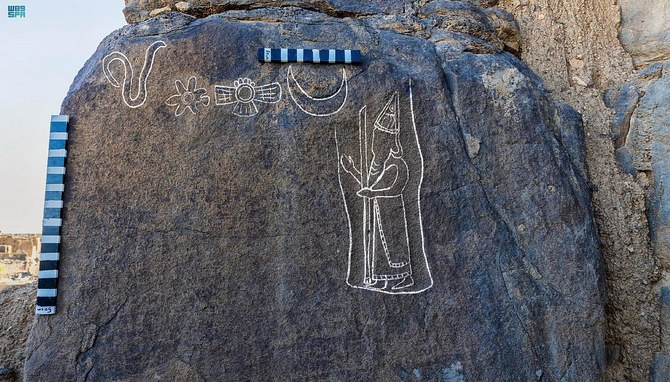
Inscriptions from mid 6th century B.C. found in Saudi Arabia

Finding includes an inscription on one of the basalt rocks depicting the Babylonian king holding a scepter in his hand. (SPA)
Short Url
Updated 14 July 2021
Follow

Inscriptions from mid 6th century B.C. found in Saudi Arabia

  • Discovery reveals archaeological evidence of Babylonian King Nabonidus in Al-Hadeed Governorate in Hail
  • Inscription also includes longest written text found so far in the Kingdom

RIYADH: Saudi Arabia’s Heritage Commission announced an archaeological discovery in the country’s northern region that consists of rock inscriptions to the Babylonian King Nabonidus that date as far back as 540 B.C.
The discovery in Al-Hadeed Governorate in the Hail region provides further evidence of the historical role of the Arabian Peninsula and its cultural link with most of the civilizations of the ancient Near East.
The finding includes an inscription on one of the basalt rocks depicting the Babylonian king holding a scepter in his hand, and in front of him are a number of religious symbols. The inscription also contained a cuneiform text with around 26 lines, making it the longest written text found so far in the Kingdom.

Details of the discovery will be released after specialists have more time to analyze. It will be linked to previous results that have been documented in the northwest of the Kingdom.
This archaeological finding will accompany previous discoveries of stone inscriptions and obelisks in a number of sites between Tayma and Hail that mention King Nabonidus, who ruled from 556 to 539 B.C. The finding proves the expansion of cultural and commercial contact between the Arabian Peninsula and the Mesopotamian civilizations.
The site of the wall, known in the past as Fadak, represents an important site in northwestern Arabia from the first millennium B.C. until the early Islamic era. A group of drawings, rock inscriptions, and early Islamic writings were found on the sides of its mountains. The site also contains a set of castles, forts, and walls, along with water facilities that give another dimension to its cultural importance.


Ithra will bring Spain to life for 2-week cultural celebration

Updated 5 sec ago
Follow

Ithra will bring Spain to life for 2-week cultural celebration

  • Ithra Cultural Days will unfold across the plaza, museum, theater, lush garden, library, idea lab, cinema, children’s museum, energy exhibit and Ithra tower

DHAHRAN: Visitors to the King Abdulaziz Center for World Culture (Ithra) can enjoy a taste of Spanish culture from Jan. 12-31.

Under the banner “Live Spain,” spaces at Ithra will be transformed to give a glimpse of life in this vibrant European country.

Ithra Cultural Days will unfold across the plaza, museum, theater, lush garden, library, idea lab, cinema, children’s museum, energy exhibit and Ithra tower, with exhibitions dedicated to Spanish photography, fashion and sports. There will also be Spanish cuisine and interactive installations exploring historical and linguistic connections between Arab and Spanish traditions.

There will be live performances across various stages, with a production of “Carmen” among the highlights.

“Cultural exchange is a core part of Ithra’s approach to programming. Celebrating Spain’s culture and history reflects this focus, particularly as this year’s Cultural Days take on a distinctive character by exploring Spain’s cultural heritage,” Noura Alzamil, program manager at Ithra, said.

“Visitors to Ithra will experience an exciting program in every sense, given the scale and variety of events designed to appeal to all tastes and interests.”

Cinema showings will feature Spanish short and feature films, accompanied by post-screening discussions to provide additional cultural context, while talks and sessions in the idea lab and library will explore architecture, literature and creative practice.

Hands-on workshops will invite visitors to engage directly with Spanish crafts and creative traditions, from visual arts and design to food-related practices.

A dedicated program for children and youth will run alongside with storytelling, creative workshops and performances among the attractions. Food and market experiences in Ithra’s public spaces will reflect the important social role played in the country by food.

Ithra Cultural Days present international cultures through immersive, public-facing experiences. This year’s focus on Spain follows the success of last year’s Japan edition, which welcomed more than 200,000 visitors in just two weeks.